Question
  1. Define mutual inductance and write its S.I. unit.
  2. Derive an expression for the mutual inductance of two long co-axial solenoids of same length wound one over the other.
  3. In an experiment, two coils c1 and c2 are placed close to each other. Find out the expression for the emf induced in the coil c1 due to a change in the current through the coil c2.

Answer

  1. $\phi = \text{MI}$

Mutual inductance of two coils is equal to the magnetic flux linked with one coil when a unit current is passed in the other coil.

Alternate Answer

$\text{e} = - \text{M}\frac{\text{dl}}{\text{dt}}$

Mutual inductance is equal to the induced emf set up in one coil when the rate of change of current flowing through the other coil is unity.

SI unit: henry/(weber ampere–1)/(volt second ampere–1)
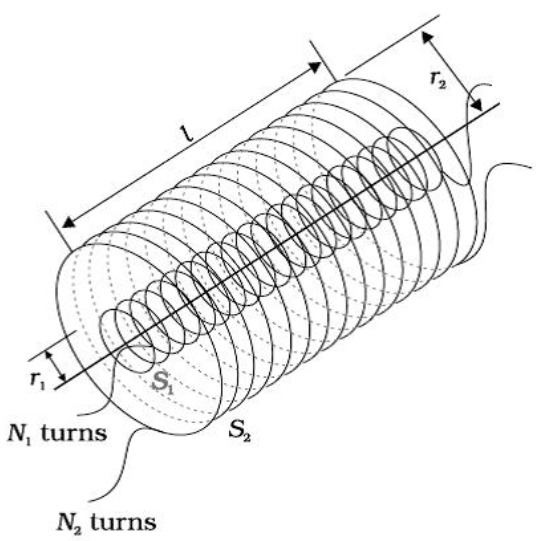
Let a current I2 flow through S2.This sets up a magnetic flux $\phi_{1}$ through each turn of the coil S1.

Total flux linked with S1

$\text{N}_{1}\phi_{1} = \text{M}_{12}\text{I}_{2}$......(i)

where M12 is the mutual inductance between the two solenoids Magnetic field due to the current I2 in S2 is $\text{S}_{2}\text{ is } \mu_{\circ}\text{n}_{2}\text{I}_{2}$

Therefore, resulting flux linked with S1.

$\text{N}_{1}\phi_{1} = [ (\text{n}_{1}\ell)\pi\text{r}^{2}](\mu_0\text{n}_{2}\text{I}_{2})$........(ii)

Comparing (i) & (ii),we get

M12 I2 $ =(\text{n}_{1}\ell)\pi\text{r}_{1}^{2}(\mu_{0}\text{n}_{2}\text{I}_{2})$

$\therefore\text{M}_{12} = \mu_{0}\text{n}_{1}\text{n}_{2}\pi\text{r}_{1}^{2}\ell$

  1. Let a magnetic flux be $(\phi_{1})$linked with coil C1 due to current (I2) in coil C2;

We have:

$\Phi_{1}\propto\text{I}_{2}$

$ = > \Phi_{1} = \text{MI}_{2}$

$\therefore\frac{\text{d}\Phi_{1}}{\text{dt}}= \text{M}\frac{\text{dI}_{2}}{\text{dt}}$

$= > \text{e} = - \text{M}\frac{\text{dI}_{2}}{\text{dt}}$.
Need a full question paper?

Generate a complete, print-ready paper with questions like this in minutes — across 16+ boards, with answer keys.

Start Generating Free

Similar questions

A capacitor having a capacitance of $100\mu\text{F}$ is charged to a potential difference of 50V.
  1. What is the magnitude of the charge on each plate?
  2. The charging battery is disconnected and a dielectric of dielectric constant 2.5 is inserted. Calculate the new potential difference between the plates.
  3. What charge would have produced this potential difference in absence of the dielectric slab.
  4. Find the charge induced at a surface of the dielectric slab.
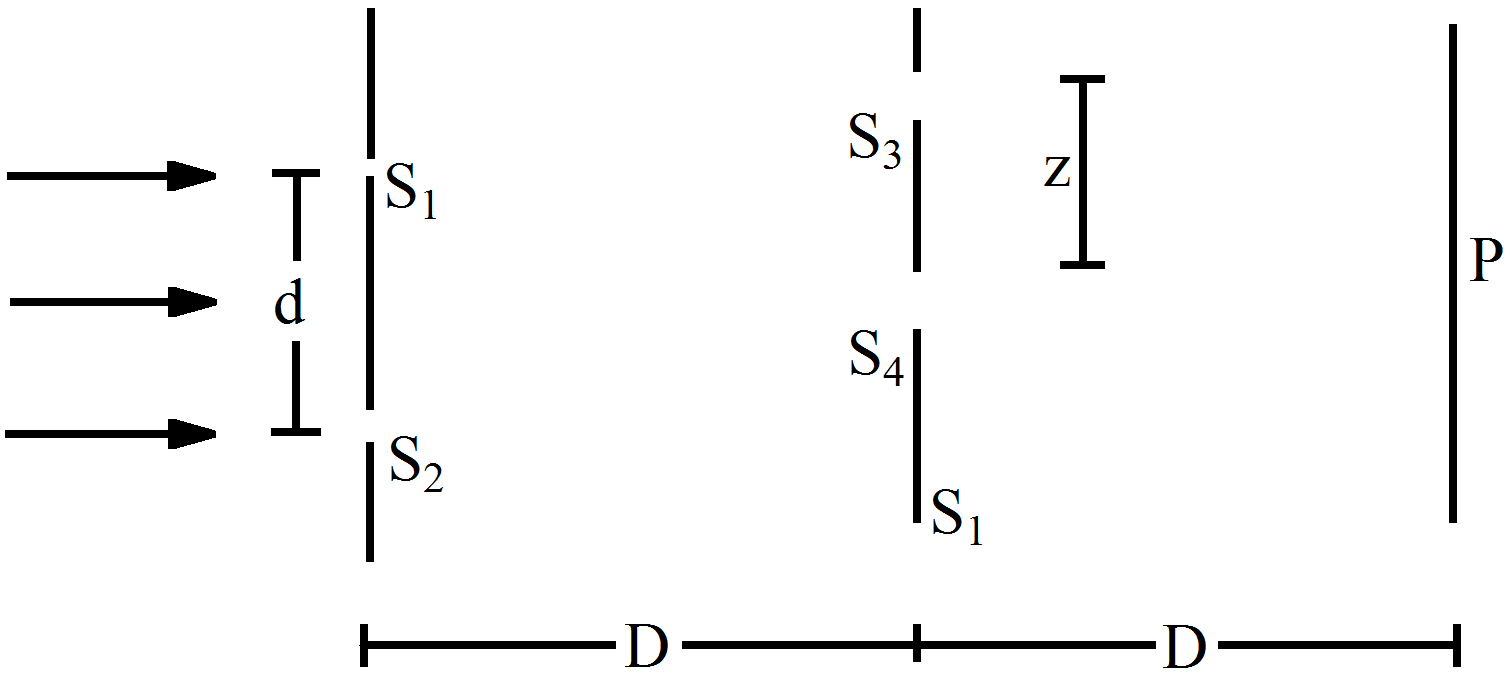
Consider the arrangement shown in figure. By some mechanism, the separation between the slits S3 and S4 can be changed. The intensity is measured at the point P which is at the common perpendicular bisector

of S1S2 and S3S4. When $\text{z}=\frac{\text{D}\lambda}{2\text{d}},$ intensity measured at P is I. Find this intensity when z is equal to:
  1. $\frac{\text{D}\lambda}{\text{d}}$
  2. $\frac{3\text{D}\lambda}{2\text{d}}$
  3. $\frac{2\text{D}\lambda}{\text{d}}$
The count rate of nuclear radiation coming from a radiation coming from a radioactive sample containing 128I varies with time as follows.
Time t(minute): 0 25 50 75 100
Ctount rate R(109s-1): 30 16 8.0 3.8 2.0
  1. Plot In $\Big(\frac{\text{R}_0}{\text{R}}\Big)$ against t.
  2. From the slope of the best straight line through the points, find the decay constant $\lambda.$
  3. Calculate the half-life $\text{t}_{\frac{1}{2}}.$
Consider an excited hydrogen atom in state n moving with a velocity u(ν << c). It emits a photon in the direction of its motion and changes its state to a lower state m. Apply momentum and energy conservation principles to calculate the frequency ν of the emitted radiation. Compare this with the frequency ν0 emitted if the atom were at rest.
By defining electric dipole and dipole moment, find the necessary formula for the field intensity at any point located on the neutral (equatorial plane) of the dipole.
A particle of mass 100g moving at an initial speed u collides with another particle of same mass kept initially at rest. If the total kinetic energy becomes 0.2J after the collision, what could be the minimum and the maximum value of u.
A current of 1.0A exists in a copper wire of cross-section 1.0mm2. Assuming one free electron per atom, calculate the drift speed of the free electrons in the wire. The density of copper is 9000kg/m-3.
A paperweight in the form of a hemisphere of radius 3.0cm is used to hold down a printed page. An observer looks at the page vertically through the paperweight. At what height above the page will the printed letters near the centre appear to the observer?
  1. Draw the circuit diagrams of a p-n junction diode in (i) forward bias, (ii) reverse bias. How are these circuits used to study the V - I characteristics of a silicon diode? Draw the typical V - I characteristics.
  2. What is a light emitting diode (LED)? Mention two important advantages of LEDs over conventional lamps.
  1. Compare the individual dipole moment and the specimen dipole moment for H2O molecule and O2 molecule when placed in:
  1. Absence of external electric field.
  2. Presence of external eclectic field. Justify your answer.
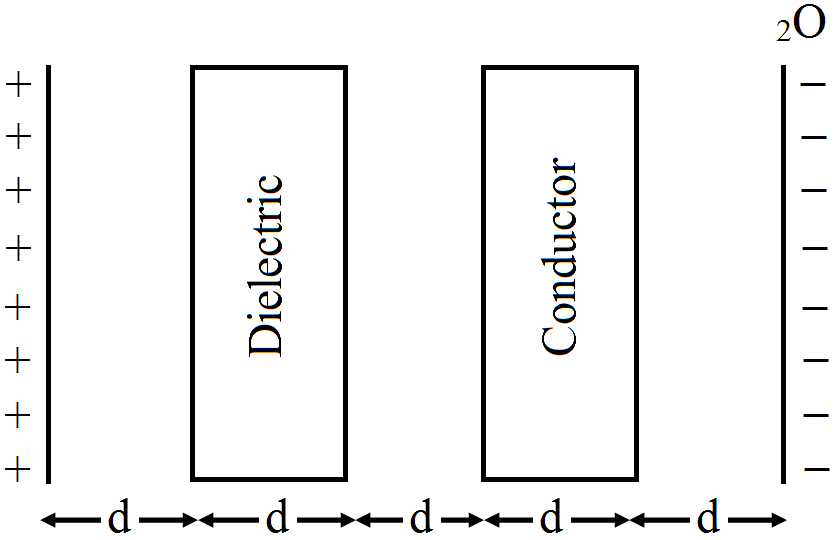
  1. Given two parallel conducting plates of area A and charge densities $+\sigma$ and $-\sigma.$ A dielectric slab of constant K and a conducting slab of thickness d each are inserted in between them as shown.

  1. Find the potential difference between the plates.
  2. Plot E versus x graph, taking x = 0 at positive plate and x = 5d at negative plate.