Question
  1. Define principal quantum number(n).
  2. Write the electronic configuration of $Cr^+$ [Atomic number of Cr = 24].
  3. Define Pauli's exclusion principle.

Answer

  1. Principal quantum number tells the principal energy level or shell to which the electron belongs. It gives the information about the distance and the energy of the electron.
  2. $Cr^+ = 1s^2 2s^2 2p^6 3s^2 3p^6 3d^5$
  3. Pauli's exclusion principle states that no two electrons in an atom can have the same set of four quantum numbers.

Need a full question paper?

Generate a complete, print-ready paper with questions like this in minutes — across 16+ boards, with answer keys.
Start Generating Free

Similar questions

Define the bond length.
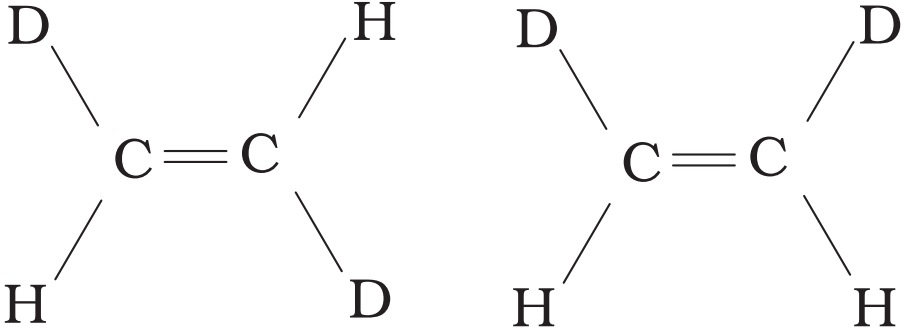
What is the relationship between the members of following pairs of structures? Are they structural or geometrical isomers or resonance contributors?
  1. What is the biological importance of Na in our body?
  2. Mention two similarities in the behaviour of Be and Al to show that they have diagonal relationship.
i. Explain, why $\mathrm{Be}_2$ molecule does not exist by using molecular orbital theory.
ii. Describe the state of hybridization in $\mathrm{PCl}_5$ Why are the axial bonds longer as compared to equatorial bonds?
For the reaction,
$2 \mathrm{Cl}(\mathrm{g}) \rightarrow \mathrm{Cl}_2(\mathrm{g})$, what are the signs of $\Delta\text{H}$ and $\Delta\text{S}?$
Among the elements of second period Li to Ne, pick out element:
  1. With the highest first ionisation energy.
  2. With highest electronegativity.
  3. With largest atomic radius.
  4. That is most reactive non-metal.
  5. That is most reactive metal.
  6. With valency equal to 4.
If 2 litres of $\mathrm{N}_2$ is mixed with 2 litres of $\mathrm{H}_2$ at a constant temperature and pressure, then what will be the volume of $\mathrm{NH}_3$ formed?
The reaction, $\text{CO (g) + 3H}_2\text{ (g)}\rightleftharpoons\text{CH}_4\text{ (g) + }\text{H}_2\text{O (g)}$ is at equilibrium at 1300K in a 1L flask. It also contain 0.30 mol of $\mathrm{CO}, 0.10 \mathrm{~molof} \mathrm{~H}_2$ and 0.02 mol of $\mathrm{H}_2 \mathrm{O}$ and an unknown amount of $\mathrm{CH}_4$ in the flask. Determine the concentration of $\mathrm{CH}_4$ in the mixture. The equilibrium constant, $\mathrm{K}_{\mathrm{c}}$ for the reaction at the given temperature is 3.90 .
Give example each of molecules which have the following geometrics:
  1. Linar.
  2. Trigular planar.
  3. Tetrahedral.
  4. Trigonal biphramidal.
  5. Octahedral.
Calculate the mass of sodium acetate $\left(\mathrm{CH}_3 \mathrm{COONa}\right)$ required to make 500 mL of 0.375 molar aqueous solution. Molar mass of sodium acetate is $82.0245 \mathrm{~g} \mathrm{~mol}^{-1}$.