Question
Define probability of an event.

Answer

The probability of an event denotes the relative frequency of occurrence of an experiment’s outcome, when repeating the experiment. Definition: The empirical or experimental definition of probability is that if n be the total number of trials of an experiment and A is an event associated to it such that A happens in m-trials, then the probability of happening of event A is denoted by P(A) and is given by$\text{P(A)}=\frac{\text{m}}{\text{n}}$
To illustrate the definition, let us take examples:
  1. When two coins are tossed simultaneously, the possible outcomes are HH, HT, TH and TT. The total number of trials is 4. Let A be the event of occurring exactly two heads. The number of times A happens is 1. So, the probability of the event A is
$\text{P(A)}=\frac{\text{m}}{\text{n}}$
$=\frac{1}{4}$
$=0.25$
  1. In the experiment of rolling a dice, the possible outcomes are 1, 2, 3, 4, 5 and 6. Let A be the event of occurring a number greater than 3. The total number of trials is 6. The number of times A happens is 3. So, the probability of the event A is
$\text{P(A)}=\frac{\text{m}}{\text{n}}$
$=\frac{3}{6}$
$=\frac{1}{2}$
$=0.5$
Note that H stands for getting a head and T stands for getting a tail in the experiment of tossing a coin.

Need a full question paper?

Generate a complete, print-ready paper with questions like this in minutes — across 16+ boards, with answer keys.
Start Generating Free

Similar questions

Prove that the line segments joining the midpoints of opposite sides of a quadrilateral bisect each other.
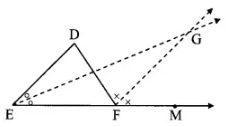
In the adjoining figure, line DE || line GF, ray EG and ray FG are bisectors of ∠DEF and ∠DFM respectively. Prove that,Image
i. $\angle DEG =\frac{1}{2} \angle EDF$
ii. $EF = FG$
In figure, ABCD and AEFD are two parallelograms. Prove that:
  1. $\text{PE}=\text{FQ}$
  2. $\text{ar}(\triangle\text{APE}) : \text{ar}(\triangle\text{PFA})\\=\text{ar}(\triangle\text{QFD}): \text{ar}(\triangle\text{PFD})$
  3. $\text{ar}(\triangle\text{PEA})=\text{ar}(\triangle\text{QFD})$
The line segments joining the midpoints M and N of parallel sides AB and DC respectively of a trapezium ABCD is perpendicular to both the sides AB and DC. Prove that AD = BC.
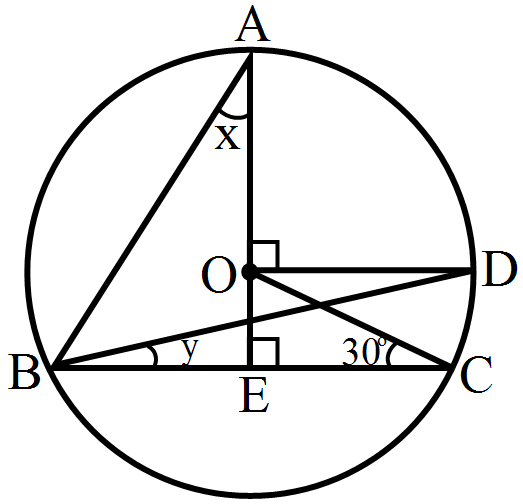
In the given figure, O is the centre of the circle and $\angle\text{BCO}=30^\circ.$ Find x and y.
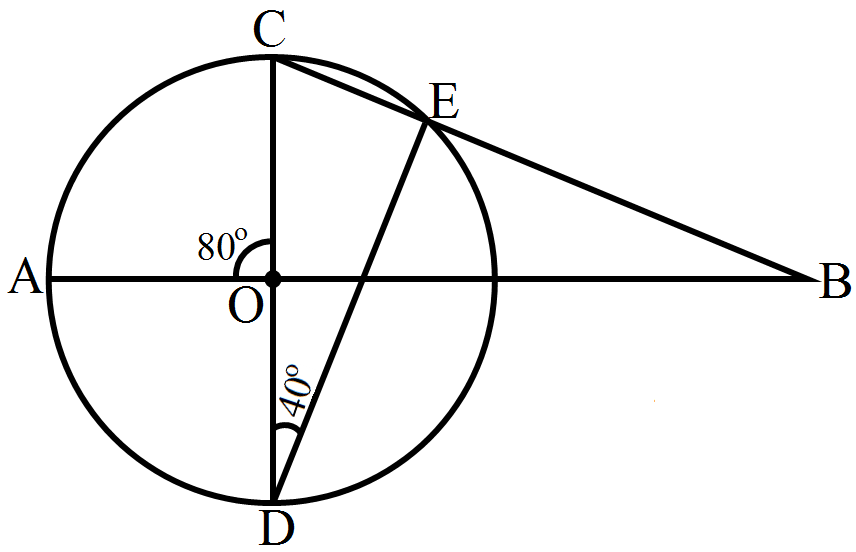
In the given figure, AB and CD are straight lines through the centre O of a circle. If $\angle\text{AOC}=80^\circ$ and $\angle\text{CDE}=40^\circ,$ find
  1. $\angle\text{DCE}$
  2. $\angle\text{ABC}$
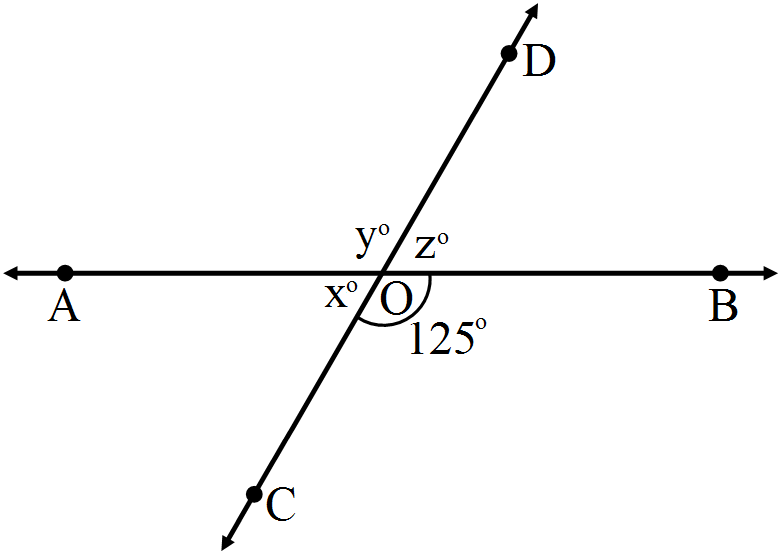
In the given figure, the two lines AB and CD intersect at a point O such that $\angle\text{BOC}=125^\circ.$ Find the values of x, y and z.
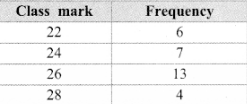
In the tables given below, class-mark and frequencies is given. Construct the frequency tables taking inclusive and exclusive classes.Image
On a graph paper, plot the points A(2, 3), B(6, -1) and C(0, 5). If these points are collinear, then draw the line which includes them. Write the co-ordinates of the points at which the line intersects the X-axis and the Y-axis.
Find the length of a chord which is at a distance of 3cm from the centre of a circle of radius $5\ cm$.