Question
In figure, ABCD and AEFD are two parallelograms. Prove that:
  1. $\text{PE}=\text{FQ}$
  2. $\text{ar}(\triangle\text{APE}) : \text{ar}(\triangle\text{PFA})\\=\text{ar}(\triangle\text{QFD}): \text{ar}(\triangle\text{PFD})$
  3. $\text{ar}(\triangle\text{PEA})=\text{ar}(\triangle\text{QFD})$
Answer

Given that, ABCD and AEFD are two parallelograms
  1. In triangles, EPA and FQD
$\angle\text{PEA}=\angle\text{QFD}$ [corresponding angles]

$\angle\text{EPA}=\angle\text{FQD}$ [corresponding angles]

PA = QD [opposite sides of parallelogram]

Then, $\triangle\text{EPA}\cong\triangle\text{FQD}$ [By AAS condition]

Therefore, EP = FQ [C.P.C.T]
  1. Since triangles, PEA and QFD stand on equal bases PE and FQ lies between the same parallels EQ and AD
Therefore, $\text{ar}(\triangle\text{PEA})=\text{ar}(\triangle\text{QFD})\ ...(1)$

Since, triangles PEA and PFD stand on the same base PF and between same parallels PF and AD

Therefore, $\text{ar}(\triangle\text{PFA})=\text{ar}(\triangle\text{PFD})\ ...(2)$

Divide the equation 1 by equation 2

$\text{ar}(\triangle\text{PEA})\text{ ar}(\triangle\text{PFA})=\text{ar}(\triangle\text{QFD})\text{ ar}(\triangle\text{PFD})$
  1. From part (i),
$\triangle\text{EPA}\cong\triangle\text{FQD}$

Then, $\text{ar}(\triangle\text{PEA})=\text{ar}(\triangle\text{QFD}).$.

Need a full question paper?

Generate a complete, print-ready paper with questions like this in minutes — across 16+ boards, with answer keys.

Start Generating Free

Similar questions

Using the property $\frac{a}{b}=\frac{a k}{b k}$, fill in the blanks by substituting proper numbers in the following.
i. $\frac{5}{7}=\frac{\ldots .}{28}=\frac{35}{\ldots . .}=\frac{\ldots}{3.5}$
ii. $\quad \frac{9}{14}=\frac{4.5}{\ldots . .}=\frac{\ldots . .}{42}=\frac{\ldots .}{3.5}$
Which number should be subtracted from 12, 16 and 21 so that resultant numbers are in continued proportion?
prove the following theorem : If two parallel lines are intersected by a transversal, the interior angles on either side of the transversal are supplementary.
Solve the following equations : $\frac{x^2+12 x-20}{3 x-5}=\frac{x^2+8 x+12}{2 x+3}$
AB and CD are respectively the smallest and largest sides of a quadrilateral ABCD. Show that $\angle\text{A}>\angle\text{C}$ and $\angle\text{B}>\angle\text{D}.$
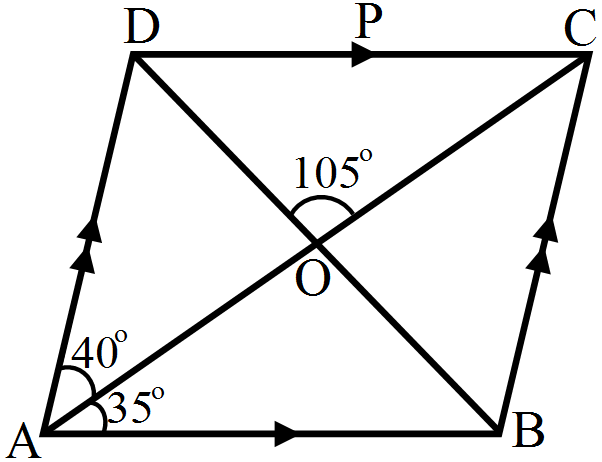
In the adjoining figure, ABCD is a parallelogram in which $\angle\text{BAO}=35^{\circ},\angle\text{DAO}=40^{\circ}$ and $\angle\text{COD}=150^{\circ}.$ Calculate
  1. $\angle\text{ABO},$
  2. $\angle\text{ODC},$
  3. $\angle\text{ACB},$
  4. $\angle\text{CBD}.$
A two digit number is 3 more than 4 times the sum of its digits. If 18 is added to this number, the sum is equal to the number obtained by interchanging the digits. Find the number.
On a graph paper, plot the points (0, 1), (1, 3), (2, 5). Are they collinear? If so, draw the line that passes through them.
i. Through which quadrants does this line pass ?
ii. Write the co-ordinates of the point at which it intersects the Y-axis.
iii. Show any point in the third quadrant which lies on this line. Write the co-ordinates of the point.
Three numbers are in continued proportion, whose mean proportional is $12$ and the sum of the remaining two numbers is $26$, then find these numbers.
If p(y) = $4 - 3y -y^2 + 5y^3$, find:
  1. $p(0)$
  2. $p(2)$
  3. $p(-1)$