Systems of Particles and Rotational Motion — Physics STD 11 Science — Question
Rajasthan BoardEnglish MediumSTD 11 SciencePhysicsSystems of Particles and Rotational Motion3 Marks
Question
Define 'Radius of Gyration'. Derive an expression for it.
✓
Answer
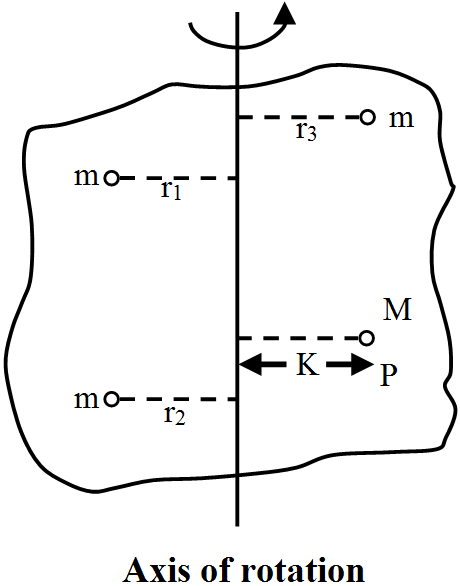
The radius of gyration is the root mean square of the perpendicular distances of the constituent masses. It is the perpendicular distance from the axis, square of which when multiplied by the total mass of the body gives the same value of moment of inertia as is given by the actual distribution of mass. It is written as $\text{K}=\sqrt{\frac{\text{r}^2_1+\text{r}^2_2+\dots+\text{r}^2_{\text{n}}}{\text{n}}}$$=\sqrt{\frac{\sum\text{r}^2_{\text{i}}}{\text{n}}}$
Suppose a rigid body consists of n particles, each of mass m. Let r1, r2, r3,..., rn, be the perpendicular distances of these particles from the axis of rotation in the figure. By the definition, the moment of inertia of the body about the given axis is calculated as $\text{I}=\text{mr}_1^2+\text{mr}^2_2+\text{mr}^2_3+\dots\text{mr}^2_{\text{n}}$$=\text{m}(\text{r}^2_1+\text{r}^2_2+\text{r}^2_3+\dots+\text{r}^2_{\text{n}}$$\text{I}=\text{m}\times\text{n}\Big(\frac{\text{r}^2_1+\text{r}^2_2+\text{r}^2_3+\dots+\text{r}^2_{\text{n}}}{\text{n}}\Big)$$\text{I}=\text{M}\Big(\frac{\text{r}^2_1+\text{r}^2_2+\text{r}^2_3+\dots+\text{r}^2_{\text{n}}}{\text{n}}\Big)$ where M= m × n = total mass of the body. If the total mass of the body M which is concentrated at P at a perpendicular distance K from the axis, its moment of inertia would be $\therefore\text{Mk}^2=\frac{\text{M}(\text{r}^2_1+\text{r}^2_2+\dots+\text{r}^2_{\text{n}}}{\text{n}}$$\Rightarrow\text{K}=\sqrt{\frac{\text{r}^2_1+\text{r}^2_2+\dots+\text{r}^2_{\text{n}}}{\text{n}}}$
Need a full question paper?
Generate a complete, print-ready paper with questions like this in minutes — across 16+ boards, with answer keys.