Question
Need a full question paper?
Generate a complete, print-ready paper with questions like this in minutes — across 16+ boards, with answer keys.
Explore more
More "5 Marks Questions" from Semiconductor Electronics: Materials, Devices and Simple Circuits→Semiconductor Electronics: Materials, Devices and Simple Circuits — all question types→Physics STD 12 Science question papers→Gujarat Board STD 12 Science question papers→Gujarat Board question paper generator→
Similar questions
Two long, straight wires, each carrying a current of 5A, are placed along the X and Y-axes respectively. The currents point along the positive directions of the axes. Find the magnetic fields at the points (a) (1m, 1m), (b) (-1m, 1m), (c) (-1m,-1m) and (d) (1m, -1m),
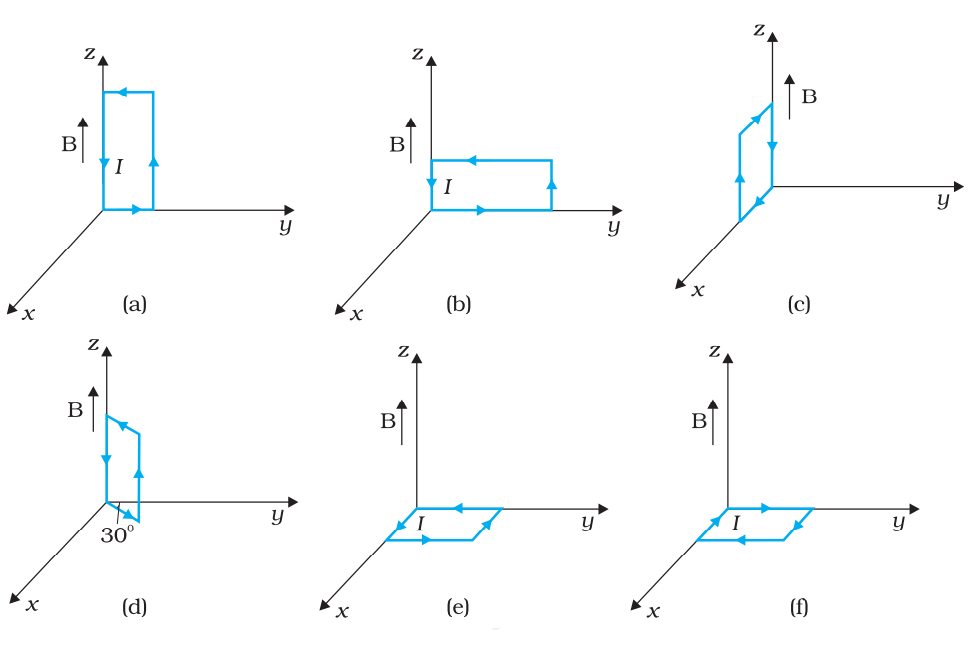
A uniform magnetic field of 3000 G is established along the positive z-direction. A rectangular loop of sides 10 cm and 5 cm carries a current of 12 A. What is the torque on the loop in the different cases shown in Fig.? What is the force on each case? Which case corresponds to stable equilibrium?
In an experiment with Foucault's apparatus, the various distances used are as follows:
Distance between the rotating and the fixed mirror $= 16m$
Distance between the lens and the rotating mirror $= 6m$
Distance between the source and the lens $= 2m$
When the mirror is rotated at a speed of 356 revolutions per second, the image shifts by 0.7mm. Calculate the speed of light from these data.
→Distance between the rotating and the fixed mirror $= 16m$
Distance between the lens and the rotating mirror $= 6m$
Distance between the source and the lens $= 2m$
When the mirror is rotated at a speed of 356 revolutions per second, the image shifts by 0.7mm. Calculate the speed of light from these data.
An object is placed at a distance of 30cm from a converging lens of focal length 15cm. A normal eye (near point 25cm, far point infinity) is placed close to the lens on the other side.
- Can the eye see the object clearly?
- What should be the minimum separation between the lens and the eye so that the eye can clearly see the object?
- Can a diverging lens, placed in contact with the converging lens, help in seeing the object clearly when the eye is close to the lens?
A steel frame $(\text{K}=45\text{Wm}^{-1}{^{\circ}}\text{C}^{-1})$of total length 60cm and cross sectional area $0.20cm^2,$ forms three sides of a square. The free ends are maintained at 20°C and 40°C. Find the rate of heat flow through a cross section of the frame.
→A person with a normal near point (25 cm) using a compound microscope with objective of focal length 8.0 mm and an eyepiece of focal length 2.5 cm can bring an object placed at 9.0 mm from the objective in sharp focus. What is the separation between the two lenses? Calculate the magnifying power of the microscope.
The teachers of Geeta’s school took the students on a study trip to a power generating station, located nearly 200km away from the city. The teacher explained that electrical energy is transmitted over such a long distance to their city, in the form of alternating current (ac) raised to a high voltage. At the receiving end in the city, the voltage is reduced to operate the devices. As a result, the power loss is reduced. Geeta listened to the teacher and asked questions about how the ac is converted to a higher or lower voltage.
- Name the device used to change the alternating voltage to a higher or lower value. State one cause for power dissipation in this device.
- Explain with an example, how power loss is reduced if the energy is transmitted over long distances as an alternating current rather than a direct current.
- Write two values each shown by the teachers and Geeta.
A uniform rod of mass m and length l is struck at an end by a force F perpendicular to the rod for a short time interval t. Calculate:
- The speed of the centre of mass.
- The angular speed of the rod about the centre of mass.
- The kinetic energy of the rod.
- The angular momentum of the rod about the centre of mass after the force has stopped to act. Assume that t is so small that the rod does not appreciably change its direction while the force acts.
The gravitational attraction between electron and proton in a hydrogen atom is weaker than the coulomb attraction by a factor of about $10^{–40}$. An alternative way of looking at this fact is to estimate the radius of the first Bohr orbit of a hydrogen atom if the electron and proton were bound by gravitational attraction. You will find the answer interesting.
→Figure. shows two vessels A and B with rigid walls containing ideal gases. The pressure, temperature and the volume are $p_A, T_A, V$ in the vessel A and $p_B, T_B, V$ in the vessel B. The vessels are now connected through a small tube. Show that the pressure p and the temperature T satisfy $\frac{\text{p}}{\text{T}}=\frac{1}{2}\Big(\frac{\text{P}_\text{A}}{\text{T}_\text{A}}+\frac{\text{p}_\text{B}}{\text{T}_\text{B}}\Big)$ when equilibrium is achieved.
→