A person with a normal near point (25 cm) using a compound microscope with objective of focal length 8.0 mm and an eyepiece of focal length 2.5 cm can bring an object placed at 9.0 mm from the objective in sharp focus. What is the separation between the two lenses? Calculate the magnifying power of the microscope.
Exercise
Download our app for free and get started
Focal length of the objective lens, $f_0 = 8 mm = 0.8 cm$
Focal length of the eyepiece, $f_e = 2.5$ cm
Object distance for the objective lens, $u_0 = - 9.0 mm = - 0.9$ cm
Least distance of distant vision, $d = 25$ cm
Image distance for the eyepiece, $v_e = - d= - 25$ cm
Object distance for the eyepiece $= u_e$ Using the lens formula,
we can obtain the value of $u_e$
as: $\frac{1}{\text{v}_\text{e}}-\frac{1}{\text{u}_\text{e}}=\frac{1}{\text{f}_\text{e}}$ $\frac{1}{\text{u}_\text{e}}=\frac{1}{\text{v}_\text{e}}-\frac{1}{\text{f}_\text{e}}$
$=\frac{1}{-25}-\frac{1}{2.5}=\frac{-1-10}{25}=\frac{-11}{25}$
$\therefore \ \text{u}_\text{e}=-\frac{25}{11}=-2.27 \ \text{cm}$
We can also obtain the value of the image distance for the objective lens ( ) 0 v using the lens formula.
$\frac{1}{\text{v}_0}-\frac{1}{\text{u}_0}=\frac{1}{\text{f}_0}$
$\frac{1}{\text{v}_0}=\frac{1}{\text{f}_0}+\frac{1}{\text{u}_0}$
$=\frac{1}{0.8}-\frac{1}{0.9}=\frac{0.9-0.8}{0.72}=\frac{0.1}{0.72}$
$\therefore \ \text{v}_0=7.2 \ \text{cm}$
The distance between the objective lens and the eyepiece $= |u_e| + v_0 = 2.27 + 7.2 = 9.47\ cm$
The magnifying power of the microscope is calculated as:
According to the lens formula, we have the relation:
$\frac{\text{v}_0}{|\text{u}_0|}\Big(1+\frac{\text{d}}{\text{f}_\text{e}}\Big)$ $=\frac{7.2}{0.9} \Big(1+\frac{25}{2.5}\Big)=8(1+10)=88$
Hence, the magnifying power of the microscope is 88.
Focal length of the eyepiece, $f_e = 2.5$ cm
Object distance for the objective lens, $u_0 = - 9.0 mm = - 0.9$ cm
Least distance of distant vision, $d = 25$ cm
Image distance for the eyepiece, $v_e = - d= - 25$ cm
Object distance for the eyepiece $= u_e$ Using the lens formula,
we can obtain the value of $u_e$
as: $\frac{1}{\text{v}_\text{e}}-\frac{1}{\text{u}_\text{e}}=\frac{1}{\text{f}_\text{e}}$ $\frac{1}{\text{u}_\text{e}}=\frac{1}{\text{v}_\text{e}}-\frac{1}{\text{f}_\text{e}}$
$=\frac{1}{-25}-\frac{1}{2.5}=\frac{-1-10}{25}=\frac{-11}{25}$
$\therefore \ \text{u}_\text{e}=-\frac{25}{11}=-2.27 \ \text{cm}$
We can also obtain the value of the image distance for the objective lens ( ) 0 v using the lens formula.
$\frac{1}{\text{v}_0}-\frac{1}{\text{u}_0}=\frac{1}{\text{f}_0}$
$\frac{1}{\text{v}_0}=\frac{1}{\text{f}_0}+\frac{1}{\text{u}_0}$
$=\frac{1}{0.8}-\frac{1}{0.9}=\frac{0.9-0.8}{0.72}=\frac{0.1}{0.72}$
$\therefore \ \text{v}_0=7.2 \ \text{cm}$
The distance between the objective lens and the eyepiece $= |u_e| + v_0 = 2.27 + 7.2 = 9.47\ cm$
The magnifying power of the microscope is calculated as:
According to the lens formula, we have the relation:
$\frac{\text{v}_0}{|\text{u}_0|}\Big(1+\frac{\text{d}}{\text{f}_\text{e}}\Big)$ $=\frac{7.2}{0.9} \Big(1+\frac{25}{2.5}\Big)=8(1+10)=88$
Hence, the magnifying power of the microscope is 88.

Download our appand get started for free
Experience the future of education. Simply download our apps or reach out to us for more information. Let's shape the future of learning together!No signup needed.*
Similar Questions
- 1A thin prism of angle $6.0^\circ,\omega=0.07$ and $\mu_\text{y}=1.50$ is combined with another thin prism having $\omega=0.08$ and $\mu_\text{y}=1.60.$ The combination produces no deviation in the mean ray.View Solution
- Find the angle of the second prism.
- Find the net angular dispersion produced by the combination when a beam of white light passes through it.
- If the prisms are similarly directed, what will be the deviation in the mean ray
- Find the angular dispersion in the situation described in (c).
- 2View Solution
- For a ray of light travelling from a denser medium of refractive index $n_1$ to a rarer medium of refractive index $n_2$ prove that $\frac{\text{n}_{2}}{\text{n}_{1}} = \sin \text{i}_{c} ,$ where $i_c$ is the critical angle of incidence for the media.
- Explain with the help of a diagram, how the above principle is used for transmission of video signals using optical fibres.
- 3View Solution
- With the help of a suitable ray diagram, derive the mirror formula for a concave mirror.
- The near point of a hypermetropic person is 50 cm from the eye. What is the power of the lens required to enable the person to read clearly a book held at 25 cm from the eye?
- 4View SolutionAn optical instrument used for angular magnification has a 25D objective and a 20D eyepiece. The tube length is 25cm when the eye is least strained.
- Whether it is a microscope or a telescope?
- What is the angular magnification produced?
- 5View SolutionA paperweight in the form of a hemisphere of radius 3.0cm is used to hold down a printed page. An observer looks at the page vertically through the paperweight. At what height above the page will the printed letters near the centre appear to the observer?
- 6View Solution
- Derive the mathematical relation between refractive indices $n_1$ and $n_2 $ of two radii and radius of curvature R for refraction at a convex spherical surface. Consider the object to be a point since lying on the principle axis in rarer medium of refractive index $n_1$ and a real image formed in the denser medium of refractive index $n_{2}$.Hence, derive lens maker's formula.
- Light from a point source in air falls on a convex spherical glass surface of refractive index 1.5 and radius of curvature 20 cm. The distance of light source from the glass surface is 100 cm. At what position is the image formed?
- 7View SolutionA Cassegrain telescope uses two mirrors. Such a telescope is built with the mirrors 20 mm apart. If the radius of curvature of the large mirror is 220 mm and the small mirror is 140 mm, where will the final image of an object at infinity be?
- 8View Solution
- A point object is placed on the principal axis of a convex spherical surface of radius of curvature R, which separates the two media of refractive indices $n_1$ and $n_2(n_2 > n_1)$. Draw the ray diagram and deduce the relation between the object distance (u), image distance (v) and the radius of curvature (R) for refraction to take place at the convex spherical surface from rarer to denser medium.
- A converging lens has a focal length of 20 cm in air. It is made of a material of refractive index 1.6. If it is immersed in a liquid of refractive index 1.3, find its new focal length.
- 9Find the diameter of the image of the moon formed by a spherical concave mirror of focal length 7.6m. The diameter of the moon is 3450km and the distance between the earth and the moon is $3.8 \times 10^5km.$View Solution
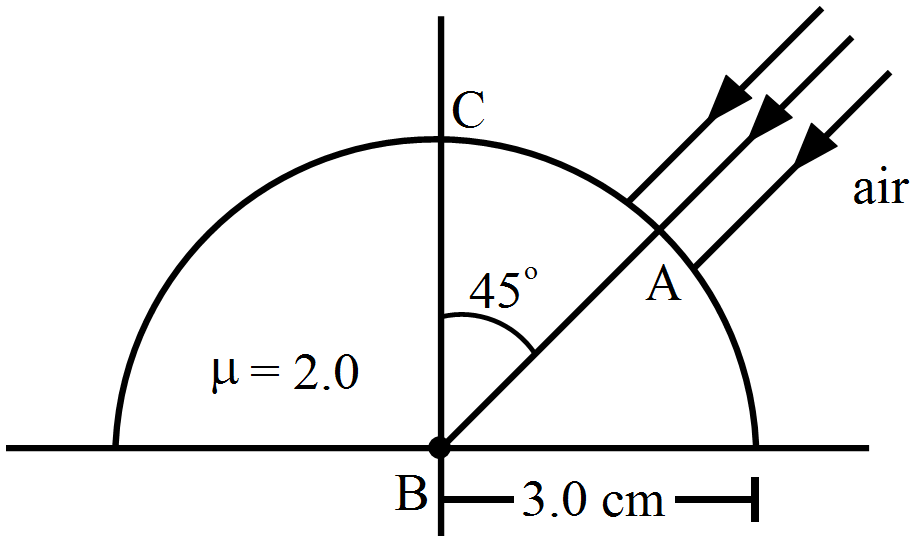
- 10View SolutionFigure shows a transparent hemisphere of radius 3.0cm made of a material of refractive index 2.0.
- A narrow beam of parallel rays is incident on the hemisphere as shown in the figure. Are the rays totally reflected at the plane surface?
- Find the image formed by the refraction at the first surface.
- Find the image formed by the reflection or by the refraction at the plane surface.
- Trace qualitatively the final rays as they come out of the hemisphere.