Question
Need a full question paper?
Generate a complete, print-ready paper with questions like this in minutes — across 16+ boards, with answer keys.
Explore more
More "Long Answer Type Questions [5M]" from Semiconductor Electronics: Materials, Devices and Simple Circuits→Semiconductor Electronics: Materials, Devices and Simple Circuits — all question types→Physics STD 12 Science question papers→Bihar Board STD 12 Science question papers→Bihar Board question paper generator→
Similar questions
A plane electromagnetic wave is passing through a region. Consider (a) electric field (b) magnetic field (c) electrical energy in a small volume and (d) magnetic energy in a small volume. Construct the pairs of the quantities that oscillate with equal frequencies.
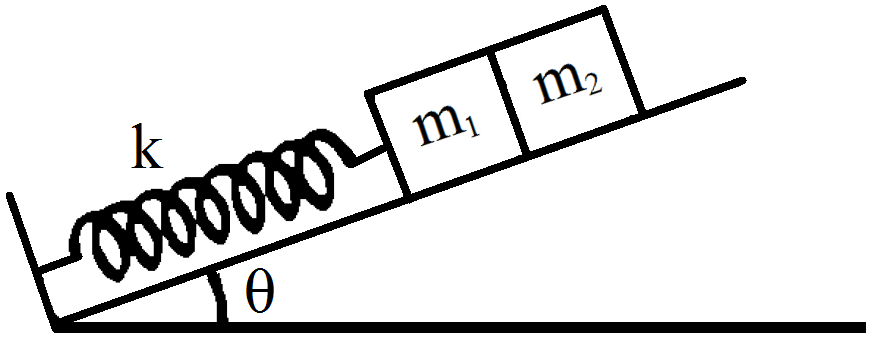
The block of mass m1 shown in figure is fastened to the spring and the block of mass m2 is placed against it.
→- Find the compression of the spring in the equilibrium position.
- The blocks are pushed a further distance $\big(\frac{2}{\text{k}}\big)(\text{m}_1+\text{m}_2)\text{g}\sin\theta$ sine against the spring and released. Find the position where the two blocks separate.
- What is the common speed of blocks at the time of separation?
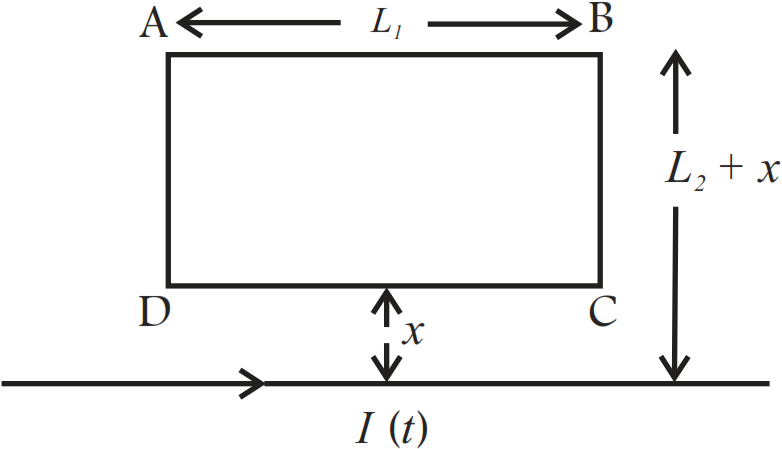
A rectangular loop of wire ABCD is kept close to an infinitely long wire carrying a current $\text{I}(\text{t})=\text{I}_0\Big(1-\frac{\text{t}}{\text{T}}\Big)$ for 0 and I(0) = 0 for t > T (Fig). Find the total charge passing through a given point in the loop, in time T. The resistance of the loop is R.
→A pin of length 2.0cm lies along the principal axis of a converging lens, the centre being at a distance of 11cm from the lens. The focal length of the lens is 6cm. Find the size of the image.
Suppose there is a circuit consisting of only resistances and batteries. Suppose one is to double (or increase it to n-times) all voltages and all resistances. Show that currents are unaltered.
A hot body placed in a surrounding of temperature $\theta_0$ obeys Newton's law of cooling $\frac{\text{d}\theta}{\text{dt}}=-\text{k}(\theta-\theta_0).$ Its temperature at t = 0 is $\theta_1.$ The specific heat capacity of the body is s and its mass is m. Find,
→- The maximum heat that the body can lose.
- The time starting from t = 0 in which it will lose 90% of this maximum heat.
Two point charges $q$ and $-q$ are located at points $(0,0,-a)$ and $(0,0, a)$ respectively.
i. Find the electrostatic potential at $(0,0, z)$ and $(x, y, 0)$.
ii. How much work is done in moving a small test charge from the point $(5,0,0)$ to $(-7,0,0)$ along the $X$-axis?
iii. How would your answer change if the path of the test charge between the same points is not along the $x$-axis but along any other random path?
iv. If the above point charges are now placed in the same positions in a uniform external electric field $\vec{E}$, what would be the potential energy of the charge system in its orientation of unstable equilibrium? Justify your answer in each case.
→i. Find the electrostatic potential at $(0,0, z)$ and $(x, y, 0)$.
ii. How much work is done in moving a small test charge from the point $(5,0,0)$ to $(-7,0,0)$ along the $X$-axis?
iii. How would your answer change if the path of the test charge between the same points is not along the $x$-axis but along any other random path?
iv. If the above point charges are now placed in the same positions in a uniform external electric field $\vec{E}$, what would be the potential energy of the charge system in its orientation of unstable equilibrium? Justify your answer in each case.
Total charge -Q is uniformly spread along length of a ring of radius R. A. small test charge +q of mass m is kept at the centre of the ring and is given a gentle push along the axis of the ring.
- Show that the particle executes a simple harmonic oscillation.
- Obtain its time period.
Radiation coming from transition n = 2 to n = 1 of hydrogen atoms falls on helium ions in n = 1 and n = 2 states. What are the possible transitions of helium ions as they absorbs energy from the radiation?
A rectangular frame of wire abcd has dimensions 32cm × 8.0cm and a total resistance of $2.0\Omega.$ It is pulled out of a magnetic field B = 0.020T by applying a force of 3.2 × 10⁻⁵N (figure). It is found that the frame moves with constant speed. Find
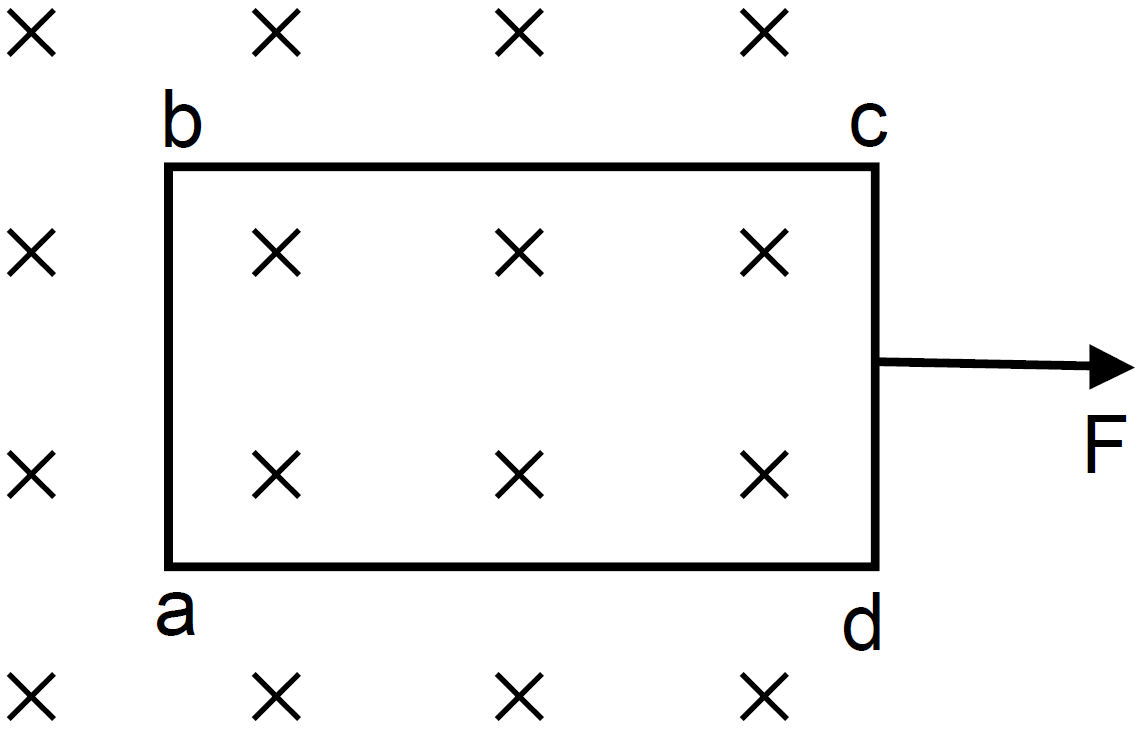
→- This constant speed.
- The emf induced in the loop.
- The potential difference between the points a and b.
- The potential difference between the points c and d.