Question
Define the activity of a given radioactive substance. Write its S.I. unit.

Answer

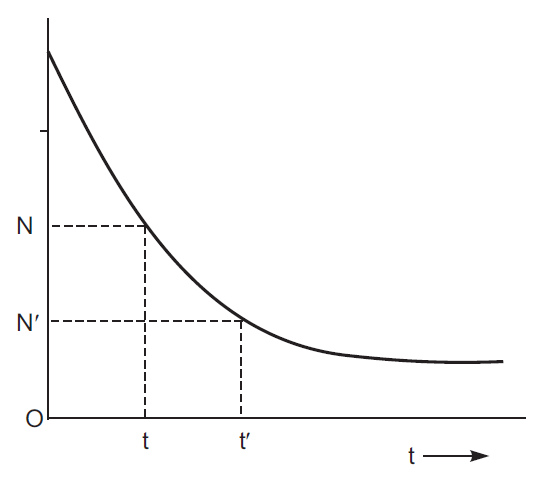
The rate of decay of a radioactive substance is called activity of that substance. It is negative of the rate of decay of the radioactive substance.

Activity, $\text{R} = \frac{\text{N}' - \text{N}}{\text{t}' - \text{t}}$

$ = - \frac{\Delta\text{N}}{\Delta\text{t}}$

$ \DeclareMathOperator*{\median}{\text{lim}} \median_{\Delta\text{t}\rightarrow0}\bigg(-\frac{\Delta\text{N}}{\Delta\text{t}}\bigg) = -\frac{\text{dN}}{\text{dt}}$ S.I. unit of activity


  1. becquerel (Bq).
  2. decay per second.

Need a full question paper?

Generate a complete, print-ready paper with questions like this in minutes — across 16+ boards, with answer keys.

Start Generating Free

Similar questions

On what components does diffraction depend?
A cube of iron (density = 8000kg m-3, specific heat capacity = 470J kg-1 K-1) is heated to a high temperature and is placed on a large block of ice at 0°C. The cube melts the ice below it, displaces the water and sinks. In the final equilibrium position, its upper surface just goes inside the ice. Calculate the initial temperature of the cube. Neglect any loss of heat outside the ice and the cube. The density of ice = 900kg m-3 and the latent heat of fusion of ice = 3.36 × 10⁵J kg-1.
How two coils should be winded so that magnitude of induced electromotive force is maximum?
Write the formula for wavelength of matter waves according to de Broglie.
An inductor and a resistor are joined in series with any ac source. What is the phase difference in the potential difference across their ends?
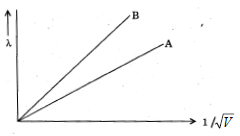
Two lines, A and B, in the plot given below show. the variation of de Broglie wavelength, $\lambda$ versus $1/\sqrt{\text{V}},$ where V is the accelerating potential difference, for two particles carrying the same charge. Which one of two represents a particle of smaller mass?

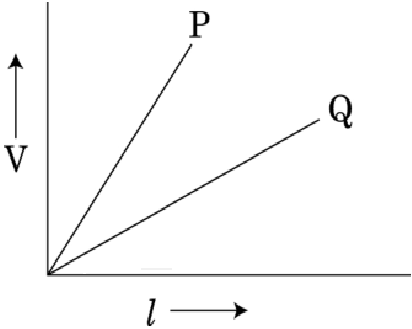
The variation of potential V with length l in case of two potentiometers wires P and Q is as shown. Which one of these will you prefer comparing emfs of two primary cells and why?

Which of the statements is true for p-type semiconductos.
  1. Electrons are majority carriers and trivalent atoms are the dopants.
  2. Electrons are minority carriers and pentavalent atoms are the dopants.
  3. Holes are minority carriers and pentavalent atoms are the dopants.
  4. Holes are majority carriers and trivalent atoms are the dopants.
Write the law of reflection.