Question
Define the current sensitivity of a galvanometer. Write its $S.I.$ unit.
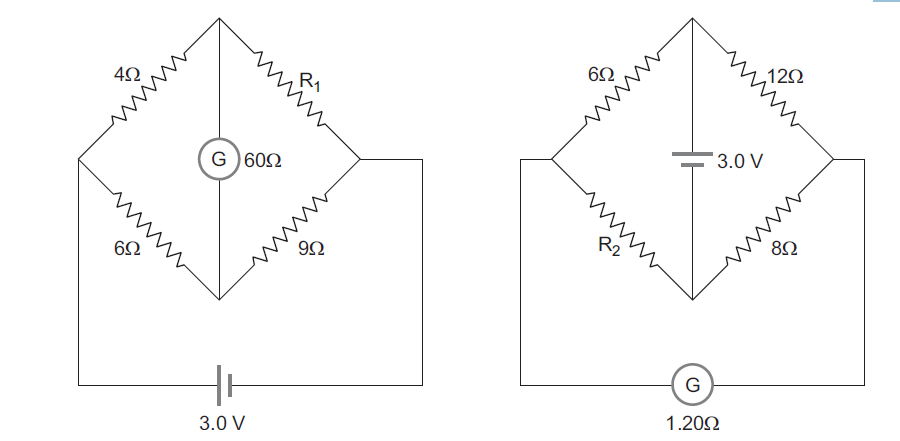
Figure shows two circuits each having a galvanometer and a battery of $3 V. $ When the galvanometers in each arrangement do not show any deflection, obtain the ratio $R_{1 }/ R_2.$
Answer

Ratio of deflection produced in the galvanometer to the current flowing through it.
Current sensitivity $\text{S}_{i} = \frac{\theta}{\text{I}}$
$S.I.$ unit of current sensitivity $S_i$ is division/ampere or radian/ampere.
For balanced Wheatone bridge, if no current flows through the galvanometer
$\frac{4}{\text{R}_{1}} = \frac{6}{9}$
$\Rightarrow\text{R}_{1} = \frac{4\times9}{6} =6\Omega$
For another current
$\frac{6}{12} = \frac{\text{R}_{2}}{8}$
$\Rightarrow\text{R}_{2} = \frac{6\times8}{12} = 4\Omega$
$\therefore\frac{\text{R}_{1}}{\text{R}_{2}} = \frac{6}{4} = \frac{3}{2}.$

Need a full question paper?

Generate a complete, print-ready paper with questions like this in minutes — across 16+ boards, with answer keys.

Start Generating Free

Similar questions

State Biot – Savart law. Deduce the expression for the magnetic field at a point on the axis of a current carrying circular loop of radius ‘R’, distant ‘x’ from the centre. Hence write the magnetic field at the centre of a loop.
Prove that, if an insulated, uncharged conductor is placed near a charged conductor and no other conductors are present, the uncharged body must be intermediate in potential between that of the charged body and that of infinity.
A diver having a moment of inertia of $6.0\ kg-m^2$ about an axis through its centre of mass rotates at an angular speed of $2\ rad/s$ about this axis. If he folds his hands and feet to decrease the moment of inertia to $5.0\ kg-m^2,$ what will be the new angular speed?
A 100W light bulb is placed at the centre of a spherical chamber of radius 20cm. Assume that 60% of the energy supplied to the bulb is converted into light and that the surface of the chamber is perfectly absorbing. Find the pressure exerted by the light on the surface of the chamber.
State the underlying principle of a cyclotron. Explain its working with the help of a schematic diagram. Obtain the expression for cyclotron frequency.
A simple pendulum of length (l) is pulled aside to make an angle $\theta$ with the vertical. Find the magnitude of the torque of the weight (w) of the bob about the point of suspension. When is the torque zero?
The magnetic field $B$ inside a long solenoid, carrying a current of $5.00A,$ is $3.14 \times 10^{-2}T.$ Find the number of turns per unit length of the solenoid.
A metal wire PQ of mass 10g lies at rest on two horizontal metal rails separated by 4.90cm A vertically-downward magnetic field of magnitude 0.800T exists in the space. The resistance of the circuit is slowly decreased and it is found that when the resistance goes below 20.0Ω, the wire PQ starts sliding on the rails. Find the coefficient of friction.
Can we find the mass of a photon by the definition p = mv?
$(a)$ Obtain the expression for the magnetic energy stored in a solenoid in terms of magnetic field $B,$ area $A$ and length $l$ of the solenoid. $(b)$ How does this magnetic energy compare with the electrostatic energy stored in a capacitor?