Question 13 Marks
- Obtain the expression for the cyclotron frequency.
- A deuteron and a proton are accelerated by the cyclotron. Can both be accelerated with the same oscillator frequency? Give reason to justify your answer.
Answer
- $\frac{mv^2}{r}=qvB$
$r=\frac{mv}{qB}$
Frequency of revolution $(v)=\frac{1}{Time\text{ }period}=\frac{v}{2\pi r}$
$v=\frac{qB}{2\pi m}$
- No The mass of the two particles, i.e deuteron and proton, is different. Since (cyclotron) frequency depends inversely on the mass, they cannot be accelerated by the same oscillator frequency.
View full question & answer→Question 23 Marks
A square coil of side 10 cm consists of 20 turns and carries a current of 12 A. The coil is suspended vertically and the normal to the plane of the coil makes an angle of 30º with the direction of a uniform horizontal magnetic field of magnitude 0.80 T. What is the magnitude of torque experienced by the coil?
AnswerLength of a side of the square coil, l = 10 cm = 0.1 m
Current flowing in the coil, I = 12 A
Number of turns on the coil, n = 20
Angle made by the plane of the coil with magnetic field, $\theta=30^\circ$
Strength of magnetic field, B = 0.80 T
Magnitude of the magnetic torque experienced by the coil in the magnetic field is given by the relation,
$\text{T}=\text{n}\text{BIA}\sin\theta$
Where,
A = Area of the square coil
$\Rightarrow\text{l}\times\text{l}=0.1\times0.1=0.01\ \text{m}^{2}$
$\therefore\text{T}=20\times0.8\times12\times0.01\times\sin\theta$
$=0.96\ \text{N m}$
Hence, the magnitude of the torque experienced by the coil is 0.96 N m.
View full question & answer→Question 33 Marks
The wires which connect the battery of an automobile to its starting motor carry a current of 300 A (for a short time). What is the force per unit length between the wires if they are 70 cm long and 1.5 cm apart? Is the force attractive or repulsive?
AnswerCurrent in both wires, I = 300 A
Distance between the wires, r = 1.5 cm = 0.015 m
Length of the two wires, l= 70 cm = 0.7 m
Force between the two wires is given by the relation,
$\text{F}=\frac{\mu_{0}\text{I}^{2}}{2\pi\text{r}}$
Where,
$\mu_{0}=\text{Permeability of free space}=4\pi\times10^{-7}\text{T m A}^{-1}$
$\therefore\text{F}=\frac{4\pi\times10^{-7}\times(300)^{2}}{2\pi\times0.015}$
$=1.2\ \text{N/m}$
Since the direction of the current in the wires is opposite, a repulsive force exists between them.
View full question & answer→Question 43 Marks
A circular coil of wire consisting of $100$ turns, each of radius $8.0 \ cm$ carries a current of $0.40 A.$ What is the magnitude of the magnetic field $B$ at the centre of the coil?
AnswerNumber of turns on the circular coil, $n = 100$
Radius of each turn, $r = 8.0 \ cm = 0.08 m$
Current flowing in the coil, $I = 0.4 A$
Magnitude of the magnetic field at the centre of the coil is given by the relation,
$|\text{B}|=\frac{\mu_{0}}{4\pi}\frac{2\pi\text{nl}}{\text{r}}$
Where,
$\mu_{0}$ = Permeability of free space
$=4\sqcap\times10^{-7}\text{T m A}^{-1}$
$|\text{B}|=\frac{4\pi\times10^{-7}}{4\pi}\times\frac{2\pi\times100\times0.4}{0.08}$
$=3.14\times10^{-4}\text{T}$
Hence, the magnitude of the magnetic field is $3.14 \times 10^{-4} T.$
View full question & answer→Question 53 Marks
A long straight wire in the horizontal plane carries a current of 50 A in north to south direction. Give the magnitude and direction of B at a point 2.5 m east of the wire.
AnswerCurrent in the wire, I = 50 A
A point is 2.5 m away from the East of the wire.
$\therefore$ Magnitude of the distance of the point from the wire, r = 2.5 m.
Magnitude of the maqnetic field at that point is given by the relation,$\text{B}=\frac{\mu_{0}2\text{l}}{4\pi\text{r}}$
Where,
$\text{B}=\frac{\mu_{0}}{4\pi}\frac{2\text{l}}{\text{r}}$
Where,
$\mu_{0}$ = Permeability of free space $=4\sqcap\times10^{-7}\text{T m A}^{-1}$
$\text{B}=\frac{4\pi\times10^{-7}\times2\times50}{4\pi\times2.5}$
$=4\times10^{-6}\text{T}$
The point is located normal to the wire length at a distance of 2.5 m. The direction of the current in the wire is vertically downward. Hence, according to the Maxwell's right hand thumb rule, the direction of the magnetic field at the given point is vertically upward.
View full question & answer→Question 63 Marks
A circular coil of $20$ turns and radius $10 \ cm$ is placed in a uniform magnetic field of $0.10 T$ normal to the plane of the coil. If the current in the coil is $5.0 A,$ what is the
- Total torque on the coil,
- Total force on the coil,
- Average force on each electron in the coil due to the magnetic field.
$($The coil is made of copper wire of cross$-$sectional area $10^{–5} m^{_2} ,$ and the free electron density in copper is given to be about $10^{29} m^{–3}).$ AnswerNumber of turns on the circular coil, $n = 20$ Radius of the coil, $r = 10 \ cm = 0.1 m$ Magnetic field strength, $B = 0.10 T$ Current in the coil, $I= 5.0 A$
- The total torque on the coil is zero because the field is uniform.
- The total force on the coil is zero because the field is uniform.
- Cross$-$sectional area of copper coil, $A= 10^{-5} m^2.$
Number of free electrons per cubic meter in copper, $N = 10^{29}/m^3.$
charqe on the electron, $e = 1.6 \times 10^{-19} c$
Magnetic force, $F = Bev_d$
Where,$V_d =$ Drift velocity of electrons
$=\frac{\text{I}}{\text{NeA}}$
$\therefore\text{F}=\frac{\text{BeI}}{\text{NeA}}$
$=\frac{0.10\times5.0}{10^{29}\times10^{-5}}=5\times10^{-25}\text{N}$
Hence, the average force on each electron is $5\times10^{-25}\text{N}$. View full question & answer→Question 73 Marks
A horizontal overhead power line carries a current of 90 A in east to west direction. What is the magnitude and direction of the magnetic field due to the current 1.5 m below the line?
AnswerCurrent in the power line, I = 90 A
Point is located below the power line at distance, r = 1.5 m
Hence, magnetic field at that point is given by the relation,
$\text{B}=\frac{\mu_{0}2\text{l}}{4\pi\text{r}}$
Where,
$\mu_{0}$ = Permeability of free space $=4\sqcap\times10^{-7}\text{T m A}^{-1}$
$\text{B}=\frac{4\pi\times10^{-7}\times2\times90}{4\pi\times1.5}$
$=1.2\times10^{-5}\text{T}$
The current is flowing from East to West. The point is below the power line. Hence, according to Maxwell's right hand thumb rule, the direction of the magnetic field is towards the South.
View full question & answer→Question 83 Marks
Two long and parallel straight wires $A$ and $B$ carrying currents of $8.0 A$ and $5.0 A$ in the same direction are separated by a distance of $4.0 \ cm.$ Estimate the force on a $10 \ cm$ section of wire $A.$
AnswerCurrent flowing in wire $A, I_A = 8.0 A$
Current flowing in wire $B, 1_B = 5.0 A$
Distance between the two wires, $r = 4.0 \ cm = 0.04 m$
Length of a section of wire $A, l = 10 \ cm = 0.1 m$
Force exerted on length $I$ due to the magnetic field is given as:
$\text{B}=\frac{\mu_{0}2\text{I}_{\text{A}}\text{I}_{\text{B}}\text{l}}{4\pi\text{r}}$
Where,
$\mu_{0}=$ Permeability of free space $= 4n \times 10^{-7} T m A^{-1}$
$\text{B}=\frac{4\pi\times10^{-7}\times2\times8\times5\times0.1}{4\pi\times0.04}$
$=2\times10^{-5}\ \text{N}$
The magnitude of force is $2 \times 10^{-5} N.$
This is an attractive force normal to $A$ towards $B$ because the direction of the currents in the wires is the same.
View full question & answer→Question 93 Marks
A galvanometer coil has a resistance of $12 \Omega$ and the metre shows full scale deflection for a current of $3 m$ A. How will you convert the metre into a voltmeter of range $0$ to $18 V$?
AnswerResistance of the qalvanorneter coil, $G = 12 \Omega$
Current for which there is full scale deflection, $I_{g = }3 mA = 3 \times 10^{-3} A$
Range of the voltmeter is 0, which needs to be converted to $18 V.$
$\therefore\text{V}=18\text{V}$
Let a resistor of resistance $R$ be connected in series with the galvanorneter to convert it into a voltmeter. This resistance is given as:
$\text{R}=\frac{\text{V}}{\text{I}_{\text{g}}}-\text{G}$
$=\frac{18}{3\times10^{-3}}-12=6000-12-5988\Omega$
Hence, a resistor of resistance $5988 \Omega$ is to be connected in series with the galvanometer.
View full question & answer→Question 103 Marks
A toroid has a core $($non$-$ferromagnetic$)$ of inner radius $25 \ cm$ and outer radius $26 \ cm,$ around which $3500$ turns of a wire are wound. If the current in the wire is $11 A,$ what is the magnetic field,
- Outside the toroid,
- Inside the core of the toroid and,
- In the empty space surrounded by the toroid.
AnswerInner radius of the toroid, $r_1 = 25 \ cm = 0.25 m$
Outer radius of the toroid, $r_2 = 26 \ cm = 0.26 m$
Number of turns on the coil, $N = 3500$
Current in the coil, $I = 11 A$
- Magnetic field outside a toroid is zero. It is non$-$zero only inside the core of a toroid.
- Magnetic field inside the core of a toroid is given by the relation.
$\text{B}=\frac{\mu_{0}\text{NI}}{l}$
Where,
$\mu_{0}=$ Permeability of free space $=4\pi\times10^{-7}\text{T mA}^{-1}$
$l =$ length of toroid
$2\pi\Big[\frac{\text{r}_{1}+\text{r}_{2}}{2}\Big]$
$\pi(0.25+0.26)$
$\therefore\text{B}=\frac{4\pi\times10^{-7}\times3500\times11}{0.51\pi}$
$≈ 3.0 \times 10^{-2} T$
- Magnetic field in the empty space surrounded by the toroid is zero.
View full question & answer→Question 113 Marks
What is the magnitude of magnetic force per unit length on a wire carrying a current of $8 A$ and making an angle of $30^\circ$ with the direction of a uniform magnetic field of $0.15 T?$
AnswerCurrent in the wire, $I = 8 A$
Magnitude of the uniform magnetic field, $B = 0.15 T$
Angle between the wire and magnetic field, $\theta = 30^\circ .$
Magnetic force per unit length on the wire is given as:
$\text{f}=\text{BI}\ \sin\theta$
$=0.15\times8\times1\times\sin30^\circ$
$=0.6\text{N m}^{-1}$
Hence, the magnetic force per unit length on the wire is $0.6 N m^{-1}.$
View full question & answer→Question 123 Marks
A long straight wire carries a current of $35 A.$ What is the magnitude of the field $B$ at a point $20 \ cm$ from the wire?
AnswerCurrent in the wire, $I = 35 A$
Distance of a point from the wire,$ r = 20 \ cm = 0.2 m$
Magnitude of the magnetic field at this point is given as:
$\text{B}=\frac{\mu_{0}}{4\pi}\frac{2\text{l}}{\text{r}}$
Where,
$\mu_{0} =$ Permeability of free space
$=4\sqcap\times10^{-7}\text{T m A}^{-1}$
$\text{B}=\frac{4\pi\times10^{-7}\times2\times35}{4\pi\times0.2}$
$=3.5\times10^{-5}\text{T}$
Hence, the magnitude of the magnetic field at a point $20 \ cm$ from the wire is $3.5 \times 10^{-5} T.$
View full question & answer→Question 133 Marks
A $3.0 \ cm$ wire carrying a current of $10 A$ is placed inside a solenoid perpendicular to its axis. The magnetic field inside the solenoid is given to be $0.27 T.$ What is the magnetic force on the wire?
AnswerLength of the wire, $I = 3 \ cm = 0.03 m$
Current flowing in the wire, $I = 10 A$
Magnetic field, $B = 0.27 T$
Angle between the current and magnetic field, $\theta = 90^\circ$
Magnetic force exerted on the wire is given as:
$\text{f}=\text{BI}\ \sin\theta$
$=0.27\times10\times0.03\times\sin90^\circ$
$=8.1\times10^{-2}\ \text{N}$
Hence, the magnetic force per unit length on the wire is $8.1 \times 10^{-2} N.$
The direction of the force can be obtained from Fleming's left hand rule.
View full question & answer→Question 143 Marks
Two moving coil meters, $M_1$ and $M_2$ have the following particulars:
$R_1 = 10 \Omega, N_1 = 30,$
$A_1 = 3.6 \times 10^{–3} m^2, B_1 = 0.25 T$
$R_2 = 14 \Omega, N_2 = 42,$
$A_2 = 1.8 \times 10^{–3} m^2, B_2 = 0.50 T$
$($The spring constants are identical for the two meters$).$
Determine the ratio of $(a)$ current sensitivity and $(b)$ voltage sensitivity of $M_2$ and $M_1.$
AnswerFor moving coil meter $M:$ Resistance$, R_1 = 10 \Omega$ Number of turns, $N_1 = 30$ Area of cross$-$section, $A_1 = 3.6 x 10^{-3} m^2$ Magnetic field strength, $B_1 = 0.25\ T$ Spring constant $K_1 = K$ For moving coil meter $M_2:$ Resistance,$ R_2 = 14 \Omega$ Number of turns, $N_2 = 42$ Area of cross$-$section, $A_2 = 1.8 \times 10^{-3} m^2$ Magnetic field strength,$ B_2 = 0.50\ T$ Spring constant, $K_2 = K$
- Current sensitivity of $M_1$ is given as:
$\text{l}_{s1}=\frac{\text{N}_{1}\text{B}_{1}\text{A}_{1}}{\text{K}_{1}}$
And, current sensitivity of $M_2$ is given as:
$\text{l}_{s2}=\frac{\text{N}_{2}\text{B}_{2}\text{A}_{2}}{\text{K}_{2}}$
$\therefore\text{Ratio}\frac{\text{l}_{\text{s}2}}{\text{l}_{\text{s}1}}=\frac{\text{N}_{2}\text{B}_{2}\text{A}_{2}\text{K}_{1}}{\text{K}_{2}\text{N}_{1}\text{B}_{1}\text{A}_{1}}$
$=\frac{42\times0.5\times1.8\times10^{-3}\times\text{K}}{\text{K}\times30\times0.25\times3.6\times10^{-3}}=1.4$
- Voltage sensitivity for $M_2$ is given as:
$\text{V}_{s2}=\frac{\text{N}_{2}\text{B}_{2}\text{A}_{2}}{\text{K}_{2}\text{R}_{2}}$
And, voltage sensitivity for M_1 is given as:
$\text{V}_{s1}=\frac{\text{N}_{1}\text{B}_{1}\text{A}_{1}}{\text{K}_{1}\text{R}_{1}}$
$\therefore\text{Ratio}\frac{\text{V}_{\text{s}2}}{\text{V}_{\text{s}1}}=\frac{\text{N}_{2}\text{B}_{2}\text{A}_{2}\text{K}_{1}\text{R}_{1}}{\text{R}_{2}\text{K}_{2}\text{N}_{1}\text{B}_{1}\text{A}_{1}}$
$=\frac{42\times0.5\times1.8\times10^{-3}\times10\times\text{K}}{\text{K}\times14\times30\times0.25\times3.6\times10^{-3}}=1$
Hence, the ratio of voltage sensitivity of $M_2$ to $M_1$ is $1.$ View full question & answer→Question 153 Marks
Two concentric circular coils $X$ and $Y$ of radii $16 \ cm$ and $10 \ cm,$ respectively, lie in the same vertical plane containing the north to south direction. Coil $X$ has $20$ turns and carries a current of $16 A;$ coil $Y$ has $25$ turns and carries a current of $18 A$. The sense of the current in $X$ is anticlockwise, and clockwise in $Y$, for an observer looking at the coils facing west. Give the magnitude and direction of the net magnetic field due to the coils at their centre.
AnswerRadius of coil $X, r_1 = 16 \ cm = 0.16 m$
Radius of coil $Y, r_2 = 10 \ cm = 0.1 m$
Number of turns of on coil $X, n_1 = 20$
Number of turns of on coil $Y, n_2 = 25$
Current in coil $X, I_1 = 16 A$
Current in coil $Y, I_2 = 18 A$
Magnetic field due to coil $X$ at their centre is given by the relation,
$\text{B}=\frac{\mu\text{n}_{1}\text{I}_{1}}{2\text{r}_{1}}$
Where,
$\mu_{0}=$ Permeability of free space $=4\pi\times10^{-7}\text{T m A}^{-1}$
$\therefore\text{B}_{1}=\frac{4\pi\times10^{-7}\times20\times16}{1\times0.16}$
$=4\pi\times10^{-4}\text{T}($ towards East $)$
Magnetic field due to coil Y at their centre is given by the relation,
$\text{B}=\frac{\mu\text{n}_{2}\text{I}_{2}}{2\text{r}_{2}}$
$\text{B}_{2}=\frac{4\pi\times10^{-7}\times25\times18}{2\times0.10}$
$=9\pi\times10^{-4}\text{T}($ towards East$)$
Hence, net magnetic field can be obtained as:
$\text{B}=\text{B}_{2}-\text{B}_{1}$
$=9\pi\times10^{-4}-4\pi\times10^{-4}$
$=5\pi\times10^{-4}\text{T}$
$=1.57\times10^{-3}\text{T}($ towards west $)$
View full question & answer→Question 163 Marks
A galvanometer coil has a resistance of $15 Ω$ and the metre shows full scale deflection for a current of $4\ mA.$ How will you convert the metre into an ammeter of range $0$ to $6 A$?
AnswerResistance of the qalvanorneter coil, $G = 15 Ω$
Current for which there is full scale deflection,
$I_{g =}4 mA = 4 \times 10^{-3} A$
Range of the voltmeter is $0,$ which needs to be converted to $6 A.$
$\therefore\text{Current, I}=6\text{A}$
a shunt resistor of resistance $S$ is to be connected in parallel with the galvanorneter to convert it into a ammeter. This value of $S$ is given as:
$\text{S}=\frac{\text{I}_{g}\text{G}}{\text{I}-\text{I}_{\text{g}}}$
$=\frac{4\times10^{-3}\times15}{6-4\times10^{-3}}$
$\text{S}=\frac{6\times10^{-2}}{6-0.004}=\frac{0.06}{5.996}$
$≈ 0.01 Ω = 10\ mΩ$
Hence, a $10\ mΩ$ shunt resistor is to be connected in parallel with the galvanometer.
View full question & answer→Question 173 Marks
- A circular coil of 30 turns and radius 8.0 cm carrying a current of 6.0 A is suspended vertically in a uniform horizontal magnetic field of magnitude 1.0 T. The field lines make an angle of 60º with the normal of the coil. Calculate the magnitude of the counter torque that must be applied to prevent the coil from turning.
- Would your answer change, if the circular coil in (a) were replaced by a planar coil of some irregular shape that encloses the same area? (All other particulars are also unaltered.)
Answer
- Number of turns on the circular coil, n = 30
Radius of the coil, r = 8.0 cm = 0.08 m
Area of the coil $=\pi\text{r}^{2}=\pi(0.08)^{2}=0.0201$
Current flowing in the coil, I = 6.0 A
Magnetic field strength, B = 1 T
Angle between the field lines and normal with the coil surface,
θ = 60°
The coil experiences a torque in the magnetic field. Hence, it turns. The counter torque applied to prevent the coil from turning is given by the relation,
$\text{T}=\text{nIBA}\sin\theta...(\text{i})$
= 30 × 6 × 1 × 0.0201 × sin60°
= 3.133 N m
- It can be inferred from relation (i) that the magnitude of the applied torque is not dependent on the shape of the coil. It depends on the area of the coil. Hence, the answer would not change if the circular coil in the above case is replaced by a planar coil of some irregular shape that encloses the same area.
View full question & answer→Question 183 Marks
A closely wound solenoid $80 \ cm$ long has $5$ layers of windings of $400$ turns each. The diameter of the solenoid is $1.8 \ cm.$ If the current carried is $8.0 A,$ estimate the magnitude of $B$ inside the solenoid near its centre.
AnswerLength of the solenoid, $I = 80 \ cm = 0.8 m$
There are five layers of windings of $400$ turns each on the solenoid.
$\therefore$ Total number of turns on the solenoid, $N = 5 \times 400 = 2000$
Diameter of the solenoid, $D = 1.8 \ cm = 0.018 m$
Current carried by the solenoid, $I = 8.0 A$
Magnitude of the magnetic field inside the solenoid near its centre is given by the relation,
$\text{B}=\frac{\mu\text{NI}}{\text{l}}$
Where,
$\mu_{0}=$ Permeability of free space $=4\pi\times10^{-7}\ \text{Tm A}^{-1}$
$\text{B}=\frac{4\pi\times10^{-7}\times2000\times8}{0.8}$
$=8\pi\times10^{-3}=2.512\times10^{-2}\ \text{T}$
Hence, the magnitude of the magnetic field inside the solenoid near its centre is $2.512 \times 10^{-2} T.$
View full question & answer→Question 193 Marks
In Exercise $4.11$ obtain the frequency of revolution of the electron in its circular orbit. Does the answer depend on the speed of the electron? Explain.
AnswerMagnetic field strength, $B = 6.5 \times 10^{-4} T$
Charge of the electron, $e = 1.6 \times 10^{-19} C$
Mass of the electron, $me = 9.1 \times 10^{-31} \ kg$
Velocity of the electron, $v = 4.8 \times 10^6 m/s$
Radius of the orbit, $r = 4.2 \ cm = 0.042 m$
Frequency of revolution of the electron $= v$
Angular frequency of the electron $=\omega=2\pi\text{v}$
Velocity of the electron is related to the angular frequency as:
$\text{v}=\text{r}\omega$
In the circular orbit, the magnetic force on the electron is balanced by the centripetal force.
Hence, we can write: $\text{ev B}=\frac{\text{mv}^{2}}{\text{r}}$
$\text{eB}=\frac{\text{m}}{\text{r}}(\text{r}\omega)=\frac{\text{m}}{\text{r}}(\text{r}2\pi\text{v})$
$\text{v}=\frac{\text{B}e}{2\pi\text{m}}$
This expression for frequency is independent of the speed of the electron.
On substituting the known values in this expression,
we get the frequency as:
$\text{v}=\frac{6.5\times10^{-4}\times1.6\times10^{-19}}{2\times3.14\times9.1\times10^{-31}}$
$=18.2\times10^{6}\text{Hz}$
$=18\ \text{MHz}$
Hence, the frequency of the electron is around $=18\ \text{MHz}$ and is independent of the speed of theelectron.
View full question & answer→Question 203 Marks
In a chamber, a uniform magnetic field of $6.5 G (1 G = 10^{–4} T)$ is maintained. An electron is shot into the field with a speed of $4.8 \times 10^6\ m s^{–1}$ normal to the field. Explain why the path of the electron is a circle. Determine the radius of the circular orbit.
$(e = 1.6 \times 10^{–19} C, m_e = 9.1\times 10^{–31} \ kg)$
AnswerMagnetic field strength, $B = 6.5 G = 6.5 \times 10^{-4} T$
Speed of the electron, $v = 4.8 \times 10^6 m/s$
Charge on the electron, $e = l.6 \times 10^{-19} C$
Mass of the electron, $m_e= 9.1 \times 10^{-31} \ kg$
Angle between the shot electron and magnetic field, $\theta=90^\circ$
Magnetic force exerted on the electron in the magnetic field is given as:
$\text{F}=\text{evB}\sin\theta$
This force provides centripetal force to the moving electron $1,$
Hence, the electron starts moving in a circular path of radius $r.$
Hence, centripetal force exerted on the electron,
$\text{F}_{e}=\frac{\text{mv}^{2}}{\text{r}}$
In equilibrium, the centripetal force exerted on the electron is equal to the magnetic force
i.e., $\text{F}_{e}=\text{F}$
$\frac{\text{mv}^{2}}{\text{r}}=\text{ev B}\sin\theta$
$=\frac{9.1\times10^{-31}\times4.8\times10^{6}}{6.5\times10^{-4}\times1.6\times10^{-19}\times\sin90^\circ}$
$=4.2\times10^{-2}\text{m}$
$=4.2\ \text{cm}$
Hence, the radius of the circular orbit of the electron is $=4.2\ \text{cm}$
View full question & answer→Question 213 Marks
An element $\Delta l =\Delta x \hat{ i }$ is placed at the origin and carries a large current $I=10 A \ ($Fig. $4.8).$ What is the magnetic field on the $y$ axis at a distance of $0.5 m . \Delta x=1 \ cm$.
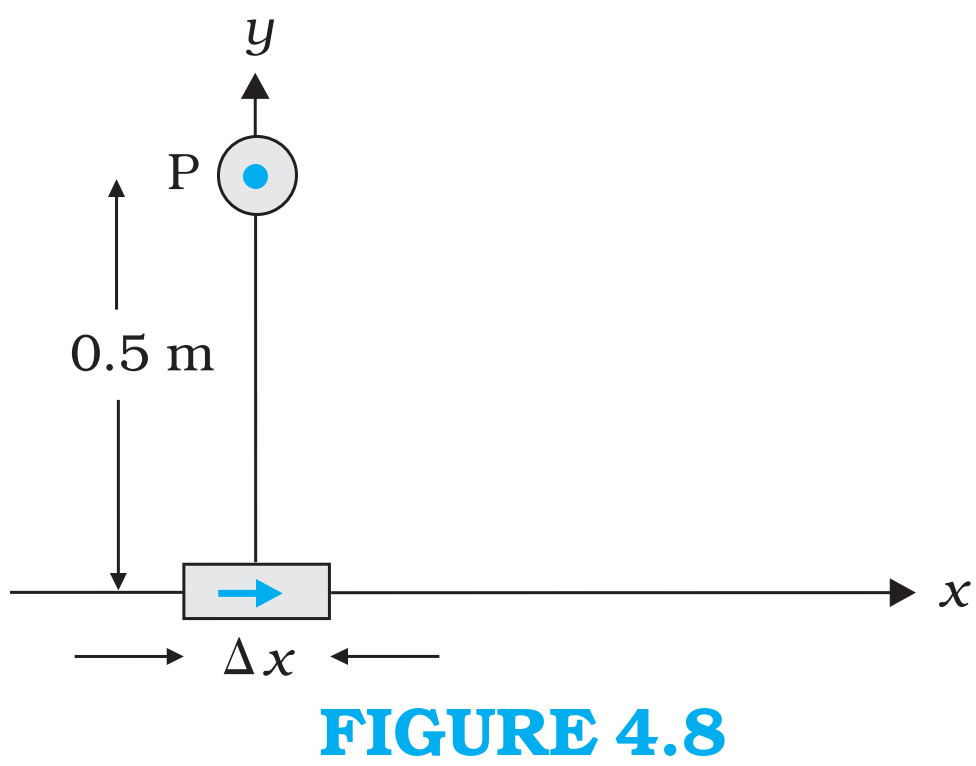
Answer$| d B |=\frac{\mu_0}{4 \pi} \frac{I d l \sin \theta}{r^2}\ [$using Eq. $(4.11)] $
$d l=\Delta x=10^{-2} m , I=10 \text { A, } r=0.5 m =y, \mu_0 / 4 \pi=10^{-7} \frac{ Tm }{ A }$
$\theta=90^{\circ} ; \sin \theta=1$
$| d B |=\frac{10^{-7} \times 10 \times 10^{-2}}{25 \times 10^{-2}}=4 \times 10^{-8} T$
The direction of the field is in the $+z-$ direction. This is so since,
$d l \times r =\Delta x \hat{ i } \times y \hat{ j }=y \Delta x(\hat{ i } \times \hat{ j })=y \Delta x \hat{ k }$
We remind you of the following cyclic property of cross $-$ products,
$\hat{ i } \times \hat{ j }=\hat{ k } ; \hat{ j } \times \hat{ k }=\hat{ i } ; \hat{ k } \times \hat{ i }=\hat{ j }$
Note that the field is small in magnitude.
View full question & answer→Question 223 Marks
(a) A current-carrying circular loop lies on a smooth horizontal plane. Can a uniform magnetic field be set up in such a manner that the loop turns around itself (i.e., turns about the vertical axis).
(b) A current-carrying circular loop is located in a uniform external magnetic field. If the loop is free to turn, what is its orientation of stable equilibrium? Show that in this orientation, the flux of the total field (external field + field produced by the loop) is maximum.
(c) A loop of irregular shape carrying current is located in an external magnetic field. If the wire is flexible, why does it change to a circular shape?
Answer(a) No, because that would require $\tau$ to be in the vertical direction. But $\tau=I A \times B$, and since $A$ of the horizontal loop is in the vertical direction, $\tau$ would be in the plane of the loop for any $B$.
(b) Orientation of stable equilibrium is one where the area vector $A$ of the loop is in the direction of external magnetic field. In this orientation, the magnetic field produced by the loop is in the same direction as external field, both normal to the plane of the loop, thus giving rise to maximum flux of the total field.
(c) It assumes circular shape with its plane normal to the field to maximise flux, since for a given perimeter, a circle encloses greater area than any other shape.
View full question & answer→Question 233 Marks
The horizontal component of the earth's magnetic field at a certain place is $3.0 \times 10^{-5} T$ and the direction of the field is from the geographic south to the geographic north. A very long straight conductor is carrying a steady current of $1 A$. What is the force per unit length on it when it is placed on a horizontal table and the direction of the current is $(a)$ east to west; $(b)$ south to north?
Answer$F =I l \times B$
$F=I l B \sin \theta$
The force per unit length is
$f=F / l=I B \sin \theta$
$(a)$ When the current is flowing from east to west,
$\theta=90^{\circ}$
Hence,
$f =I B$
$ =1 \times 3 \times 10^{-5}=3 \times 10^{-5} N m ^{-1}$
This is larger than the value $2 \times 10^{-7} Nm ^{-1}$ quoted in the definition of the ampere.
Hence it is important to eliminate the effect of the earth's magnetic field and other stray fields while standardising the ampere.
The direction of the force is downwards.
This direction may be obtained by the directional property of cross product of vectors.
$(b)$ When the current is flowing from south to north,
$\theta=0^{\circ}$
$f=0$
Hence there is no force on the conductor. $Z$
View full question & answer→Question 243 Marks
A cyclotron’s oscillator frequency is 10 MHz. What should be the operating magnetic field for accelerating protons? If the radius of its ‘dees’ is 60 cm, calculate the kinetic energy (in MeV) of the proton beam produced by the accelerator.
AnswerMagnetic field ? $ = 2\pi\text{mv}/\text{q}$
$ = \frac{2\times3.14 \times1.67\times 10^{−27}\times 10^{7}}{1.6\times 10^{−19}} = 0.66\text{T}$
Final velocity of proton $\text{v} =\text{R} \times2\pi\text{v} = 0.6\times 2 \times 3.14 \times 10^{7} = 3.77 \times 10^{7}\text{?/?}$
$\text{Energy} =\frac{1}{2}\text{mv}^{2}=\frac{1}{2}\times 1.67 \times 10^{−27}\times (3.77 \times 10^{7})^2\text{?} = 7.4\text{ ???}$.
View full question & answer→Question 253 Marks
Use Biot-Savart law to derive the expression for the magnetic field on the axis of a current carrying circular loop of radius R. Draw the magnetic field lines due to a circular wire carrying current I.
Answer
-
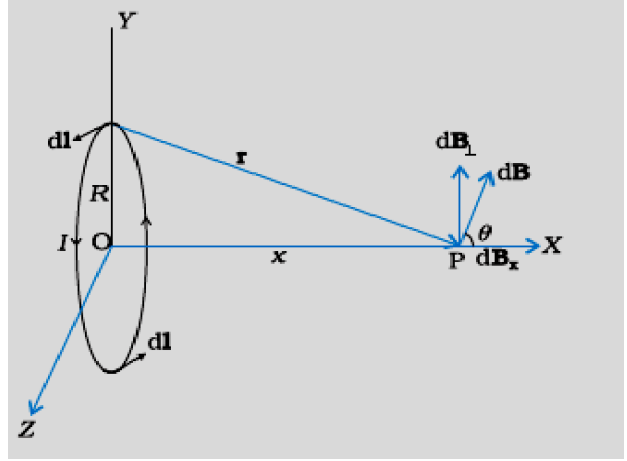
$\overrightarrow{\text{dB}} = \frac{\mu_{o}\overrightarrow{\text{dl}}\text{x}\overrightarrow{\text{r}}}{4\pi\text{r}^{3}}$
$\text{dB}_{x} = \frac{\mu_{o}\text{id}l\text{R}}{4\pi(\text{x}^{2} + \text{R}^{2})^{\frac{3}{2}}}$
$\overrightarrow{\text{B}} = \text{B}_{x}\hat{\text{i}} = \frac{\mu_{o}\text{IR}^{2}}{2(\text{x}^{2}\text{R}^{2})^{\frac{3}{2}}}\hat{\text{i}}$
-
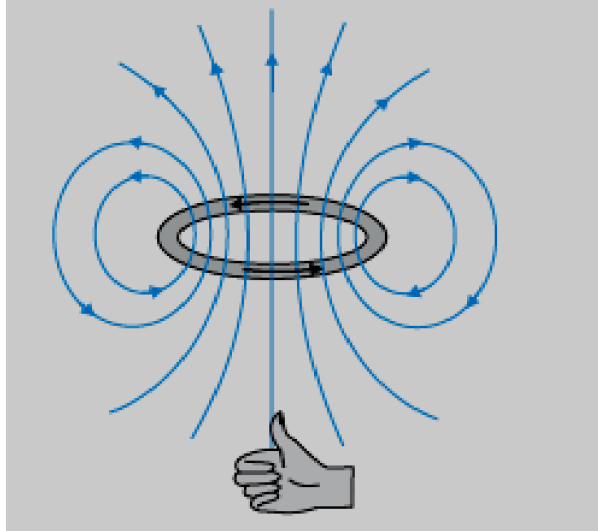
View full question & answer→Question 263 Marks
Two identical loops P and Q each of radius 5 cm are lying in perpendicular planes such that they have a common centre as shown in the figure. Find the magnitude and direction of the net magnetic field at the common centre of the two coils, if they carry currents equal to 3 A and 4 A respectively.
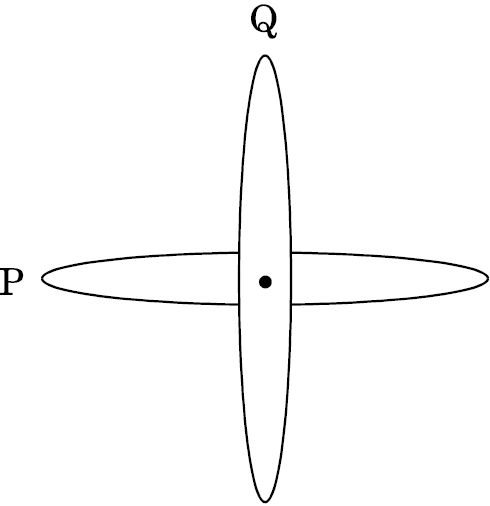
AnswerField at the centre of a circular coil = $\frac{\mu _0{I}}{2R}$ Field due to coil $\text{P}=\frac{\mu_{0}\times3}{2\times5\times10^{-2}}\text{tesla}$$=12\pi\times10^{-6}\text{tesla}$.
Field due to coil $\text{Q}=\frac{\mu_{0}\times4}{2\times5\times10^{-2}}\text{tesla}$$=16\pi\times10^{-6}\text{tesla}$
$\therefore$ Resultant Field $=(\pi\sqrt{12^{2}+{16^{2}}})\mu\text{T}$$=(20\pi)\mu{\text{T}}$
Let the field make an angle $\theta$ with the vertical $\tan{\theta}=\frac{12\pi\times10^{-6}}{16\pi\times10{-6}}=\frac{3}{4}$ $\theta=\tan^{-1}\frac{3}{4}$
View full question & answer→Question 273 Marks
A cyclotron’s oscillator frequency is 10MHz. What should be the operating magnetic field for accelerating protons? If the radius of its ‘dees’ is 60 cm, calculate the kinetic energy (in MeV) of the proton beam produced by the accelerator.
AnswerMagnetic field $\text{B} = \frac{2\pi\text{mf}}{\text{q}}$
$ = \frac{2\times3.14 \times1.67\times 10^{−27}\times 10^{7}}{1.6\times 10^{−19}} = 0.66\text{T}$
Final velocity of proton $\text{v} =\text{R} \times2\pi\text{f} = 0.6\times 2 \times 3.14 \times 10^{7} = 3.77 \times 10^{7}\text{?/?}$
Energy $ =\frac{1}{2}\text{m}v^{2}=\frac{1}{2}\times 1.67 \times 10^{−27}\times (3.77 \times 10^{7})^2\text{?} = 7.4\text{ ???}.$
View full question & answer→Question 283 Marks
- State Biot – Savart law and express this law in the vector form.
- Two identical circular coils, P and Q each of radius R, carrying currents 1 A and $\sqrt{3}$ A respectively, are placed concentrically and perpendicular to each other lying in the XY and YZ planes. Find the magnitude and direction of the net magnetic field at the centre of the coils.
Answer
- It states that magnetic field strength, $\vec{dB}$ due to a current element, $I\vec{dl}$ at a point, having a position vector r relative to the current element is found to depend.
- Directly on the current element.
- Inversely on the square of the distance |r|.
- Directly on the sine of angle between the current element and the position vector r.
In vector notation,
$\overrightarrow{dB}=\frac{\mu_0}{4\pi}\frac{I\vec{dl}\times\vec{r}}{|\vec{r}|^3}$
Alternate Answer
$\bigg(\overrightarrow{dB}=\frac{\mu_0}{4\pi}\frac{I\vec{dl}\times\hat{r}}{|\vec{r}|^2}\bigg)$
- $B_p=\frac{\mu_0\times1}{2R}=\frac{\mu_0}{2R}$ (along z − direction)
$B_Q=\frac{\mu_0\times\sqrt{3}}{2R}=\frac{\mu_0\sqrt{3}}{2R}$ (along x − direction)
$\therefore\text{ }B=\sqrt{B_{p}\text{ }^2+B_Q\text{ }^2}=\frac{\mu_0}{R}$
This net magnetic field B, is inclined to the field Bp, at an angle $\theta$, where
$\tan\theta=\sqrt{3}$
$(/\theta=\tan^{-1}\sqrt{3}=60^\circ)$
(in XZ plane) View full question & answer→Question 293 Marks
Define the current sensitivity of a galvanometer. Write its $S.I.$ unit.
Figure shows two circuits each having a galvanometer and a battery of $3 V. $ When the galvanometers in each arrangement do not show any deflection, obtain the ratio $R_{1 }/ R_2.$
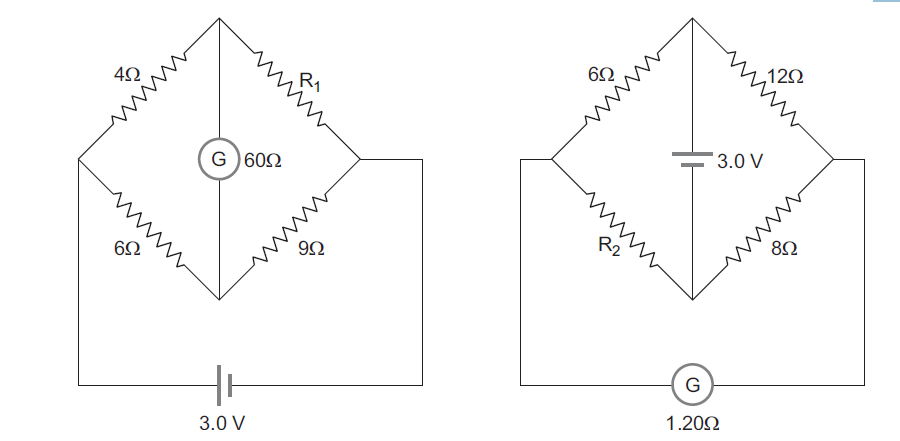
AnswerRatio of deflection produced in the galvanometer to the current flowing through it.
Current sensitivity $\text{S}_{i} = \frac{\theta}{\text{I}}$
$S.I.$ unit of current sensitivity $S_i$ is division/ampere or radian/ampere.
For balanced Wheatone bridge, if no current flows through the galvanometer
$\frac{4}{\text{R}_{1}} = \frac{6}{9}$
$\Rightarrow\text{R}_{1} = \frac{4\times9}{6} =6\Omega$
For another current
$\frac{6}{12} = \frac{\text{R}_{2}}{8}$
$\Rightarrow\text{R}_{2} = \frac{6\times8}{12} = 4\Omega$
$\therefore\frac{\text{R}_{1}}{\text{R}_{2}} = \frac{6}{4} = \frac{3}{2}.$
View full question & answer→Question 303 Marks
A circular coil of $200$ turns and radius $10 \ cm$ is placed in a uniform magnetic field of $0.5 T,$ normal to the plane of the coil. If the current in the coil is $3.0 A,$ calculate the
- Total torque on the coil.
- Total force on the coil.
- Average force on each electron in the coil, due to the magnetic field.
Assume the area of cross$-$section of the wire to be $10–5m^2$ and the free electron density is $10^{29}/m^3.$ Answer
- $\tau = \text{NBIA}\sin\theta$
$\text{ as }\theta = 0^{o}\text{ so }\tau = 0$
- $\overrightarrow{\text{F}} = \text{I}(\overrightarrow{l}\times\overrightarrow{\text{B}})$
$\text{F}_{net} = 0$
- $\text{F}_{e} = \text{evB}\text{ or } \text{F}_{e} = \frac{\text{BI}}{\text{NA}}$
$\text{F}_{e} = 1.5\times10^{-24}\text{N}.$ View full question & answer→Question 313 Marks
A proton and an $\alpha$ particle move perpendicular to a magnetic field. Find the ratio of radii of circular paths described by them when both have (i) equal velocities, and (ii) equal kinetic energy.
Answer
- $r=\frac{mv}{qB}$
For proton $r_p=\frac{m_pv}{q_pB}$
For $\alpha$ particle $r_\alpha=\frac{m_{\alpha}v}{q_{\alpha}B}$
$\frac{r_p}{r_{\alpha}}=\frac{m_p}{q_p}\frac{q_{\alpha}}{m_{\alpha}}=\frac{1}{2}$
- $r=\frac{\sqrt{2mk}}{q_B}$
$r_{p}=\frac{\sqrt{2m_{p}K}}{q_{p}B}$
$r_\alpha=\sqrt{2m_\alpha{k}} \over{q_\alpha}B$
$\frac{r_p}{r{\alpha}}=\frac{q_{\alpha}}{q_p}\sqrt{\frac{m_p}{m_{\alpha}}}=\frac{1}{1}$ View full question & answer→Question 323 Marks
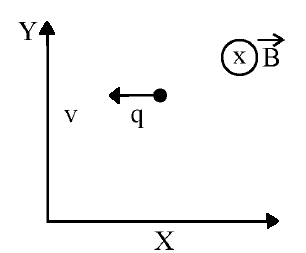
- A point charge q moving with speed v enters a uniform magnetic field B that is acting into the plane of the paper as shown. What is the path followed by the charge q and in which plane does it move?
- How does the path followed by the charge get affected if its velocity has a component parallel to $\overrightarrow{\text{B}}$?
- If an electric field $\overrightarrow{\text{E}}$ is also applied such that the particle continues moving along the original straight line path, what should be the magnitude and direction of the electric field $\overrightarrow{\text{E}}$?
Answer
- The charge q describes a circular path; anti-clockwise in XY plane.
- The path will become helical.
- Direction of Lorentz magnetic force is –Y
$\therefore$ Applied electric field should be in +Y direction.
$F_E=F_m$
$\Rightarrow qE=qvB$
$\Rightarrow E=vB$ View full question & answer→Question 333 Marks
Using Biot-Savart law, deduce the expression for the magnetic field at a point (x) on the axis of a circular current carrying loop of radius R. How is the direction of the magnetic field determined at this point?
Answer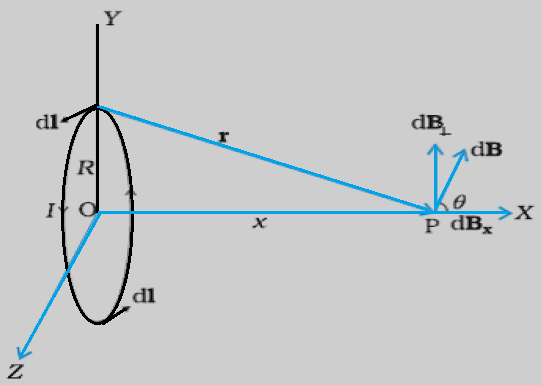
$\overrightarrow{dB}=\frac{\mu_0}{4\pi}\text{ }\text{I}\text{ }\frac{\vec{dl}\times\overrightarrow{r}}{r^3}$
$[\text{OR}\text{ }dB=\frac{\mu_0}{4\pi}\frac{Idl}{r^2}]$
$\text{Here}\text{ }r^2=x^2+R^2$
$\text{dB}=\frac{\mu_0}{4\pi}\frac{I dl}{x^2+R^2}$
$\sum\text{dB}_\perp=0$
$\text{d}B_x=\text{dB}\cos\theta\text{ }\text{ }\text{ }\text{ }\text{w}here\text{ }\text{ }\text{ }\cos\theta=\frac{R}{(x^2+R^2)^{\text{ }^1/_2}}$
$\text{d}B_x=\frac{\mu_0\text{ }Idl}{4\pi}\frac{R}{(x^2+R^2)^{\text{ }^3/_2}}$
$\overrightarrow{B}=\int\text{d}b_x\hat{i}=\frac{\mu_0IR^2}{2(x^2+R^2)^{\text{ }^3/_2}}\hat{i}$ View full question & answer→Question 343 Marks
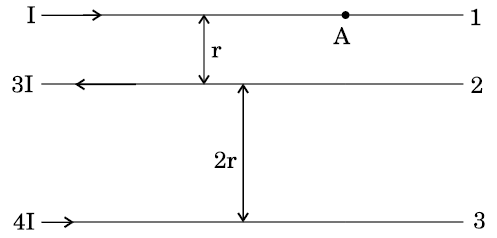
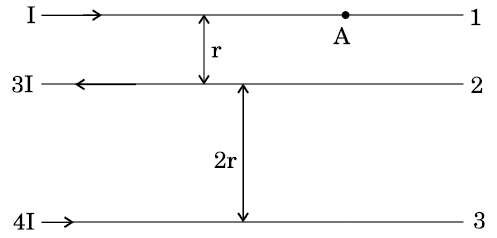
The figure shows three infinitely long straight parallel current carrying conductors. Find the
- magnitude and direction of the net magnetic field at point A lying on conductor 1,
- magnetic force on conductor 2.
Answer
- $B_2=\frac{\mu_0}{4\pi}\frac{2(3I)}{r}=\frac{\mu_0}{4\pi}\big(\frac{6I}{r}\big)$into the plane of the paper/$(\otimes)$.
$B_3=\frac{\mu_0}{4\pi}\frac{2(4I)}{3r}=\frac{\mu_0}{4\pi}\big(\frac{8I}{3r}\big)$out of the plane of the paper/$(\bigodot)$.
$B_A=B_2-B_3$ into the paper.
$=\frac{\mu_0}{4\pi}\Big(\frac{10I}{3r}\Big) into\text{ }the\text{ }paper.\text{} (\otimes)$
- $F_{21}=\frac{\mu_0}{4\pi}\frac{2I(3I)}{r}$ away from wire1 (/towards 3)
$F_{23}=\frac{\mu_0}{4\pi}\frac{2(3I)(4I)}{2r}$ away from wire 3 (towards 1)
$F_{\text{net}}=F_{23}-F_{21}$ towards wire1
$=\frac{\mu_0}{4\pi}\frac{6(I)^2}{r}$ towards wire1 View full question & answer→Question 353 Marks
The figure shows three infinitely long straight parallel current carrying conductors. Find the:
- Magnitude and direction of the net magnetic field at point A lying on conductor 1.
- Magnetic force on conductor 2.
Answer
- $B_2=\frac{\mu_0}{4\pi}\frac{2(3I)}{r}=\frac{\mu_0}{4\pi}\big(\frac{6I}{r}\big)$into the plane of the paper/$(\otimes)$.
$B_3=\frac{\mu_0}{4\pi}\frac{2(4I)}{3r}=\frac{\mu_0}{4\pi}\big(\frac{8I}{3r}\big)$out of the plane of the paper/$(\bigodot)$.
$B_A=B_2-B_3$ into the paper.
$=\frac{\mu_0}{4\pi}\Big(\frac{10I}{3r}\Big) into\text{ }the\text{ }paper.\text{} (\otimes)$
- $F_{21}=\frac{\mu_0}{4\pi}\frac{2I(3I)}{r}$ away from wire1 (/towards 3)
$F_{23}=\frac{\mu_0}{4\pi}\frac{2(3I)(4I)}{2r}$ away from wire 3 (towards 1)
$F_{\text{net}}=F_{23}-F_{21}$ towards wire1
$=\frac{\mu_0}{4\pi}\frac{6(I)^2}{r}$ towards wire1 View full question & answer→Question 363 Marks
- State the condition under which a charged particle moving with velocity v goes undeflected in a magnetic field B.
- An electron, after being accelerated through a potential difference of 104 V, enters a uniform magnetic field of 0.04 T, perpendicular to its direction of motion. Calculate the radius of curvature of its trajectory.
Answer
- The force experienced $\vec{F}=q(\vec{v}\times\vec{B})$
The charge will go undeflected when $\vec{v}$ is parallel or
antiparallel to$\vec{B}\because\vec{F}=0$
- The radius of electron
$eV=\frac{1}{2}mv^2$
$\frac{mv^2}{r}=qvB$
$\therefore\text{ }r=\frac{1}{B}\sqrt{\frac{2mV}{e}}$
$=\Bigg[\sqrt{\frac{2\times9.1\times10^{-31}\times10^4}{1.6\times10^{-19}}}\times\frac{1}{0.04}\Bigg]m$
$=8.4\times10^{-3}m$ View full question & answer→Question 373 Marks
Two identical coils P and Q each of radius R are lying in perpendicular planes such that they have a common centre. Find the magnitude and direction of the magnetic field at the common centre of the two coils, if they carry currents equal to $\text{I}$ and $\sqrt{3\text{I}}$ respectively. 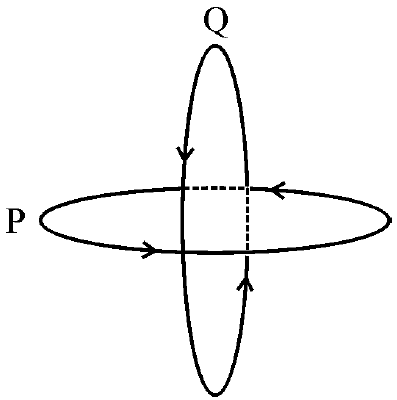
Answer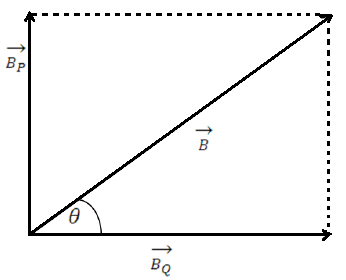
$B_p=\frac{\mu_0}{4\pi}\frac{2\pi I}{R}$
$B_Q=\frac{\mu_0}{4\pi}\frac{2\pi(\sqrt{3}I)}{R}$
$B=\sqrt{B_P\text{ }^2+B_Q\text{ }^2}$
$=\frac{\mu_0}{4\pi}\frac{2\pi I}{R}\sqrt{1+3}$
$=\frac{\mu_0I}{R}$
$\tan\theta=\frac{B_p}{B_Q}=\frac{1}{\sqrt{3}}$
$\Rightarrow\theta=30^\circ$ View full question & answer→Question 383 Marks
Describe the working principle of a moving coil galvanometer. Why is it necessary to use (i) a radial magnetic field and (ii) a cylindrical soft iron core in a galvanometer? Write the expression for current sensitivity of the galvanometer.
Can a galvanometer as such be used for measuring the current? Explain.
AnswerWhen a coil, carrying current, and free to rotate about a fixed axis, is placed in a uniform magnetic field, it experiences a torque (which is balanced by a restoring torque of suspension).
To have deflection proportional to current/to maximize the deflecting torque acting on the current carrying coil.
To make magnetic field radial/to increase the strength of magnetic field.
Expression for current sensitivity
$I_S=\frac{\theta}{I}\text{ }or\text{ }\frac{NAB}{K}$
where $\theta$ is the deflection of the coil
No
The galvanometer, can only detect currents but cannot measure them as it is not calibrated. The galvanometer coil is likely to be damaged by currents in the (mA/A) range.
View full question & answer→Question 393 Marks
- Write the expression for the force $ \overrightarrow{\text{F}}$ acting on a particle of mass m and charge q moving with velocity $ \overrightarrow{\text{V}} $ in a magnetic field $ \overrightarrow{\text{B}}$ Under what conditions will it move in (i) a circular path and (ii) a helical path?
- Show that the kinetic energy of the particle moving in a magnetic field remains constant.
Answer
- $ \overrightarrow{\text{F}}=Q(\overrightarrow{\text{V}}\times\overrightarrow{\text{B}})$
- When velocity of charged particle and magnetic field are perpendicular to each other.
- When velocity is neither parallel nor perpendicular to the magnetic field.
- The force, experienced by the charged particle, is perpendicular to the instantaneous velocity $\overrightarrow{V}$ at all instants. Hence the magnetic force cannot bring any change in the speed of the charged particle. Since speed remains constant, the kinetic energy also stays constant.
View full question & answer→Question 403 Marks
Write the expression for the magnetic force acting on a charged particle moving with velocity n in the presence of magnetic field B. A neutron, an electron and an alpha particle moving with equal velocities, enter a uniform magnetic field going into the plane of the paper as shown. Trace their paths in the field and justify your answer.
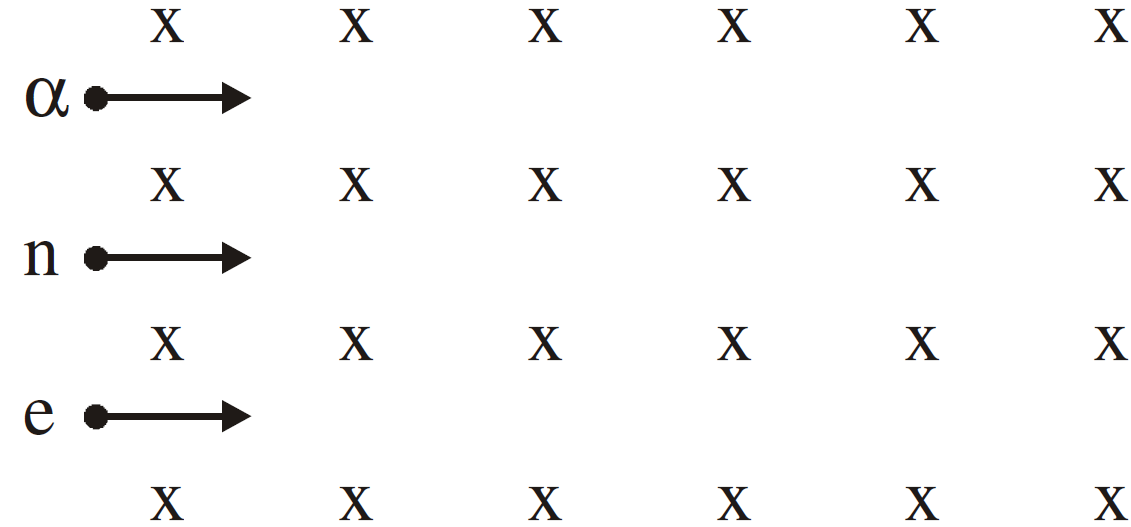
Answer$\overrightarrow{\text{F}} = \text{q}(\overrightarrow{\text{v}}\times\overrightarrow{\text{B}})$
$\text{F}= \text{qvB}\sin\theta$ and Force (F) acts perpendicular to the plane containing $\overrightarrow{\text{v}} \text{and} \overrightarrow{\text{B}}$
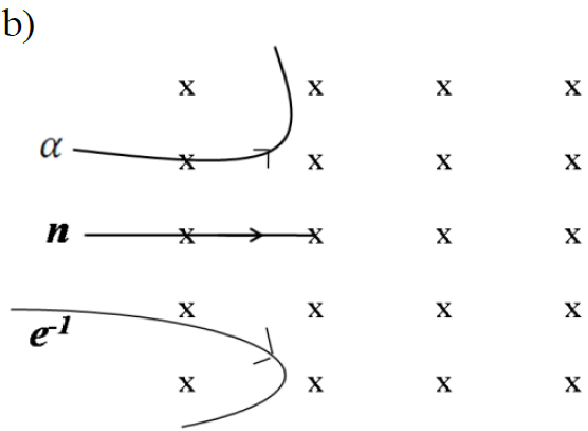
Justification: Direction of force experienced by the particle will be according to the Fleming’s Left-hand rule. View full question & answer→Question 413 Marks
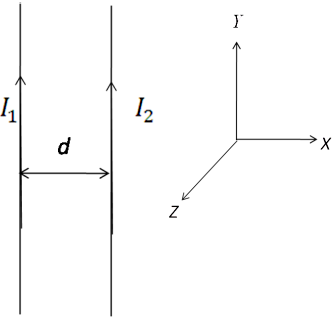
Two long straight parallel conductors carry steady current $I_1$ and $I_2$ separated by a distance $d.$ If the currents are flowing in the same direction, show how the magnetic field set up in one produces an attractive force on the other. Obtain the expression for this force. Hence define one ampere.
Answer
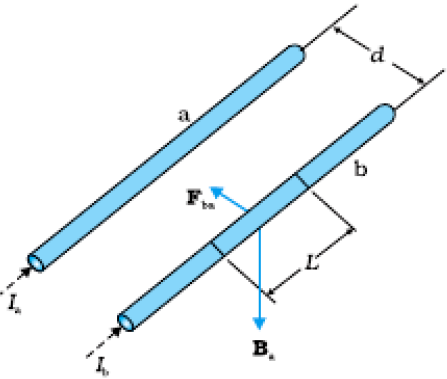
As shown in Figure, the direction of force on conductor $b$ is attractive.
Alternate Answer
$\overrightarrow{\text{B}}$at a point on wire $2,$ is along $- \hat{\text{k}}$
$\therefore\overrightarrow{\text{F}} , $
on wire $2,$ due to the $\overrightarrow{\text{B}}$ is along $-$ $\hat{\text{i}}$
i.e.towards wire$1.$
Hence the force is attractive.
Magnetic field, due to current in conductor $a,$
$\text{B}_{1} = \frac{\mu_\circ\text{I}_{1}}{2\pi\text{d}}$
The magnitude of force on a length $L$ of conductor $b,$
$\text{F}_{2} = \text{I}_{2}\text{LB}_{1}$
$\text{F}_{2} =\frac{\mu_\circ\text{I}_{1}\text{I}_{2}\text{L}}{2\pi\text{d}}$
One ampere is that steady current which,
when maintained in each of the two very long, straight, parallel conductors,
placed one meter apart in vacuum,
would produce on each of these conductors a force equal to $2 \times10^{-7}$ newton per meter of their length. View full question & answer→Question 423 Marks
A $12\ pF$ capacitor is connected to a $50 V$ battery. How much electrostatic energy is stored in the capacitor? If another capacitor of $6\ pF$ is connected in series with it with the same battery connected across the combination, find the charge stored and potential difference across each capacitor.
AnswerEnergy stored, in the capacitor of capacitance $12\ pF,$
$\text{U}=\frac{1}{2}\text{CV}^2$
$=\frac{1}{2}\times12\times10^{-12}\times50\times50\text{J}$
$=1.5\times10^{-8}\text{ }\text{J}$
$C=$ Equivalent capacitance of $12\ pF$ and $6\ pF,$ in series, is given by
$\frac{1}{\text{C}}=\frac{1}{12}+\frac{1}{6}=\frac{1+2}{12}$
$\therefore\text{C}=4\text{ }\text{pF}$
$\therefore$ Charge stored across each capacitor
$\text{q}=\text{CV}$
$=4\times10^{-12}\times50\text{ }\text{C}$
$=2\times10^{-10}\text{ }\text{C}$
Charge on each capacitor $12\ pF$ as well as $6\ pF$
$\therefore$ Potential difference across capacitor $C_1$
$\therefore\text{V}_{1}=\frac {2\times10^{-10}}{12\times10^{-12}}\text{Volt}=\frac{50}{3}\text{ }\text{V}$
Potential difference across capacitor $C_2$
$\text{V}_{2}=\frac {2\times10^{-10}}{6\times10^{-12}}\text{Volt}=\frac{100}{3}\text{ }\text{V}$
View full question & answer→Question 433 Marks
A electron of mass $m_e$ revolves around a nucleus of charge $+Ze.$ Show that it behaves like a tiny magnetic dipole. Hence prove that the magnetic moment associated wit it is expressed as $\vec\mu=-_{e2{\text{ me}}}\overrightarrow{\text{L}}$, where $\overrightarrow{\text{L}}$ is the orbital angular momentum of the electron. Give the significance of negative sign.
AnswerElectron, in circular motion around the nucleus, constitutes a current loop which behaves like a magnetic dipole. Current associated with the revolving electron: $I=\frac{e}{T}$
and $\text{T}=\frac{2{\pi{r}}}{\vartheta}$
$\therefore\text{I}=\frac{e}{2{\pi}r}\vartheta$
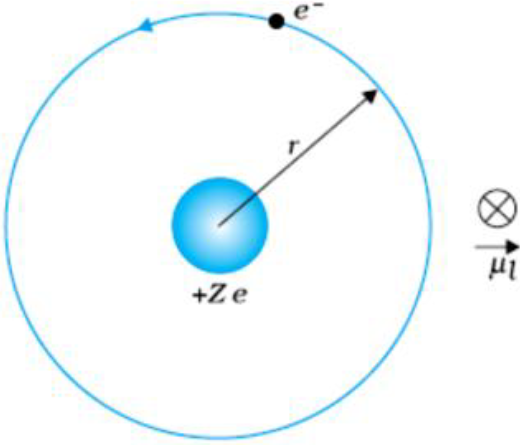
Magnetic moment of the loop, $\mu=\text{IA}$
$\mu=\text{IA}=\frac{e\vartheta}{2{\pi}r}\pi{r}^2=\frac{{e\vartheta}r}{2}=\frac{e.m_{e}\vartheta{r}}{2m_{e}}$
Orbital angular momentum of the electron, $ \text{L}= m_e\vartheta{r}$ $\vec\mu=\frac{-e}{2{m}_e}\vec{L}$
$-ve$ sign signifies that the angular momentum of the revolving electron is opposite in direction to the magnetic moment associated with it. View full question & answer→Question 443 Marks
A rectangular loop of wire of size 4cm × 10cm carries a steady current of 2A. A straight long wire carrying 5A current is kept near the loop as shown. If the loop and the wire are coplanar, find
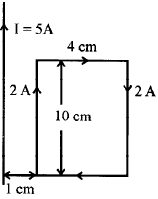
- The torque acting on the loop and.
- The magnitude and direction of the force on the loop due to the current carrying wire.
Answer
- Torque on the loop
$\tau =\text{MB}\sin\theta$
As Mand B are parallel, $\theta =0 $
therefore, $\tau = 0 $
- Force acting on the loop
$|\text{F}| =\frac{\mu_{o}\text{I}_{1}\text{I}_{2}}{2\pi}\ell\bigg(\frac{1}{\text{r}_{1}} -\frac{1}{\text{r}_{2}}\bigg)$
$ = 2\times10^{-7}\times2\times2\times10^{-1}\bigg(\frac{1}{10^{-2}}-\frac{1}{5\times10^{-2}}\bigg)\text{N}$
$ =\frac{8\times10^{8}}{10^{-2}}\bigg(1 - \frac{1}{5}\bigg)\text{N}$
$ = 8\times10^{-6}\bigg(\frac{4}{5}\bigg)\text{N}$
$ = 6.4\times10^{-6}\text{N}$
Direction: Towards conductor /Attractive
Magnetic field $\text{B} =\frac{\mu_{0}\text{I}}{2\pi\text{r}}$
$|\text{F}_{1}| =\text{I}\ell\text{B}_{1}\text{ (towards the conductor) }$
$|\text{F}_{2}| =\text{I}\ell\text{B}_{2}\text{ (away from the conductor}$
$|\text{F}| = \text{I}\ell(\text{B}_{1} - \text{B}_{2} )$
$ = \text{I}\ell\bigg(\frac{\mu_{0}\text{i}}{2\pi\text{r}_{1}} -\frac{\mu_{0}\text{i}}{2\pi\text{r}_{2}}\bigg) = \frac{\mu_{0}\text{i }l\text{I}}{2\pi}\bigg(\frac{1}{\text{r}_{1}} - \frac{1}{\text{r}_{2}}\bigg)$
$|\text{F}| = \frac{2\times10^{-7}\times(2)^{2}\times10^{-1}}{10^{-2}}\bigg(1 - \frac{1}{5}\bigg)\text{N}$
$ = 6.4\times10^{-6}\text{N}$
Direction: Towards the conductor/attractive. View full question & answer→Question 453 Marks
Write the expression for the magnetic moment $(\overrightarrow{\text{m}})$ due to a planar square loop of side $'l\ '$ carrying a steady current I in a vector form. In the given figure this loop is placed in a horizontal plane near a long straight conductor carrying a steady current $I_1$ at a distance l as shown. Give reasons to explain that the loop will experience a net force but no torque. Write the expression for this force acting on the loop.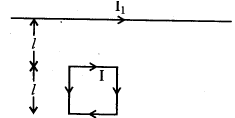
Answer$\overrightarrow{\text{m}} = \text{I}\overrightarrow{\text{A }} ( \overrightarrow{\text{A}} = \text{ area vector) }$ Torque: The magnetic field due to the long current carrying wire is perpendicular to the plane of paper.
Hence the force acting on each of the four sides is in the plane of the paper and the net torque is zero.
Alternate Answer
$\overrightarrow{\text{m}}$is perpendicular to the plane of paper and$\overrightarrow{\text{B}}$ is perpendicular to the plane of paper.
Hence $\overrightarrow{\tau} =\overrightarrow{\text{m}}\times\overrightarrow{\text{B}} = 0 $ Force: Force on upper horizontal side $ = \frac{\text{I}l\mu_{o}\text{I}_{1}}{2\pi\text{l}} =\frac{\text{I}\mu_{o}\text{l}_{1}}{2\pi}\text{ (attractive) }$ Force on lower horizontal side $ = \frac{\text{I}l\mu_{o}\text{I}_{1}}{2\pi(2l)} = \frac{\text{I}\mu_{o}\text{I}_{1}}{4\pi}\text{ (repulsive)}$
The direction of these forces being opposite to each other therefore net force $ = \frac{\mu_{o}\text{I}_{1}\text{I}}{4\pi}\text{ (attractive) } \ ($The net force on the two vertical sides is zero$)$ Torque: The magnetic field due to the long current carrying wire is perpendicular to the plane of paper.
Hence the force acting on each of the four sides is in the plane of the paper and the net torque is zero.
Alternate Answer
$\overrightarrow{\text{m}}$is perpendicular to the plane of paper and$\overrightarrow{\text{B}}$ is perpendicular to the plane of paper.
Hence $\overrightarrow{\tau} =\overrightarrow{\text{m}}\times\overrightarrow{\text{B}} = 0 $ Force: Award this mark irrespective of result obtained or calculation done by the students.
View full question & answer→Question 463 Marks
State the underlying principle of working of a moving coil galvanometer. Write two reasons why a galvanometer can not be used as such to measure current in a given circuit. Name any two factors on which the current sensitivity of a galvanometer depends.
AnswerPrinciple: Torque acts on a current carrying coil suspended in magnetic field.
$(\tau =\text{NIAB}\sin\theta)$
Two reasons:
- Galvanometer is a very sensitive device, it gives a full-scale deflection for a current of the order of a few μA.
- For measuring currents, the galvanometer has to be connected in series, and as it has a finite resistance, this will change the value of the current in the circuit.
Two factors: The current sensitivity of a moving coil galvanometer can be increased by (i) increasing the number of turns (ii) increasing area of the loop. (iii) increasing magnetic field (iv) decreasing the torsional constant of the suspension wire. View full question & answer→Question 473 Marks
A long straight wire of a circular cross-section of radius ‘a’ carries a steady current ‘I’. The current is uniformly distributed across the cross-section. Apply Ampere’s circuital law to calculate the magnetic field at a point ‘r’ in the region for (i) r < a and (ii) r > a.
Answer
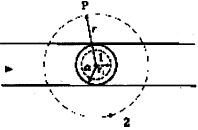
- Consider the case r < a. The Amperian loop is a circle labelled 1. For this loop, taking the radius of the circle to be r, L = 2 $\pi\text{r}.$
Now the current enclosed $\text{I}_{e} = \text{I}\bigg(\frac{\pi\text{r}^{2}}{\pi\text{a}^{2}}\bigg) = \frac{\text{Ir}^{2}}{\text{a}^{2}}$
Using Ampere’s law,
$\text{B}(2\pi\text{r}) = \frac{\mu_{o}\text{Ir}^{2}}{\text{a}^{2}}\Rightarrow\text{B} = \frac{\mu_{o}\text{Ir}^{2}}{2\pi\text{a}^{2}}$
- Consider the case r > a. The Amperian loop, labelled 2, is a circle concentric with the cross-section. For this loop, L = 2 $\pi\text{r}.$
Ie = Current enclosed by the loop = I
$\text{B}(2\pi\text{r}) = \mu_{o}\text{I}$
$\Rightarrow\text{B} =\frac{\mu_{o}\text{I}}{2\pi\text{r}}.$ View full question & answer→Question 483 Marks
Explain the principle and working of a cyclotron with the help of a schematic diagram. Write the expression for cyclotron frequency.
AnswerPrinciple: When charged particles are passed through a suitable combination of crossed electric and magnetic fields there energy can increase.
Labelled diagram:

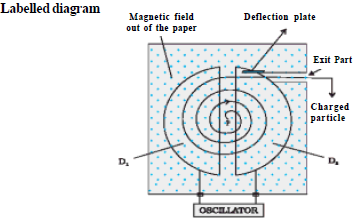
Working: Inside the metal boxes the particle is shielded and is not acted on by the electric field. The magnetic field, however, acts on the particle and makes it go round in a circular path inside a dee. Every time the particle moves from one dee to another it is acted upon by the electric field. The sign of the electric field is changed alternately in tune with the circular motion of the particle. This ensures that the particle is always accelerated by the electric field. Each time the acceleration increases the energy of the particle.
$\tau = \frac{1}{\text{v}_{c}} = \frac{2\pi\text{m}}{\text{qB}}$
or $\text{v}_{c} = \frac{\text{qB}}{2\pi\text{m}}$. View full question & answer→Question 493 Marks
Derive the expression for force per unit length between two long straight parallel current carrying conductors. Hence define one ampere.
Answer
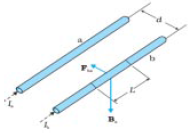
Figure shows two long parallel conductors $a$ and $b$ separated by $a$ distance $d$ and carrying $($parallel$)$ currents $I_a$ and $I _b,$ respectively.
The conductor $'a\ '$ produces, the same magnetic field $B$ a at all points along the conductor $'b\ '$.
The right-hand rule tells us that the direction of this field is downwards $($when the conductors are placed horizontally$)$. Its magnitude is given by
$\text{B}_{\alpha} = \frac{\mu_\circ\text{I}_{\alpha}}{2\pi\text{d}}$
The conductor $'b\ '$ carrying a current $I _b$ will experience a sideways force due to the field $B_a$.
The direction of this force is towards the conductor $'a\ '$.
We label this force as $F_{ba},$ the force on a segment $L$ of $'b\ '$ due to $'a\ '.$ The magnitude of this force is given by
$\int_{ba} = \text{I}_{b}\text{LB}_{a}$
$ = \frac{\mu_\circ\text{I}_{a}\text{I}_{b}}{2\pi\text{d}}\text{L}$
Let $\int_{ba}$ represent the magnitude of the force $\text{F}_{ba}$ per unit length.
$\int_{ba} = \frac{\mu_\circ\text{I}_{a}\text{I}_{b}}{2\pi\text{d}}$
One ampere: The ampere is the value of that steady current which, when maintained in each of the two very long, straight, parallel conductors of negligible cross $-$ section, and placed one metre apart in vacuum, would produce on each of these conductors a force equal to $2 \times 10^{–7}$ newton per metre of their length. View full question & answer→Question 503 Marks
A bar magnet of magnetic moment 6J/T is aligned at 60° with a uniform external magnetic field of 0·44T. Calculate (a) the work done in turning the magnet to align its magnetic moment (i) normal to the magnetic field, (ii) opposite to the magnetic field, and (b) the torque on the magnet in the final orientation in case (ii).
Answer$\text{m}=6\frac{\text{J}}{\text{T}}$
$\theta_1=60^\circ$
$\text{B}=0.44\text{T}$
- $\text{W}=-\text{mB}[\cos\theta_2-\cos\theta_1]$
- $\theta_2=90^\circ$
$\text{W}=-6\times0.44[\cos90^\circ-\cos60^\circ]$
$=-2.64\Big[0-\frac{1}{2}\Big]$
$\text{W}=1.32\text{J}$
- $\theta_2=180^\circ$
$\text{W}=-6\times0.44[\cos180^\circ-\cos60^\circ]$
$=-2.64\Big[-1-\frac{1}{2}\Big]$
$\text{W}=2.64\times\frac{3}{2}$
$\text{W}=3.965\text{J}$
- When $\theta=180^\circ$
Torque will be
$\tau=\text{mB}\sin\theta$
$=6\times0.44\times\sin180^\circ$
$\tau=0\text{Nm}$ View full question & answer→Question 513 Marks
- Write an expression of magnetic moment associated with a current (I) carrying circular coil of radius r having N turns.
- Consider the above mentioned coil placed in YZ plane with its centre at the origin. Derive expression for the value of magnetic field due to it at point (x, 0, 0).
Answer
- Magnetic moment $\vec{\text{M}}=\text{Ni}(\pi\text{r}^2)\hat{\text{n}}.$
-
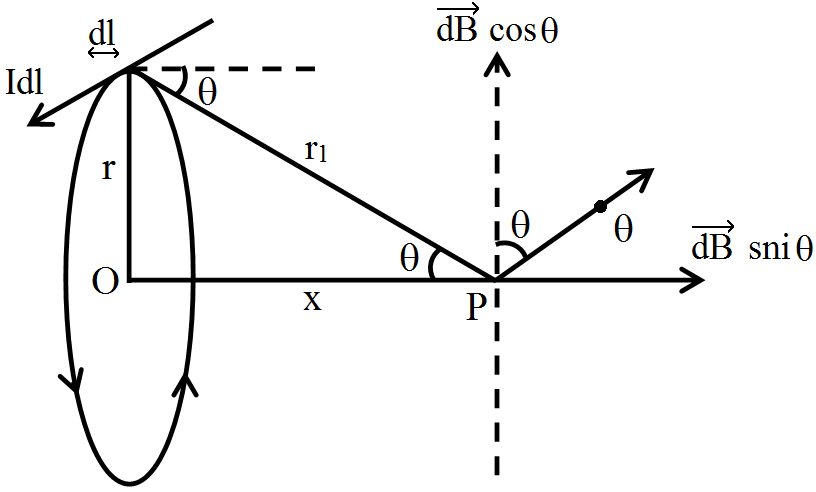
Magnetic field at point P(x, 0, 0) due to $\vec{\text{Idl}}$
$\vec{\text{dB}}=\frac{\mu_0}{4\pi}\frac{\text{Idl}\sin90^\circ}{\text{r}^2_1}\text{along PQ}$
For entire coil $\int\vec{\text{dB}}\cos\theta=0$
$\therefore\vec{\text{B}}\text{ at }\text{P}$
$\Rightarrow\text{B}=\int\text{dB}\sin\theta=\frac{\mu_0\text{I}\sin\text{R}}{4\pi\text{R}^2}\int\limits^{2\pi\text{r}}_{0}\text{dl}$
$=\frac{\mu_0\text{I}}{4\pi\text{r}^2_1}\times\frac{\text{r}}{\text{r}_1}\times(2\pi\text{r})$
$\Rightarrow\vec{\text{B}}=\frac{\mu_0\text{Ir}^2}{2\big(\text{r}^2+\text{x}^2\big)^\frac{3}{2}}\hat{\text{i}}$
Coil has N turns then,
$\vec{\text{B}}=\frac{\mu_0\text{INr}^2}{2\big(\text{r}^2+\text{x}^2\big)^\frac{3}{2}}\hat{\text{i}}$ View full question & answer→Question 523 Marks
- Define current sensitivity of a galvanometer. Write its expression.
- A galvanometer has resistance $G$ and shows full scale deflection for current $Ig.$
- How can it be converted into an ammeter to measure current up to $I_0(I_0 > Ig)?$
- What is the effective resistance of this ammeter?
Answer
- Current sensitivity: It is defined as the amount of deflection produced per unit magnitude of current passes.
$\text{C}_\text{s}=\frac{\phi}{\text{I}}\text{ or }\text{C}_\text{s}=\frac{\text{NAB}}{\mu,}$
-
-
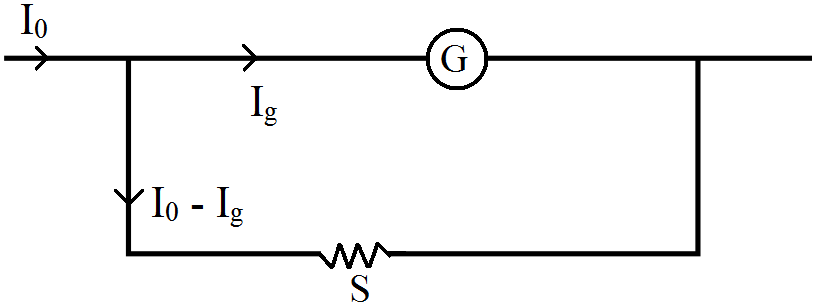
$(G)$ can be converted into an ammeter by connected a small stunt resistance parallel to $(G)$ coil so that,
$\text{IgG}=\big(\text{I}_0-\text{I}_\text{g}\big)\text{S}$
$\therefore\text{S}=\frac{\text{IgG}}{\text{I}_0-\text{I}_\text{g}}$
- Effective resistance of $(\text{A})\Rightarrow\frac{\text{GS}}{\text{G}+\text{S}}$
View full question & answer→Question 533 Marks
- Derive the expression for the torque acting on a current carrying loop placed in a magnetic field.
- Explain the significance of a radial magnetic field when a current carrying coil is kept in it.
Answer
- The plane of the loop is not along the magnetic field but makes an angle with it.
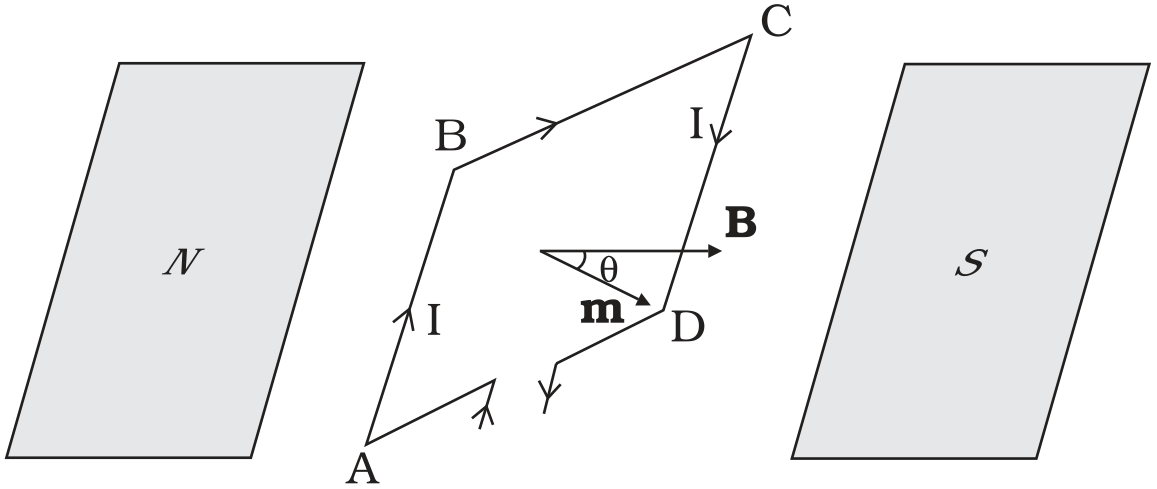
Let the dimension of the rectangular coil $\text{ABCD},$ be $AB \times BC = a \times b$
The angle between the field and the normal is $\theta $.
Forces on $BC$ and $DA$ are equal and opposite and they cancel each other as they are collinear.
Force on $AB$ is $F_1$ and force on $CD$ is $F_2.$
$F_1 = F_2 = IbB$
The magnitude of the torque on the loop as in the figure:
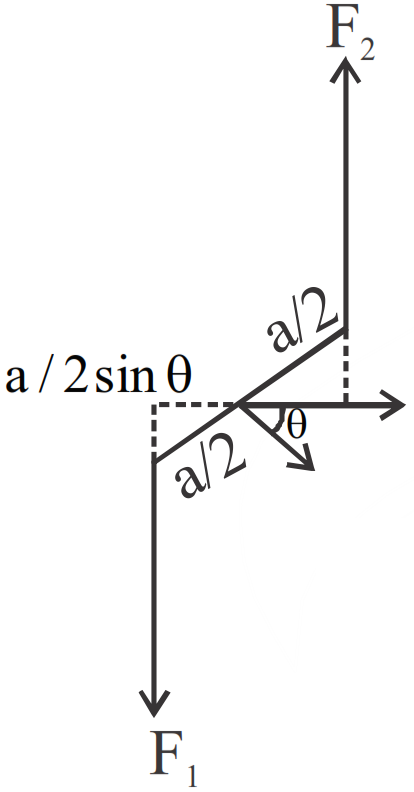
$\therefore\tau=\text{F}_1\frac{\text{a}}{2}\sin\theta+\text{F}_2\frac{\text{a}}{2}\sin\theta$
$=\text{lab}\text{ B}\sin\theta$
$\tau=\text{lab}\sin\theta$
If there are $'n\ '$ such turns the torque will be $\text{n}\text{ lab}\sin\theta$
The magnetic moment of the current, $m = lA$
$\therefore\overrightarrow{\tau}=\overrightarrow{\text{m}}\times\overrightarrow{\text{B}}$
- The uniform radial magnetic field keeps the plane of the coil always parallel to the direction of the magnetic field. that is, the angle between the plane of the coil and the magnetic field is zero in all the orientation of the coil.
View full question & answer→Question 543 Marks
A wire of length l carries a current i long the x-axis. A magnetic field exists, which is given $\overrightarrow{\text{B}}=\text{B}_0(\overrightarrow{\text{i}}+\overrightarrow{\text{j}}+\overrightarrow{\text{k}})\text{T}.$ Find the magnitude of the magnetic force acting on the wire.
Answer
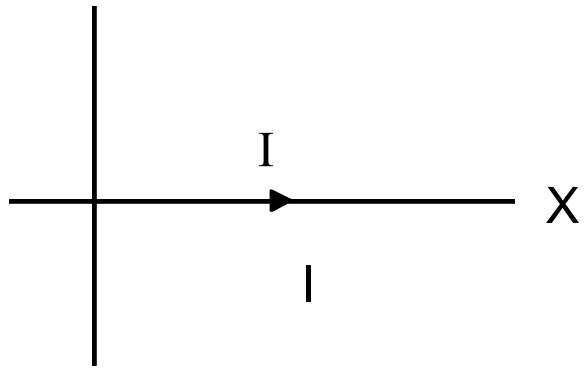 Length = l, Current $=\text{l}\hat{\text{i}}$
$\overrightarrow{\text{B}}=\text{B}_0(\hat{\text{i}}+\hat{\text{j}}+\hat{\text{k}})\text{T}$
$\text{B}_0\hat{\text{i}}+\text{B}_0\hat{\text{j}}+\text{B}_0\hat{\text{k}}\text{T}$
$\text{F}=\text{Il}\times\overrightarrow{\text{B}}=\text{Il}\hat{\text{i}}\times\text{B}_0\hat{\text{i}}+\text{B}_0\hat{\text{j}}+\text{B}_0\hat{\text{k}}$
$=\text{Il}\text{B}_0\hat{\text{i}}\times\hat{\text{i}}+\text{lB}_0\hat{\text{i}}\times\hat{\text{j}}+\text{lB}0\hat{\text{i}}\times\hat{\text{k}}=\text{Il}\text{B}_0\hat{\text{k}}-\text{IlB}\hat{\text{j}}$
or, $|\overrightarrow{\text{F}}|=\sqrt{2\text{I}^2\text{l}^2\text{B}_0^2}=\sqrt{2}\text{Il}\text{B}_0$ View full question & answer→Question 553 Marks
A solenoid of length $1.0m,$ radius $1\ cm$ and total turns $1000$ wound on it, carries a current of $5A$. Calculate the magnitude of the axial magnetic field inside the solenoid. If an electron was to move with a speed of $104ms^{–1}$ along the axis of this current carrying solenoid, what would be the force experienced by this electron?
AnswerMagnetic field inside a solenoid, $\text{B}=\mu_0\text{nI}$
$\text{n}=\frac{\text{N}}{1}=\frac{1000\ \text{turns}}{1.0\ \text{m}}=1000\ \text{turns/ m}$
$\text{I}=5\text{A}$
$\therefore\text{B}=(4\pi\times10^{-7})\times1000\times5$
$=20\times3.14\times10^{-4}\text{J}=6.28\times10^{-3}\text{T},$ along the axis Force experience by electron $\text{F}_\text{m}=\text{qvB}\sin\theta$
Here, $q = -e,v =10^{4 }m/ s$,
$\theta=$ angle between $\overrightarrow{\text{v}}\text{and}\overrightarrow{\text{B}}=0$$\therefore\text{F}_\text{m}=-\text{evB}\sin0^\circ=0$ zero
View full question & answer→Question 563 Marks
Consider the situation of the previous problem. A particle having charge q and mass m is projected from the point Q in a direction going into the plane of the diagram. It is found to describe a circle of radius r between the two plates. Find the speed of the charged particle.
AnswerCharge = q,
mass = m
We know radius described by a charged particle in a magnetic field B.
$\text{r}=\frac{\text{mv}}{\text{qB}}$
$\text{Bit}\ \text{B}=\mu_0\text{K}$ [according to Ampere’s circuital law, where K is a constant]
$\text{r}=\frac{\text{mv}}{\text{q}\mu_0\text{K}}\Rightarrow\text{v}=\frac{\text{rq}\mu_0\text{K}}{\text{m}}$
View full question & answer→Question 573 Marks
A semi-circular arc of radius 20cm carries a current of 10A. Calculate the magnitude of magnetic field at the centre of the arc.
AnswerThe magnetic field due to a semi-circular arc of radius ‘r’ carrying current (I) at centre is given by, $\Delta\text{B}=\frac{\mu_0}{4\pi}\frac{\text{I}\Delta\text{l}\sin90^\circ}{\text{r}^2}=\frac{\mu_0}{4\pi}\frac{\text{I}\Delta}{\text{r}^2}$The net magnetic field due to whole length of arc l will be
$\text{B}=\frac{\mu_0}{4\pi}\frac{\text{I}}{\text{r}^2}\sum\Delta\text{l}$ For semi-circular arc $\sum\Delta\text{l}=\pi\text{r}$ $\therefore\text{B}=\frac{\mu_0}{4\pi}\frac{\text{I}}{\text{r}^2}(\pi\text{r})=\frac{\mu_0\text{I}}{4\text{r}}$ Given I = 10A, r = 20m = 0.20m $\therefore\text{B}=\frac{4\pi\times10^{-7}\times10}{4\times0.20}$ $=\frac{4\times3.14\times10^{-7}\times10}{4\times0.20}$ $=1.57\times10^{-5}\text{T}$
View full question & answer→Question 583 Marks
Describe the motion of a charged particle in a cyclotron if the frequency of the radio frequency $(rf)$ field were doubled.
AnswerThe frequency $v_a$ of the applied voltage $($radio frequency$)$ is adjusted so that the polarity of the dees is reversed in the same time that it takes the ions to complete one half of the revolution.
The requirement $v_a = v_c$ is called the resonance condition.
When the frequency of the radio frequency $(rf)$ field were doubled, then the resonance condition are violated and the time period of the radio frequency $(rf)$ field were halved.
Therefore, the duration in which particle completes half revolution inside the dees, radio frequency completes the cycle.
So, particle will accelerate and decelerate alternatively.
So, the radius of path in the dees will remain same.
View full question & answer→Question 593 Marks
A straight wire carrying an electric current is placed along the axis of a uniformly charged ring. Will there be a magnetic force on the wire if the ring starts rotating about the wire? If yes, in which direction?
AnswerThe magnetic force on a wire carrying an electric current i is $\overrightarrow{\text{F}}=\text{i}.\big(\overrightarrow{\text{l}}\times\overrightarrow{\text{B}}\big),$ where l is the length of the wire and B is the magnetic field acting on it. If a uniformly charged ring starts rotating around a straight wire, then according to the right-hand thumb rule, the magnetic field due to the ring on the current carrying straight wire placed at its axis will be parallel to it. So, the cross product will be:
$\big(\overrightarrow{\text{l}}\times\overrightarrow{\text{B}}\big)=0$
$\Rightarrow\overrightarrow{\text{F}}=0$
Therefore, no magnetic force will act on the wire.
View full question & answer→Question 603 Marks
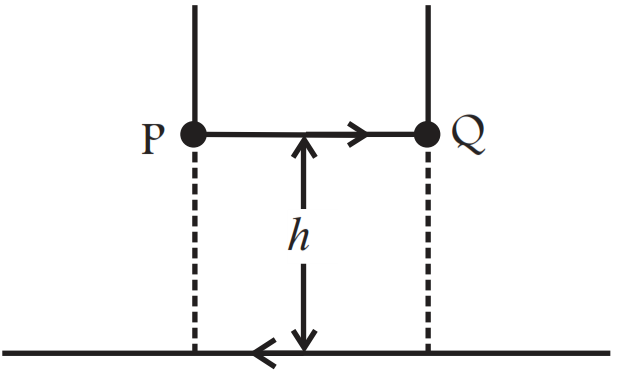
A long straight wire carrying current of 25A rests on a table as shown in Fig. Another wire PQ of length 1m, mass 2.5g carries the same current but in the opposite direction. The wire PQ is free to slide up and down. To what height will PQ rise?
AnswerIn equilibrium state,
$\text{mg}=\frac{\mu_0}{4\pi}\frac{2\text{I}_1\text{I}_2}{\text{h}}\text{l}$
According to the question,
$\text{h}=\frac{\mu_0}{4\pi}\frac{2\text{I}_1\text{I}_2\text{l}}{\text{mg}}$
$\text{h}=\frac{\mu_0}{4\pi}\frac{10^{-7}\times2\times25\times25\times1}{(2.5\times10^{-3})\times9.8}$
$=51\times10^{-4}=0.51\text{cm}.$
View full question & answer→Question 613 Marks
A particle moves in a circle of diameter $1.0\ cm$ under the action of a magnetic field of $0.40T.$ An electric field of $200 Vm^{-1}$ makes the path straight. Find the charge/ mass ratio of the particle.
Answer$r = 0.5\ cm = 0.5 \times 10^{-2}m$
$B = 0.4T,$
$\text{E}=200\frac{\text{V}}{\text{m}}$
The path will straighten, if $\text{qE}=\text{quB}$
$\Rightarrow\text{E}=\frac{\text{rqB}\times\text{B}}{\text{m}}$
$\Rightarrow\text{E}=\frac{\text{rqB}^2}{\text{m}}$
$\Rightarrow\frac{\text{q}}{\text{m}}=\frac{\text{E}}{\text{B}^2\text{r}}=\frac{200}{0.4\times0.4\times0.5\times10^{-2}}$
$=2.5\times10^5\text{c/kg}$
View full question & answer→Question 623 Marks
A long, cylindrical tube of inner and outer radii a and b carries a current i distributed uniformly over its cross section. Find the magnitude of the magnetic field at a point (a) just inside the tube (b) just outside the tube.
Answer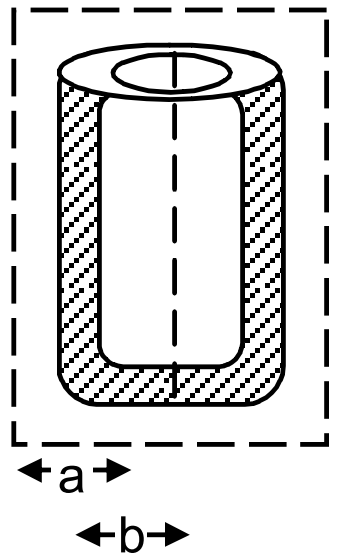
- At a point just inside the tube the current enclosed in the closed surface = 0.
Thus $\text{B}=\frac{\mu_0\text{o}}{\text{A}}=0$
- Taking a cylindrical surface just out side the tube, from ampere’s law
$\mu_0\text{i}=\text{B}\times2\pi\text{b}$
$\Rightarrow\text{B}=\frac{\mu_0\text{i}}{2\pi\text{b}}$ View full question & answer→Question 633 Marks
Consider a 10cm long piece of a wire which carries a current of 10A. Find the magnitude of the magnetic field due to the piece at a point which makes an equilateral triangle with the ends of the piece.
Answer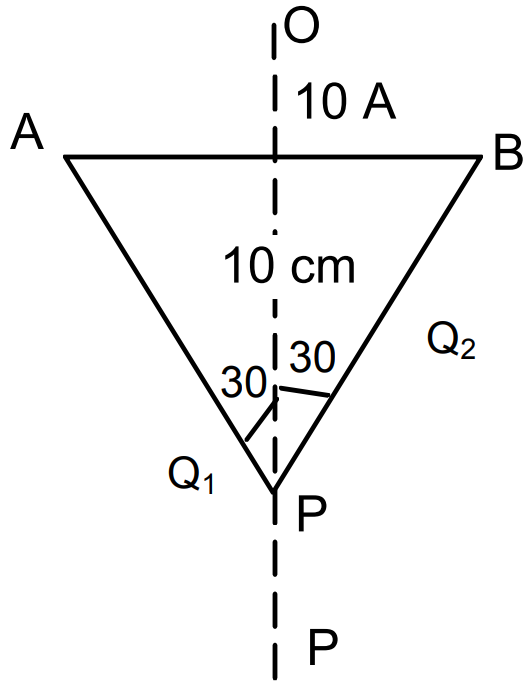
$\text{I} = 10 \text{A},\ \text{a} = 10\text{cm} = 0.1\text{m}$
$\text{r}=\text{OP}=\frac{\sqrt3}{2}\times0.1\text{m}$
$\text{B}=\frac{\mu_0\text{I}}{4\pi\text{r}}(\sin\phi_1+\sin\phi_2)$
$=\frac{10^{-7}\times10\times1}{\sqrt{\frac{\sqrt{3}}{2}}\times0.1}=\frac{2\times10^{-5}}{1.732}$
$= 1.154\times10^{-5}\text{T} = 11.54\mu\text{T}$ View full question & answer→Question 643 Marks
A long cylindrical wire of radius b carries a current i distributed uniformly over its cross-section. Find the magnitude of the magnetic field at a point inside the wire at a distance a from the axis.
Answeri is uniformly distributed throughout So, ‘i’ for the part of radius $\text{a}=\frac{\text{i}}{\pi\text{b}^2}\times\pi\text{a}^2=\frac{\text{ia}^2}{\text{b}^2}=\text{I}$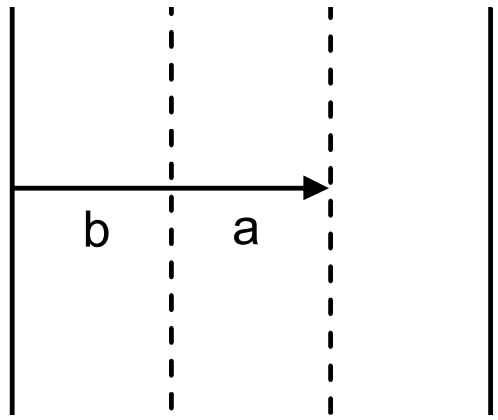
Now according to Ampere’s circuital law, $\phi\text{B}\times\text{d}\ell=\text{B}\times2\times\pi\times\text{a}=\mu_0\text{I}$ $\Rightarrow\text{B}=\mu_0\frac{\text{ia}^2}{\text{b}^2}\times\frac{1}{2\pi\text{a}}=\frac{\mu_0\text{ia}}{2\pi\text{b}^2}$ View full question & answer→Question 653 Marks
A long, straight wire carrying a current of $1.0A$ is placed horizontally in a uniform magnetic field $B = 1.0 \times 10^{-5}T$ pointing vertically upward figure. Find the magnitude of the resultant magnetic field at the points $P$ and $Q,$ both situated at a distance of $2.0\ cm$ from the wire in the same horizontal plane.
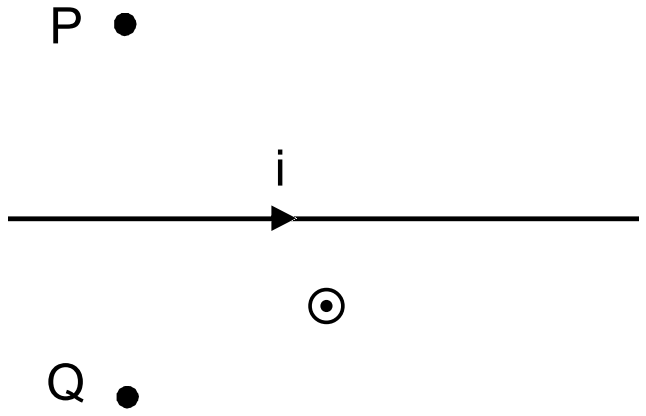
Answer$\mu_0=4\pi\times10^{-7}\text{T-m/A}$
$\text{r}2\text{cm}=0.02\text{m},$
$\text{I}=1\text{A}$
$\overrightarrow{\text{B}}$
$=1\times10^{-5}\text{T}$
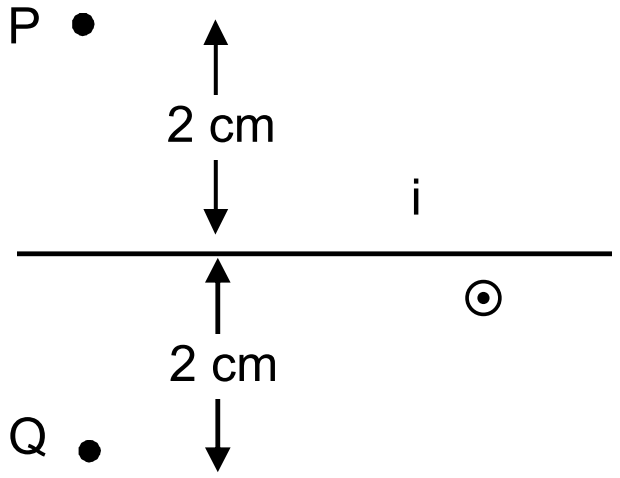
We know: Magnetic field due to a long straight wire carrying current $=\frac{\mu_0\text{I}}{2\pi\text{r}}$
$\overrightarrow{\text{B}}\ \text{at}\ \text{P}$
$=\frac{4\pi\times10^{-7}\times1}{2\pi\times0.02}$
$=1\times10^{-5}{\text{T}}$ upward net
$ \text{B} = 2\times1\times10^{–7}\text{T} $
$= 20\mu\text{T} B$ at $Q$
$= 1 \times 10^{-5}$ downwards
Hence net $\overrightarrow{\text{B}}=0$ View full question & answer→Question 663 Marks
A proton describes a circle of radius 1cm in a magnetic field of strength 0.10T. What would be the radius of the circle described by an α-particle moving with the same speed in the same magnetic field?
Answer$\text{r}=\frac{\text{mv}}{\text{qB}}$
$0.01=\frac{\text{mv}}{\text{e}0.1}\ ...(1)$
$\text{r}=\frac{\text{4}\text{m}\times\text{V}}{2\text{e}\times0.1}\ ...(2)$
$(2)\div(1)$
$\Rightarrow\frac{\text{r}}{0.01}=\frac{4\text{mVe}\times0.1}{2\text{e}\times0.1\times\text{mv}}=\frac{4}{2}=2$
$\Rightarrow\text{r}=0.02\text{m}=2\text{cm}$
View full question & answer→Question 673 Marks
A proton is projected with a velocity of $3 \times 10^6 ms^{-1}$ perpendicular to a uniform magnetic field of $0.6T.$ Find the acceleration of the proton.
Answer$\text{v}=3\times10^6\text{m/s},$
$\text{B}=0.6\text{T},$
$\text{m}=1.67\times10^{-27}\text{kg}$
$\text{F}=\text{qvB}$
$\text{q}_\text{p}=1.6\times10^{-19}\text{C}$
$\overrightarrow{\text{a}}=\frac{\text{F}}{\text{m}}=\frac{\text{quB}}{\text{m}}$
$=\frac{1.6\times10^{-19}\times3\times10^6\times10^{-1}}{1.67\times10^{27}}$
$=17.245\times10^{13}=1.724\times10^4\text{m/s}^2$
View full question & answer→Question 683 Marks
Which of the following will describe the smallest circle when projected with the same velocity perpendicular to the magnetic field B (i) $\alpha$-particle and (ii) $\beta$-particle?
AnswerRadius of circular path in transverse magnetic field, $\text{r}=\frac{\text{mv}}{\text{qB}}\propto\frac{\text{m}}{\text{q}}\ $for the same V and BFor $\alpha-$ particle$\Big(\frac{\text{m}}{\text{q}}\Big)_\alpha=\frac{4\text{mp}}{2\text{e}}=\frac{2\text{mp}}{\text{e}}$where mp is of mass proton.
For $\beta-$ particle $\Big(\frac{\text{m}}{\text{q}}\Big)_\beta=\frac{\frac{1}{1840}\text{m}_\text{p}}{\text{e}}=\frac{1}{1840}\Big(\frac{\text{m}_\text{p}}{\text{e}}\Big)$
Clearly $\beta-$ particle has smallest value of $\frac{\text{m}}{\text{q}}$; so $\beta-$ particle will describe the smalest circle.
View full question & answer→Question 693 Marks
A given galvanometer is to be converted into (i) an ammeter (ii) a milliammeter (iii) a voltmeter. In which case will the required resistance be (i) least (ii) highest and why?
AnswerThe required resistance has least value in the case of an ammeter and maximum value in the case of a voltmeter.
This is due to the reason that the shunt resistance required to convert a galvanometer into ammeter or milliammeter has the value.
$\text{S}=\frac{\text{I}_g}{\text{I}-\text{I}_\text{g}}\times\text{R}_\text{g}$
Thus, the shunt required in the case of milliammeter has higher value.
Similarly, since the voltmeter should have a high resistance, the value of required resistance should be highest in the case of a voltmeter. This is connected in series with the coil of the galvanometer.
View full question & answer→Question 703 Marks
To increase the current sensitivity of a moving coil galvanometer by $50\%,$ its resistance is increased so that the new resistance becomes twice its initial resistance. By what factor does its voltage sensitivity change?
AnswerCurrent sensitivity, $\text{S}_\text{C}=\frac{\theta}{\text{I}}=\frac{\text{NAB}}{C}$
Voltage sensitivity, $\text{S}_\text{V}=\frac{\theta}{\text{V}}=\frac{\theta}{\text{IR}}=\frac{\text{S}_\text{C}}{\text{R}}$
When current sensitivity is increased by $50\%,$ the resistance is made twice.
$\therefore$ New current sensitivity $\text{S}_{\text{C}'}=\text{S}_\text{C}+\frac{50}{100}\text{S}_\text{C}=1.5\text{S}_\text{C}$
New resistance $R' = 2R$
$\therefore$ New Voltage sesitivity. $\text{S}_\text{V'}=\frac{\text{S}_\text{C'}}{\text{R'}}=\frac{1.5\text{S}_\text{C'}}{2\text{R}}=0.75\ \text{S}_\text{V}$
Clearly, $S_{V'}<_{ }S_{V'}$ i.e, voltage sensitivity $=\frac{\text{S}_\text{V}-\text{S}_\text{V'}}{\text{S}_\text{V}}\times100\%$
$=\frac{\text{S}_\text{V}-0.75\text{S}_\text{V'}}{\text{S}_\text{V}}\times100\%=25\%$
View full question & answer→Question 713 Marks
A uniform magnetic field of magnitude $0.20T$ exists in space from east to west. With what speed should a particle of mass $0.010g$ and with charge $1.0 \times 10^{-5}C$ be projected from south to north so that it moves with uniform velocity?
Answer$B = 0.20T,$
$u = ?$
$m = 0.010g = 10^{-5}\ kg,$
$q = 1 \times 10^{-5}C$
Force due to magnetic field $=$ Gravitational force of attraction
So, $quB = mg$
$\Rightarrow 1 \times 10^{-5} \times u \times 2 \times 10^{-1} $
$= 1 \times 10–5 \times 9.8$
$\Rightarrow\text{v}=\frac{9.8\times10^{-5}}{2\times10^{-6}}$
$=49\text{m/s}.$
View full question & answer→Question 723 Marks
A circular loop of radius R carries a current I. Another circular loop of radius r ( << R) carries a current i and is placed at the centre of the larger loop. The planes of the two circles are at right angle to each other. Find the torque acting on the smaller loop.
Answer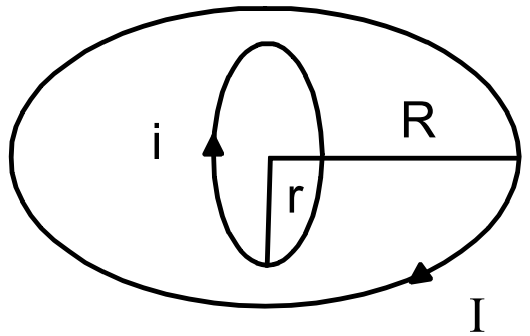
$\overrightarrow{\text{B}}$ Large loop $=\frac{\mu_0\text{I}}{2\text{R}}$
'i’ due to larger loop on the smaller loop
$=\text{i}(\text{A}\times\text{B})=\text{i}\text{AB}\ \sin90^\circ=\text{i}\times\pi\text{r}^2\times\frac{\mu_0\text{I}}{2\text{r}}$ View full question & answer→Question 733 Marks
Show that a force that does no work must be a velocity dependent force.
AnswerTo show that a force that does no work must be a velocity dependent force, then we have to assume that work done by force is zero. As shown by the equation below:
$\text{dW}=\vec{\text{F}}.\vec{\text{dI}}=0$
We can write, $\vec{\text{dI}}=\vec{\text{v}}\text{dt But}\text{ dt}\neq0 $
$\Rightarrow\ \vec{\text{F}}.\vec{\text{v}}\text{dt}=0$
$\Rightarrow\ \vec{\text{F}}.\vec{\text{v}}=0$
So we can say that force F must be velocity dependent, this implies that angle between F and v is 90°. If the direction of velocity changes, then direction of force will also change.
View full question & answer→Question 743 Marks
An experimenter's diary reads as follows: "A charged particle is projected in a magnetic field of $(7.0\vec{\text{i}}-3.0\vec{\text{j}})\times10^{-3}\text{T}.$ The acceleration of the particle is found to be $(\vec{\text{i}}+7.0\vec{\text{j}})\times10\text{m/s}^{2\text{n}}.$ The number to the left of $\vec{\text{i}}$ in the last expression was not readable. What can this number be?
Answer$\vec{\text{B}}=(7.0\hat{\text{i}}+3.0 \ \vec{\text{j}})\times10^{-3}\text{T}$
$\vec{\text{a}}=$ acceleration $=(\text{i}+7\text{j})\times10^{-6}\text{m/s}^2$
Let the gap be x.
Since $\vec{\text{B}}$ and $\vec{\text{a}}$ are always perpendicular
$\vec{\text{B}}\times\vec{\text{a}}=0$
$\Rightarrow(7\text{x}\times10^{-3}\times10^{-6}-3\times10^{-3}7\times10^{-6})=0$
$\Rightarrow7\text{x}-21=0$
$\Rightarrow\text{x}=3$
View full question & answer→Question 753 Marks
A current$-$carrying circular coil of $100$ turns and radius $5.0\ cm$ produces a magnetic field of $6.0 \times 10^{-5}\ T$ at its centre. Find the value of the current.
Answer$\text{B}=\frac{\mu_0\text{i}}{2\text{r}}$
$\text{n} = 100,\ \text{r} = 5\text{cm} = 0.05\text{m}$
$\overrightarrow{\text{B}}=6\times10^{-5}\text{T}$
$\text{i}=\frac{2\text{r}\text{B}}{\text{n}\mu_0}=\frac{2\times0.05\times6\times10^{-5}}{100\times4\pi\times10^{-7}}$
$=\frac{3}{6.28}\times10^{-1}=0.0477\approx48\text{mA}$
View full question & answer→Question 763 Marks
A long, straight wire carries a current. Is Ampere's law valid for a loop that does not enclose the wire? That encloses the wire but is not circular?
AnswerAmpere's law is valid for a loop that is not circular. However, it should have some charge distribution in the area enclosed so as to have a constant electric field in the region and a non-zero magnetic field. Even if the loop defined does not have its own charge distribution but has electric influence of some other charge distribution, it can have some constant magnetic field $\big(\oint\overrightarrow{\text{B}}.\text{d}\overrightarrow{\text{l}}=\mu_0\text{i}\ \text{enclosed}\big).$
View full question & answer→Question 773 Marks
A uniform conducting wire of length $12a$ and resistance $R$ is wound up as a current carrying coil in the shape of:
- An equilateral triangle of side $a.$
- A square of sides $a.$
- A regular hexagon of sides $a.$ The coil is connected to a voltage source $V_0.$ Find the magnetic moment of the coils in each case.
Answer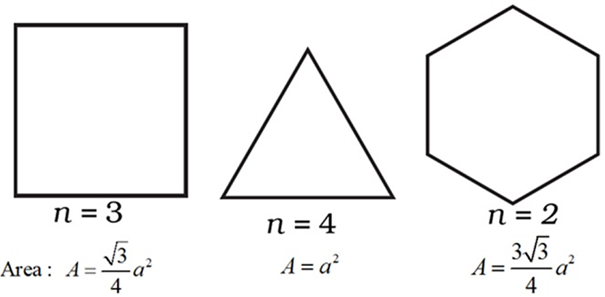
Current I is same for all Magnetic moment $m = nIA$ Here, $n$ is number of turns.
- For equilateral triangle:
$\therefore\ \text{m}=\text{nIA}=4\text{I}\bigg(\frac{\sqrt{3}}{4}\text{a}^2\bigg)=\text{Ia}^2\sqrt{3}$
- For square of side $a$
$\therefore\ \text{m}=\text{nIA}=3\text{Ia}^2$
- For a resular hexagon of sieds $a,$
$\therefore\ \text{m}=\text{nIA}=2\times\text{I}\times\bigg(\frac{3\sqrt{3}}{2}\bigg)^2=3\sqrt{3}\text{a}^2\text{I}$
$($Note: $m$ is in a geometric series$).$ View full question & answer→Question 783 Marks
A circular loop of radius $20\ cm$ carries a current of $10A.$ An electron crosses the plane of the loop with a speed of $2.0 \times 10^6m/s.$ The direction of motion makes an angle of $30^\circ$ with the axis of the circle and passes through its centre. Find the magnitude of the magnetic force on the electron at the instant it crosses the plane.
Answer$\text{r}=20\text{cm},\ \text{i}=10\text{A},$
$\text{V}=2\times10^6\text{m/s}, \theta=30^\circ$
$\text{F}=\text{e}(\overrightarrow{\text{V}}\times\overrightarrow{\text{B}})=\text{eVB}\sin\theta$
$=1.6\times10^{-19}\times2\times10^6\times\frac{\mu_0\text{i}}{2\text{r}}\sin30^\circ$
$=\frac{1.6\times10^{-19}\times2\times10^6\times4\pi\times10^{-7}\times10}{2\times2\times20\times10^{-2}}$
$=16\pi\times10^{-19}\text{N}$
View full question & answer→Question 793 Marks
Find the magnetic field B due to a semicircular wire of radius 10.0cm carrying a current of 5.0A at its centre of curvature.
Answeri = 5 Ampere,
r = 10cm = 0.1m
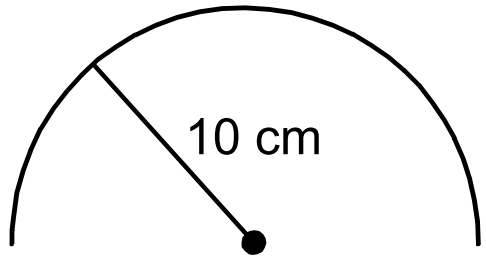
As the semicircular wire forms half of a circular wire,
So, $\overrightarrow{\text{B}}=\frac{1}{2}\frac{\mu_0\text{i}}{2\text{r}}=\frac{1}{2}\times\frac{4\pi\times10^{-7}\times5}{2\times0.1}$
$=15.7\times10^{-6}\text{T}\approx16\times10^{-6}\text{T}=1.6\times10^{-5}\text{T}$ View full question & answer→Question 803 Marks
A straight horizontal wire of mass 10mg and length 1.0m carries a current of 2.0A. What minimum magnetic field B should be applied in the region, so that the magnetic force on the wire may balance its weight?
AnswerMass $=10\text{mg}=10^{-5}\text{kg}$
Lenght $=1\text{m}$
$\text{I}=2\text{A}$
Now, $\text{Mg}=\text{ilB}$
$\Rightarrow\text{B}=\frac{\text{mg}}{\text{il}}=\frac{10^{-5}\times9.8}{2\times1}$
$=4.9\times10^{-5}\text{T}$
View full question & answer→Question 813 Marks
A straight wire carrying a current of 12A is bent into a semi-circular arc of radius 2.0cm as shown. What is the magnetic field at O due to:
- Straight segments.
- The semi-circular arc?
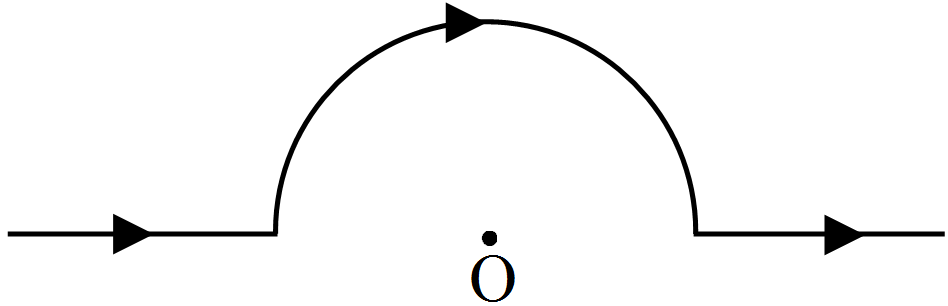
AnswerMagnetic field due to a current carrying element. $\text{d}\vec{\text{B}}=\frac{\mu_0}{4\pi}\frac{\text{I}\vec{\delta\text{l}}\times\text{r}}{\text{r}^3}$
- For straight segment $\text{}\ \theta=0\ \text{or}\ \pi\Rightarrow\vec{\delta\text{l}}\times\vec{\text{r}}=\delta\text{l}\ \text{r}\sin0\ \hat{\text{n}}=0\ \therefore\text{B}_1=0$
- For semicircular arc $\sum\text{dl}=\pi\text{r},\theta=\frac{\pi}{2}$
$\therefore\vec{\text{B}_2}=\frac{\mu_0}{4\pi}\frac{\sum\text{I}\vec{\delta\text{l}}\times\vec{\text{r}}}{\text{r}^3}=\frac{\mu _0}{4\pi}\frac{\text{I}\sum\delta\text{l}\sin\frac{\pi}{2}}{\text{r}^2}\hat{\widehat{n}}$
$=\frac{\mu_0}{4\pi}\frac{\text{I}\pi\text{r}}{\text{r}^2}\widehat{n}=\frac{\mu_0\text{I}}{4\text{r}}, $
directed perpendicular to plane of paper downward. View full question & answer→Question 823 Marks
A long, vertical wire carrying a current of $10A$ in the upward direction is placed in a region where a horizontal magnetic field of magnitude $2·0 \times 10^{-3}T $
exists from south to north. Find the point where the resultant magnetic field is zero.
Answer$\text{i}=10\text{A}.(\hat{\text{K}})$
$\text{B}=2\times10^{-3}\text{T}$ South to North $(\hat{\text{J}})$
To cancel the magnetic field the point should be choosen so that the net magnetic field is along $-\hat{\text{J}}$ direction.
$\therefore$ The point is along $-\hat{\text{i}}$ direction or along west of the wire.
$\text{B}=\frac{\mu_0\text{I}}{2\pi\text{r}}$
$\Rightarrow2\times10^{-3}=\frac{4\pi\times10^{-7}\times10}{2\pi\times\text{r}}$
$\Rightarrow\text{r}=\frac{2\times10^{-7}}{2\times10^{-3}}=10^{-3}\text{m}=1\text{ mm}.$
View full question & answer→Question 833 Marks
The magnetic field due to a long straight wire has been derived in terms of $\mu_0,$ i and d. Express this in terms of $\epsilon_0,$ C, i and d.
AnswerThe magnetic field due to a long, straight wire is given by
$\text{B}=\frac{\mu_0\text{i}}{2\pi\text{d}}$
$\because$ Speed of light, $\text{c}=\frac{1}{\sqrt{\mu_0\epsilon_0}}$
$\Rightarrow\mu_0=\frac{1}{\text{c}^2\epsilon_0}$
$\Rightarrow\text{B}=\frac{\text{i}}{2\pi\text{c}^2\epsilon_0\text{d}}$
(In terms of $\epsilon_0,$ c, i and d)
View full question & answer→Question 843 Marks
What are the advantages of using soft iron as a core, instead of steel, in the coils of galvanometers?
AnswerThe material used as a core in the moving coil galvanometer undergoes cycle of magnetization for long period. Therefore, low hysterisis loss is the first requirement for such material. In soft ron core, area under the hysteresis curve is small thus loss of energy is less as compared to steel. Further, it is easily magnetized by the magnetizing field, which increase the magnetic field and hence sensitivity of galvanometer.
View full question & answer→Question 853 Marks
You are given a low resistance $R_1$ a high resistance $R_2$ and a moving coil galvanometer. Suggest how would you use these to have an instrument that will be able to measure?
- Current.
- Potential difference.
Answer
- To measure current we shall connect low resistance $R_1$ in parallel with the coil of moving coil galvanometer. This arrangement is called ammeter.
- To measure the potential difference we shall connect high resistance $R_2$ in series with the coil of galvanometer. This arrangement is called voltmeter.
View full question & answer→Question 863 Marks
A square coil of edge l and with n turns carries a current i. It is kept on a smooth horizontal plate. A uniform magnetic field B exists parallel to an edge. The total mass of the coil is M. What should be the minimum value of B for which the coil will start tipping over?
Answer
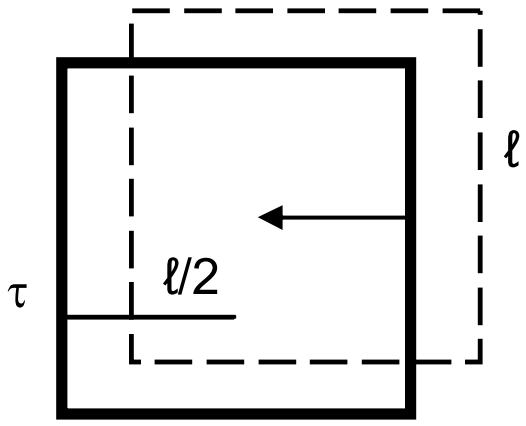
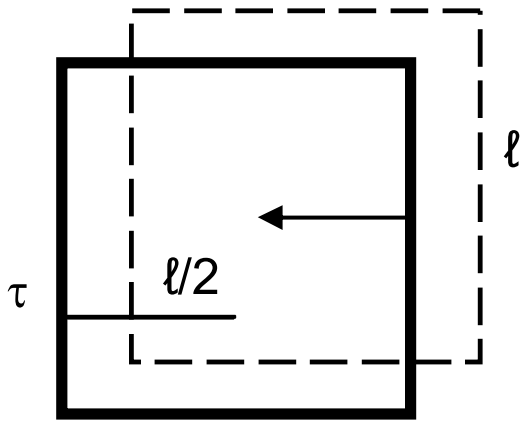 Edge = l
Current = i
Turns= n
mass = M
Magnetic filed = B
Min Torque produced must be able to balance the torque produced due to weight Now, $\tau\text{B}=\tau$ Weight.
$\mu\text{B}=\mu\text{g}\Big(\frac{1}{2}\Big)$
$\Rightarrow\text{n}\times\text{i}\times\text{l}^2\text{B}=\mu\text{g}\Big(\frac{1}{2}\Big)$
$\Rightarrow\text{B}=\frac{\mu}{2\text{nil}}$ View full question & answer→Question 873 Marks
A straight, long wire carries a current of $20A.$ Another wire carrying equal current is placed parallel to it. If the. force acting on a length of $10\ cm$ of the second wire is $2 \times 10^{-5}N,$ what is the separation between them?
Answer
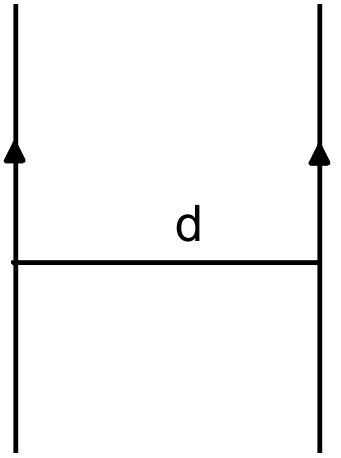 Force acting on $10\ cm$ of wire is $2 \times 10^{-5}N$
$\frac{\text{dF}}{\text{dl}}=\frac{\mu_0\text{i}_1\text{i}_2}{2\pi\text{d}}$
$\Rightarrow\frac{2\times10^{-5}}{10\times10^{-2}}=\frac{\mu_0\times20\times20}{2\pi\text{d}}$
$\Rightarrow\text{d}=\frac{4\pi\times10^{-7}\times20\times20\times10\times10^{-2}}{2\pi\times2\times10^{-5}}$
$=400\times10^{-3}=0.4\text{m}=40\ cm$ View full question & answer→Question 883 Marks
A piece of wire carrying a current of 6.00A is bent in the form of a circular arc of radius 10.0cm, and it subtends an angle of 120° at the centre. Find the magnetic field B due to this piece of wire at the centre.
Answer
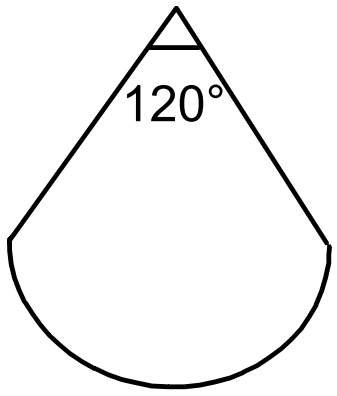 $\text{B}=\frac{\mu_0\text{i}}{2\text{R}}\frac{\theta}{2\pi}=\frac{2\pi}{3\times2\pi}\times\frac{\mu_0\text{i}}{2\text{R}}$
$=\frac{4\pi\times10^{-7}\times6}{6\times10^{-2}}=4\pi\times10^{-6}$
$=4\times3.14\times10^{-6}=12.56\times10^{-6}$
$=1.26\times10^{-5}\text{T}$ View full question & answer→Question 893 Marks
A thin but long, hollow, cylindrical tube of radius r carries a current i along its length. Find the magnitude of the magnetic field at a distance $\frac{\text{r}}{2}$ from the surface (a) inside the tube (b) outside the tube.
Answer
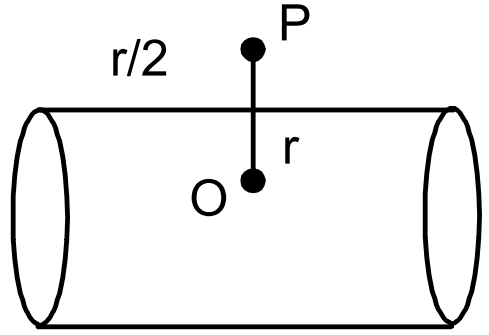
- For inside the tube $\overrightarrow{\text{B}}=0$
As, $\overrightarrow{\text{B}}$ inside the conducting tube = o
- For $\overrightarrow{\text{B}}$ outside the tube
$\text{d}=\frac{3\text{r}}{2}$
$\overrightarrow{\text{B}}=\frac{\mu_0\text{i}}{2\pi\text{d}}=\frac{\mu_0\text{i}\times2}{2\pi3\text{r}}=\frac{\mu_0\text{i}}{2\pi\text{r}}$ View full question & answer→Question 903 Marks
A hypothetical magnetic field existing in a region is given by $\overrightarrow{\text{B}}=\text{B}_0\overrightarrow{\text{e}}_\text{r},$ where $\overrightarrow{\text{e}}_\text{r}$ denotes the unit vector along the radial direction. A circular loop of radius a, carrying a current i, is placed with its plane parallel to the x-y plane and the centre at (0, 0, d). Find the magnitude of the magnetic force acting on the loop.
Answer
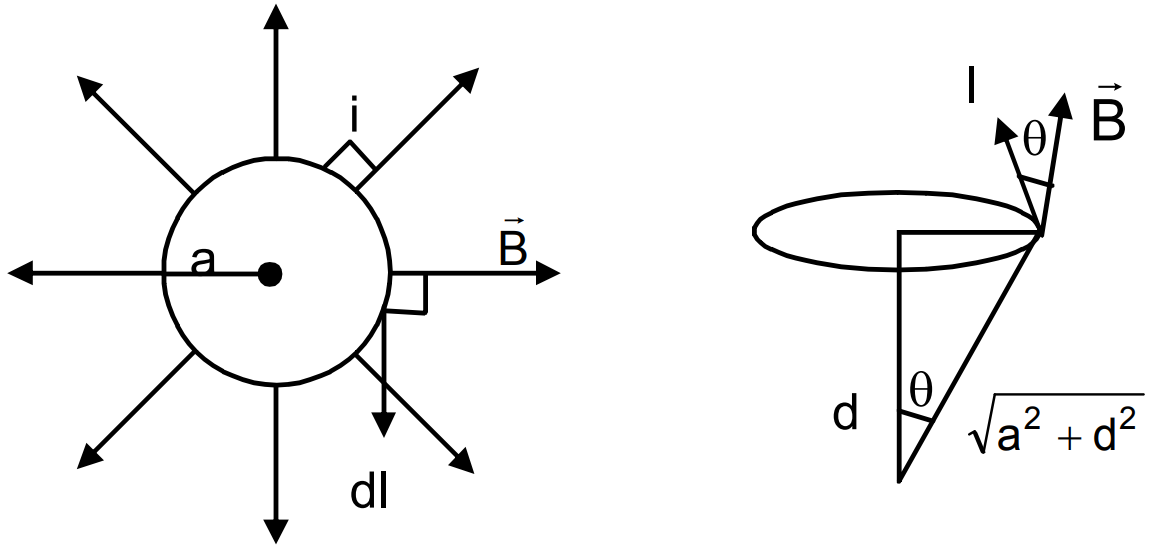 $\overrightarrow{\text{B}}=\text{B}_0\overrightarrow{\text{e}}_\text{r}$
$\overrightarrow{\text{e}}_\text{r}=$ Unit vector along radial direction
$\text{F}=\text{i}(\overrightarrow{\text{l}}\times\overrightarrow{\text{B}})=\text{ilB}\sin\theta$
$=\frac{\text{i}(2\pi\text{a})\text{B}_0\text{a}}{\sqrt{\text{a}^2}+\text{d}^2}=\frac{\text{i}2\pi\text{a}^2\text{B}_0}{\sqrt{\text{a}^2+\text{d}^2}}$ View full question & answer→Question 913 Marks
A metal wire PQ of mass 10g lies at rest on two horizontal metal rails separated by 4.90cm A vertically-downward magnetic field of magnitude 0.800T exists in the space. The resistance of the circuit is slowly decreased and it is found that when the resistance goes below 20.0Ω, the wire PQ starts sliding on the rails. Find the coefficient of friction.
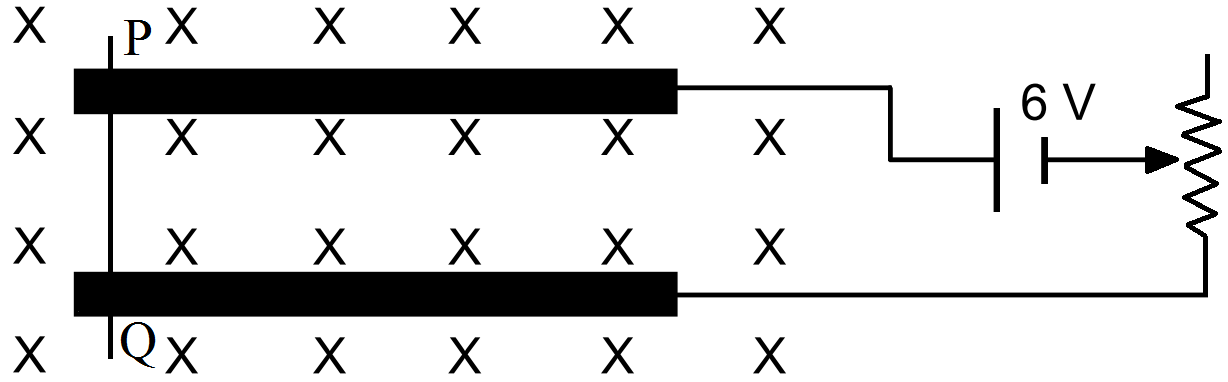
Answer
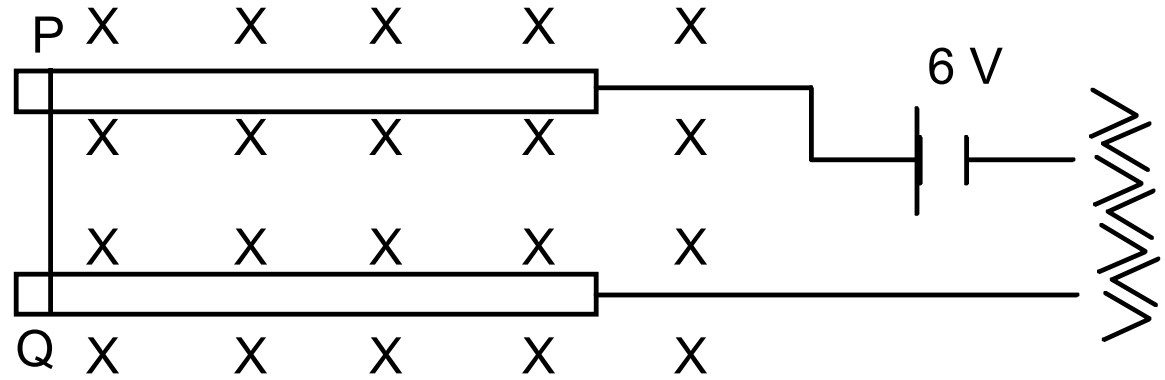 $\mu\text{R}=\text{F}$
$\Rightarrow\mu\times\text{m}\times\text{g}=\text{ilB}$
$\Rightarrow\mu\times10\times10^{-3}\times9.8$
$=\frac{6}{20}\times4.9\times10^{-2}\times0.8$
$\Rightarrow\mu=\frac{0.3\times0.8\times10^{-2}}{2\times10^{-2}}=0.12$ View full question & answer→Question 923 Marks
The shows a circular wire loop of radius a and carrying a current i, which is placed in a perpendicular magnetic field B.
- Consider a small part dl of the wire. Find the force on this part of the wire exerted by the magnetic field.
- Find the force of compression in the wire.
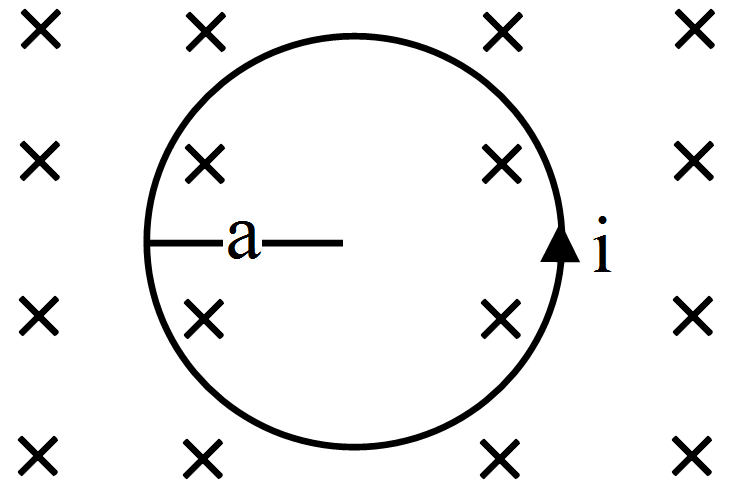
Answer
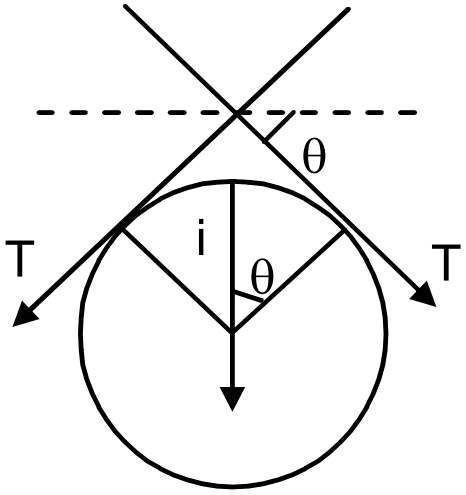
- Fdl = i × dl × B towards centre. (By cross product rule)
- Let the length of subtends an small angle of 20 at the centre.
Here, $2\text{T}\sin\theta=\text{i}\times\text{dl}\times\text{B}$
$\Rightarrow2\text{T}\theta=\text{i}\times\text{a}\times2\theta\times\text{B}$ $[\text{As}\theta\rightarrow0,\ \theta\approx0]$
$\Rightarrow\text{T}=\text{i}\times\text{a}\times\text{B}$
$\text{dl}=\text{a}\times2\theta$
Force of compression on the wire $=\text{i}\text{aB}$ View full question & answer→Question 933 Marks
A current of 5.0A exists in the circuit shown in the figure. The wire PQ has a length of 50cm and the magnetic field in which it is immersed has a magnitude of 0.20T. Find the magnetic force acting on the wire PQ.
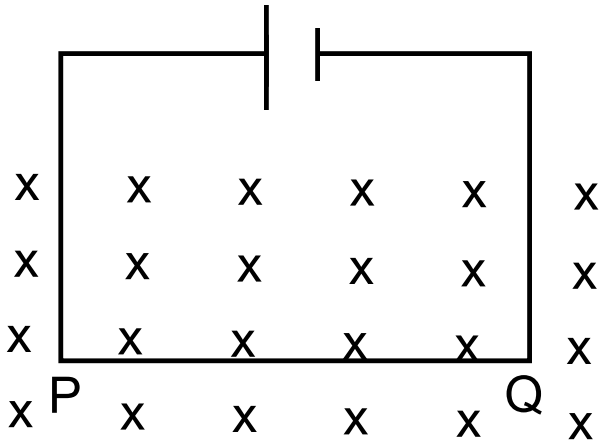
Answer
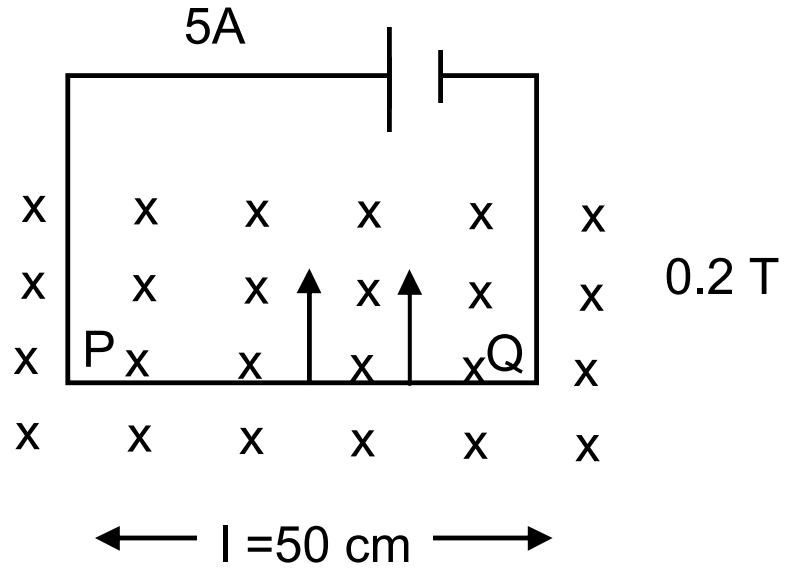 $\text{i}=5\text{A},\ \text{l}=50\text{cm}=0.5\text{m}$
$\text{B}=0.2\text{T},$
$\text{F}=\text{ilB}\sin\theta=\text{ilB}\sin90^\circ$
$=5\times0.5\times0.2$
$=0.05\text{N}$ View full question & answer→Question 943 Marks
A long, straight wire of radius r carries a current i and is placed horizontally in a uniform magnetic field B pointing vertically upward. The current is uniformly distributed over its cross-section.
- At what points will the resultant magnetic field have maximum magnitude? What will be the maximum magnitude?
- What will be the minimum magnitude of the resultant magnetic field?
Answer
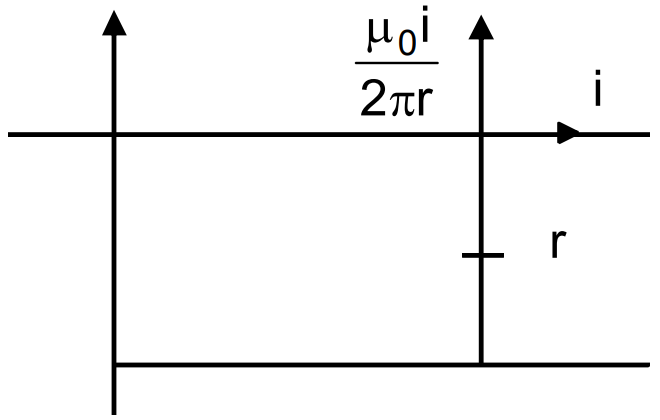
- The maximum magnetic field is $\text{B}+\frac{\mu_0\text{I}}{2\pi\text{r}}$ which are along the left keeping the sense along the direction of traveling current.
- The minimum $\text{B}-\frac{\mu_0\text{I}}{2\pi\text{r}}$
If $\text{r}=\frac{\mu_0\text{I}}{2\pi\text{B}}\ \text{B}\ \text{net}=0$
$\text{r}<\frac{\mu_0\text{I}}{2\pi\text{B}}\ \text{B}\ \text{net}=0$
$\text{r}>\frac{\mu_0\text{I}}{2\pi\text{B}}\ \text{B}\ \text{net}=\text{B}-\frac{\mu_0\text{I}}{2\pi\text{r}}$ View full question & answer→Question 953 Marks
Answer the following questions.
- Draw the magnetic field lines due to two straight, long, parallel conductors carrying currents $I_1$ and $I_2$ in the same direction. Write an expression for the force acting per unit length on one conductor due to other. Is this force attractive or repulsive?
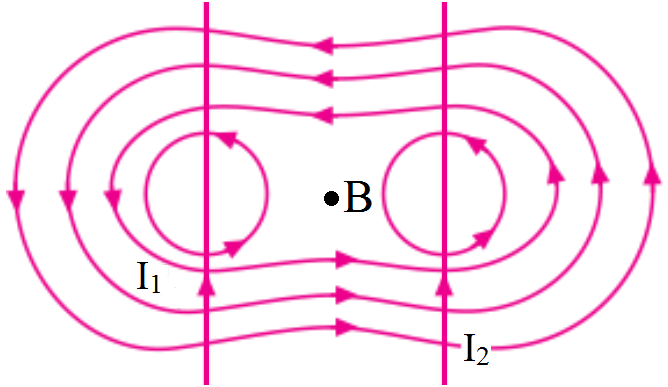
- Figure shows a rectangular current$-$carrying loop placed $2\ cm$ away from a long, straight, current$-$carrying conductor. What is the direction and magnitude of the net force acting on the loop?
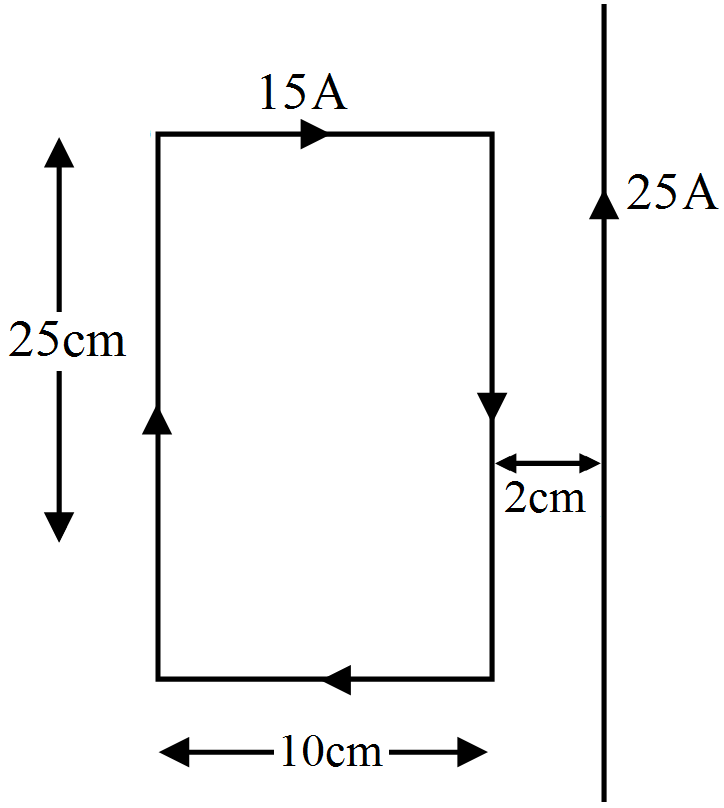
Answer
- The magnetic field lies due to two current carrying parallel wires are shown in figure. The force between parallel wires $\frac{\text{F}}{\text{l}}=\frac{\mu_0\text{I}_1\text{I}_2}{2\pi\text{r}}\text{N}/\text {m}$.
- We know that parallel currents attract and opposite currents repel and $\text{F}\propto\frac{1}{\text{r}}$. As wire of loop carrying opposite current is nearer,
- so the net force acting on the loop is repulsive.
View full question & answer→Question 963 Marks
A particle of mass ‘m’, with charge ‘q’ moving with a uniform speed ‘v’, normal to a uniform magnetic field ‘B’, describes a circular path of radius ‘r’. Derive expressions for the:
- Time period of revolution.
- Kinetic energy of the particle.
Answer
- Motion of charged particle in perpendicular magnetic field:The magnetic force on charged particle $\text{qvB}\sin90^\circ$ provides the necessary centripetal force for a circular path, so
$\text{qvB}=\frac{\text{mv}^2}{\text{r}}\Rightarrow\upsilon=\frac{\text{qBr}}{\text{m}}$
But $\upsilon=\frac{2\pi\text{r}}{\text{T}}$ where T is time period
$\frac{2\pi\text{r}}{\text{T}}=\frac{\text{qBr}}{\text{m}}\Rightarrow\text{T}=\frac{2\pi\text{r}}{\text{qB}}$
- Kinetic energy of charged paricle:
$\text{KE}=\frac{1}{2}\text{mv}^2\ \ \ \ \ \ \ \Rightarrow\ \ \ \ \ \ \ \frac{1}{2}\text{m}\frac{\text{q}^2\text{B}^2\text{r}^2}{\text{m}^2}=\frac{\text{q}^2\text{B}^2\text{r}^2}{2\text{m}}$ View full question & answer→Question 973 Marks
A charge of $3.14 \times 10^{-6}C$ is distributed uniformly over a circular ring of radius $20.0\ cm.$ The ring rotates about its axis with an angular velocity of $60.0 rad/s.$ Find the ratio of the electric field to the magnetic field at a point on the axis at a distance of $5.00\ cm$ from the centre.
Answer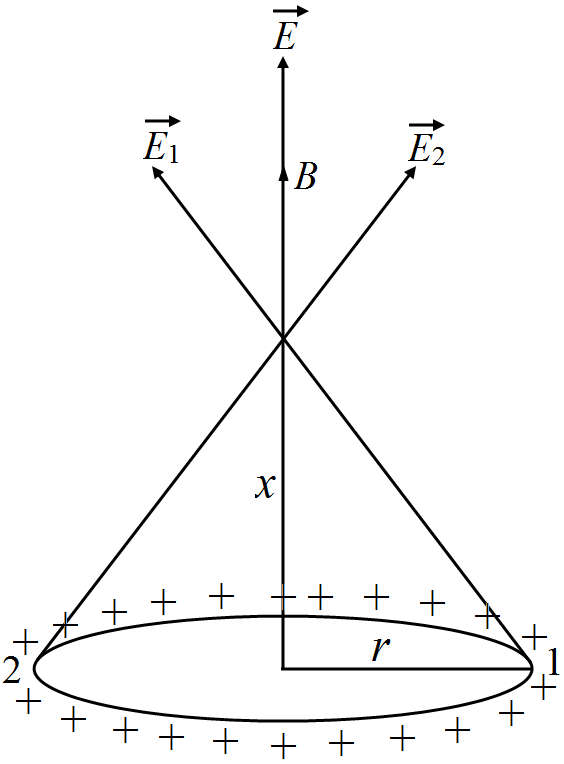
Given:
Magnitude of charges, $q = 3.14 \times 10^{−6}C$
Radius of the ring, $r = 20\ cm = 20 \times 10^{-2}mr = 20\ cm = 20 \times 10^{-2}m$
Angular velocity of the ring, $\omega=60\ \text{rad/s}$
Time for $1$ revolution $=\frac{2\pi}{60}$
$\therefore$Current $\ \text{i}=\frac{\text{q}}{\text{t}}=\frac{3.14\times10^{-6}\times60}{2\pi}$
$=30\times10^{-6}\text{A}$
In the figure,$ E_1$ and $E_2$ denotes the electric field at a point on the axis at a distance of $5.00 \ cm$ from the centre due to small element $1$ and $2$ of the ring respectively.
$E$ is the resultant electric field due to the entire ring at a point on the axis at a distance of $5.00 \ cm$ from the centre.
The electric field at a point on the axis at a distance $x$ from the centre is given by
$\text{E}=\frac{\text{xq}}{4\pi\epsilon_0(\text{x}^2+\text{r}^2)^\frac{3}{2}}$
The magnetic field at a point on the axis at a distance $x$ from the centre is given by
$\text{B}=\frac{\mu_0}{2}\frac{\text{ir}^2}{(\text{x}^2+\text{r}^2)^\frac{3}{2}}$
$\frac{\text{E}}{\text{B}}=\frac{\frac{\text{xq}}{4\pi\epsilon_0(\text{x}^2+\text{r}^2)^\frac{3}{2}}}{\frac{\mu_0}{2}\frac{\text{ir}^2}{(\text{x}^2+\text{r}^2)^\frac{3}{2}}}$
$=\frac{9\times10^9\times3.14\times10^{-6}\times2\times(20.6)^3\times10^{-6}}{25\times10^{-4}\times4\pi\times12}$
$=\frac{9\times3.14\times2\times(20.6)^3}{25\times4\pi\times12}$
$=1.88\times10^{15}\text{m/s}$ View full question & answer→Question 983 Marks
A magnetic field of strength 1.0T is produced by a strong electromagnet in a cylindrical region of radius 4.0cm, as shown in the figure. A wire, carrying a current of 2.0A, is placed perpendicular to and intersecting the axis of the cylindrical region. Find the magnitude of the force acting on the wire.
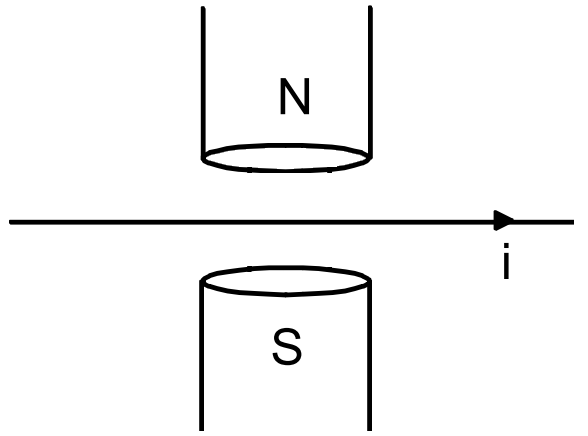
Answer
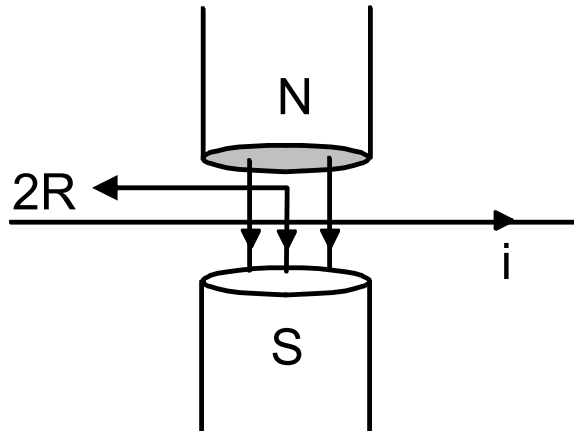 $\text{F}=\text{ilB}\sin\theta$
$=\text{ilB}\sin90^\circ$
$=\text{i}\ 2\text{RB}$
$=2\times(8\times10^{-2})\times1$
$=16\times10^{-2}$
$=0.16\text{N}.$ View full question & answer→Question 993 Marks
A circular loop of radius r carrying a current i is held at the centre of another circular loop of radius R(>> r) carrying a current I. The plane of the smaller loop makes an angle of 30° with that of the larger loop. If the smaller loop is held fixed in this position by applying a single force at a point on its periphery, what would be the minimum magnitude of this force?
Answer
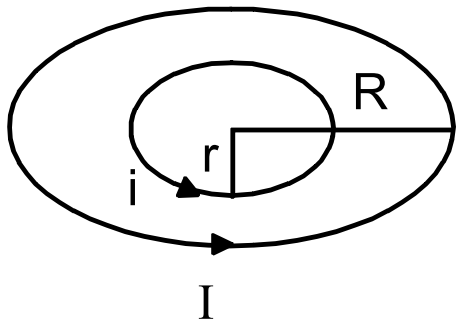 The force acting on the smaller loop
$\text{F}=\text{ilB}\sin\theta$
$=\frac{\text{i}2\pi\text{r}\mu_0\text{I}1}{2\text{R}\times2}=\frac{\mu_0\text{iI}\pi\text{r}}{2\text{R}}$ View full question & answer→Question 1003 Marks
A circular loop of radius a, carrying a current i, is placed in a two-dimensional magnetic field. The centre of the loop coincides with the centre of the field The strength of the magnetic field at the periphery of the loop is B. Find the magnetic force on the wire.
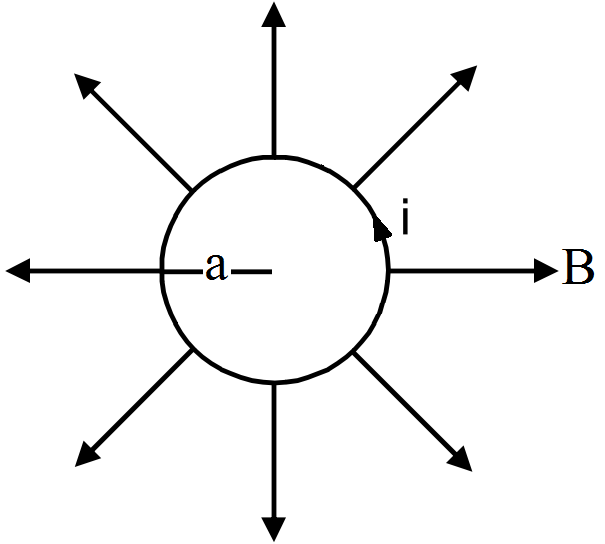
Answer
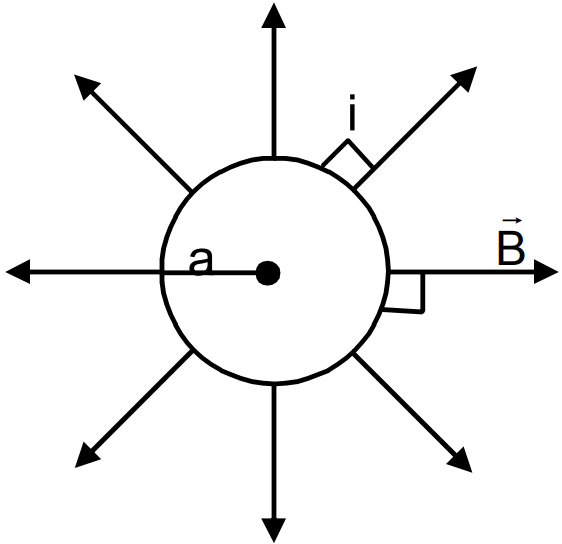 $\text{l}=2\pi\text{a}$
Magnetic field $=\overrightarrow{\text{B}}$ radially outwards
Current ⇒ 'i'
$\text{F}=\text{i l}\times\text{B}$
$=\text{i}\times(2\pi\text{a}\times\overrightarrow{\text{B}})$
$=2\pi\text{ai B}$ perpendicular to the plane of the figure going inside. View full question & answer→Question 1013 Marks
The. wire ABC shown in figure forms an equilateral triangle. Find the magnetic field B at the centre O of the triangle assuming the wire to be uniform.
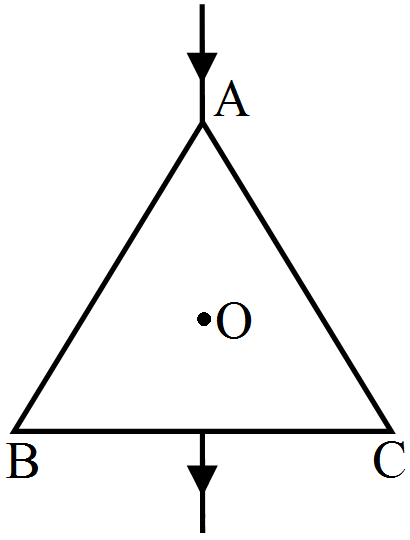
Answer
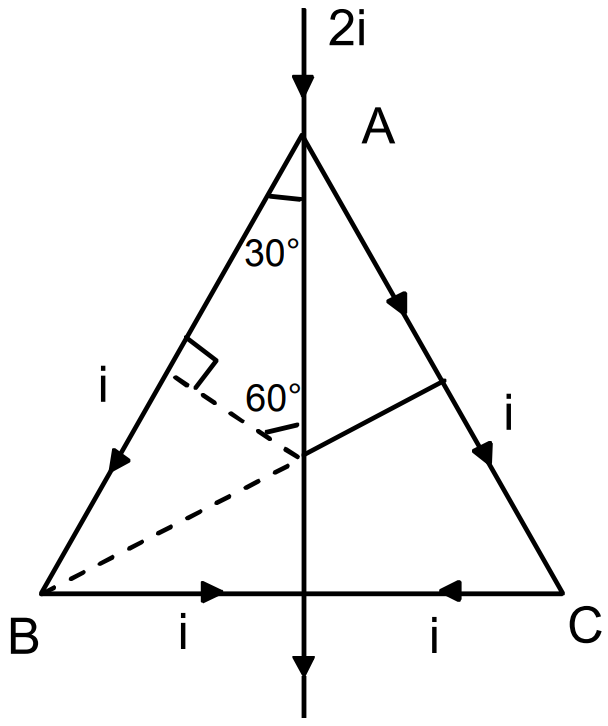 For AB B is along $\odot\ \text{B}=\frac{\mu_0\text{i}}{4\pi\text{r}}(\sin60^\circ+\sin60^\circ)$
For AC B $\otimes\ \text{B}=\frac{\mu_0\text{i}}{4\pi\text{r}}(\sin60^\circ+\sin60^\circ)$
For BD B $\odot\ \text{B}=\frac{\mu_0\text{i}}{4\pi\text{r}}(\sin60^\circ)$
For DC $\otimes\ \text{B}=\frac{\mu_0\text{i}}{4\pi\text{r}}(\sin60^\circ)$
$\therefore\ \text{Net}\ \text{B}=0$ View full question & answer→Question 1023 Marks
Figure shows a part of an electric circuit. The wires $AB, CD$ and $EF$ are long and have identical resistances. The separation between the neighbouring wires is $1.0\ cm.$ The wires $AE$ and $BF$ have negligible resistance and the ammeter reads $30A.$ Calculate the magnetic force per unit length of $AB$ and $CD.$
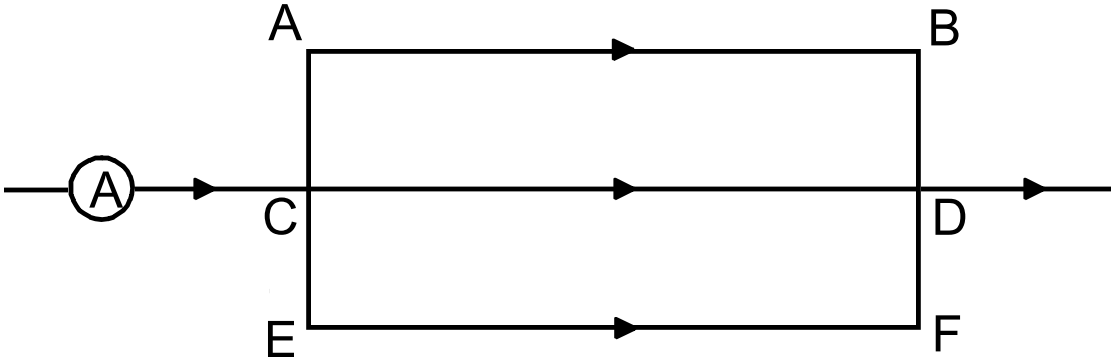
Answer
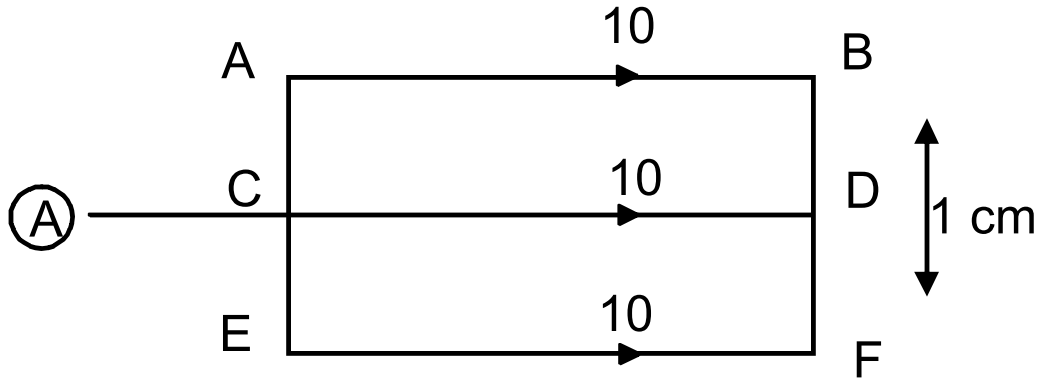 $\text{F}_\text{AB} =\text{F}_\text{CD} +\text{F}_\text{EF}$
$=\frac{\mu_0\times10\times10}{2\pi\times10\times10}+\frac{\mu_0\times10\times10}{2\pi\times2\times10^{-2}}$
$=2\times10^{-3}+10^{-3}=3\times10^{-3}$ downward
$\text{F}_\text{CD} =\text{F}_\text{AB} +\text{F}_\text{EF}$
As $F_{AB}\ \&\ F_{EF}$ are equal and oppositely directed hence $F = 0.$ View full question & answer→Question 1033 Marks
Two parallel wires carry equal currents of 10A along the same direction and are separated by a distance of 2.0cm. Find the magnetic field at a point which is 2.0cm away from each of these wires
Answer
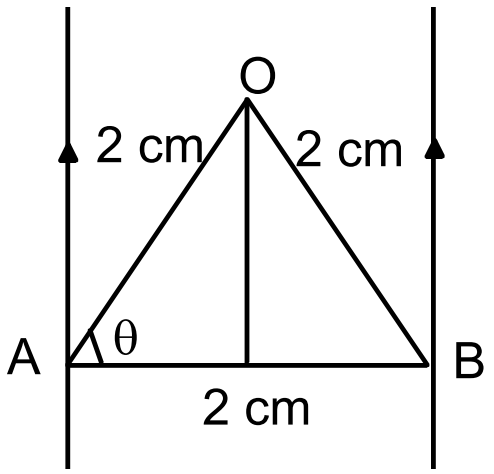 $\cos\theta=\frac{1}{2},$
$\theta=60^\circ\ \&\ \angle\text{AOB}=60^\circ$
$\text{B}=\frac{\mu_0\text{I}}{2\pi\text{r}}=\frac{10^{-7}\times2\times10}{2\times10^{-2}}=10^{-4}\text{T}$
So net is $[(10^{-4})^2]+(10^{-4})^2+2(10^{-8})\cos60^\circ]^\frac{1}{2}$
$=10^{-4}\Big[1+1+2\times\frac{1}{2}\Big]^\frac{1}{2}$
$=10^{-4}\times\sqrt3\text{T}$
$=1.732\times10^{-4}\text{T}$ View full question & answer→Question 1043 Marks
A straight wire of length l can slide on two parallel plastic rails kept in a horizontal plane with a separation d. The coefficient of friction between the wire and the rails is $\mu.$ If the wire carries a current i, what minimum magnetic field should exist in the space in order to slide the wire on the rails?
Answer
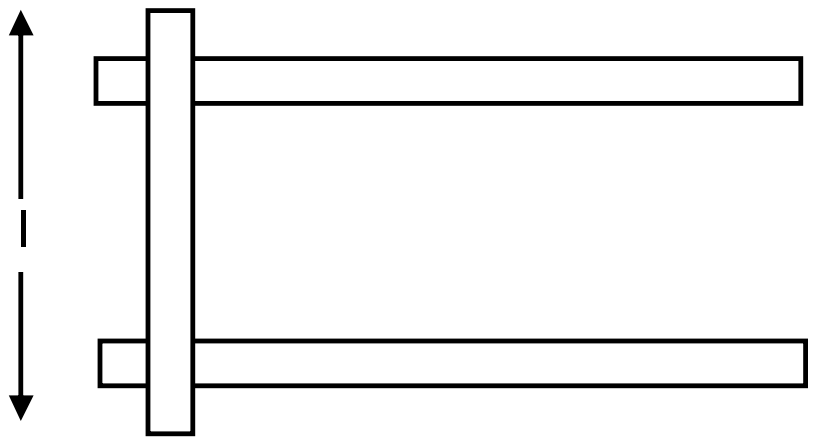 Mass = m
length = l
Current = i
Magnetic field = B = ?
$\text{iBl}=\mu\text{mg}$
$\Rightarrow\text{B}=\frac{\mu\text{gm}}{\text{il}}$ View full question & answer→Question 1053 Marks
Prove that the force acting on a current-carrying wire, joining two fixed points a and b in a uniform magnetic field, is independent of the shape of the wire.
Answer
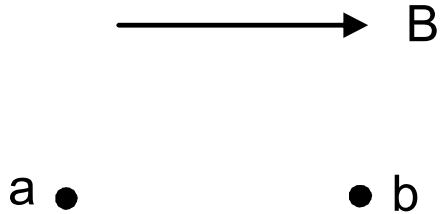 For force on a current carrying wire in an uniform magnetic field
We need, l → length of wire
i → Current
B → Magnitude of magnetic field
Since $\overrightarrow{\text{F}}=\text{i}\ell\text{B}$
Now, since the length of the wire is fixed from A to B, so force is independent of the shape of the wire. View full question & answer→Question 1063 Marks
A circular loop of radius r carries a current i. How should a long, straight wire carrying a current 4i be placed in the plane of the circle so that the magnetic field at the centre becomes zero?
Answer
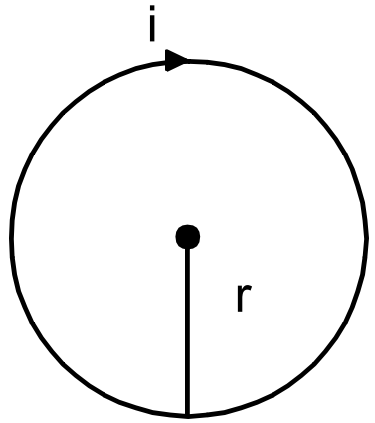 $\overrightarrow{\text{B}}$ due to loop $\frac{\mu_0\text{i}}{2\text{r}}$
Let the straight current carrying wire be kept at a distance R from centre. Given I = 4i
$\overrightarrow{\text{B}}$ due to wire $\frac{\mu_0\text{i}}{2\pi\text{R}}=\frac{\mu_0\times4\text{i}}{2\pi\text{R}}$
Now, the $\overrightarrow{\text{B}}$ due to both will balance each other
Hence $\frac{\mu_0\text{i}}{2\text{r}}=\frac{\mu_04\text{i}}{2\pi\text{R}}\Rightarrow\text{R}=\frac{4\text{r}}{\pi}$
Hence the straight wire should be kept at a distance $\frac{4\pi}{\text{r}}$ from centre in such a way that the direction of current in it is opposite to that in the nearest part of circular wire. As a result the direction will $\overrightarrow{\text{B}}$ will be oppose. View full question & answer→Question 1073 Marks
A rectangular wire loop of width a is suspended from the insulated pan of a spring balance, as shown in A current i exists in the anti-clockwise direction in the loop. A magnetic field Bexists in the lower region. Find the change in the tension of the spring if the current in the loop is reversed.
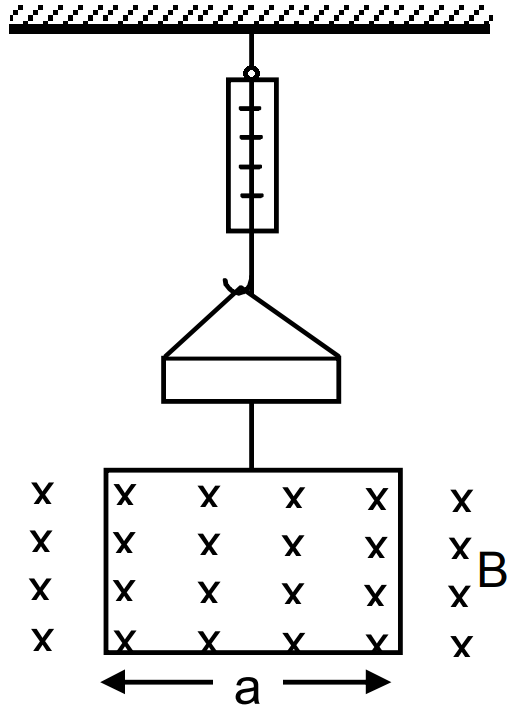
Answer
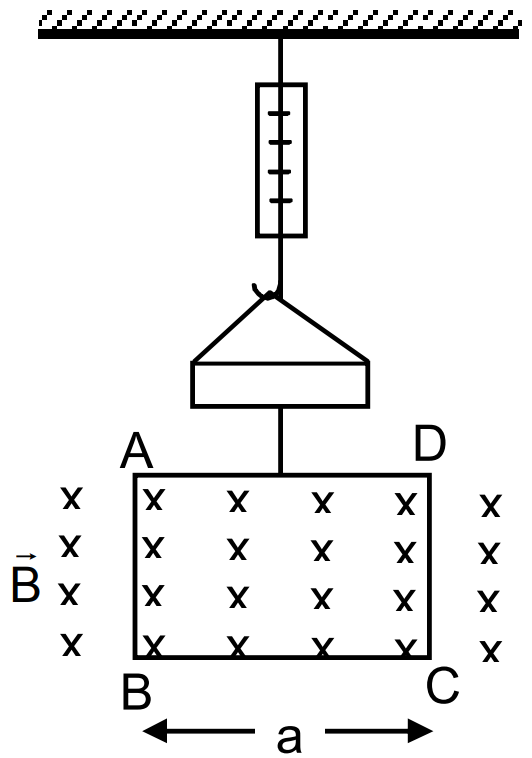 Current anticlockwise
Since the horizontal Forces have no effect.
Let us check the forces for current along AD & BC [Since there is no $\overrightarrow{\text{B}}$ ]
In AD, F = 0
For BC
F = iaB upward
Current clockwise
Similarly, F = - iaB downwards
Hence change in force = change in tension
= iaB - (-iaB) = 2 iaB View full question & answer→Question 1083 Marks
An $\alpha$-particle and a proton moving with the same speed enter the same magnetic field region at right angles to the direction of the field. Show the trajectories followed by the two particles in the region of the magnetic field. Find the ratio of the radii of the circular paths which the two particles may describe.
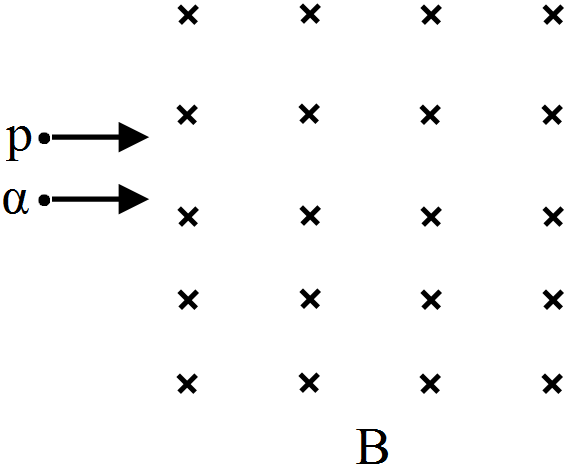
AnswerRadius of charged particle in magnetic field.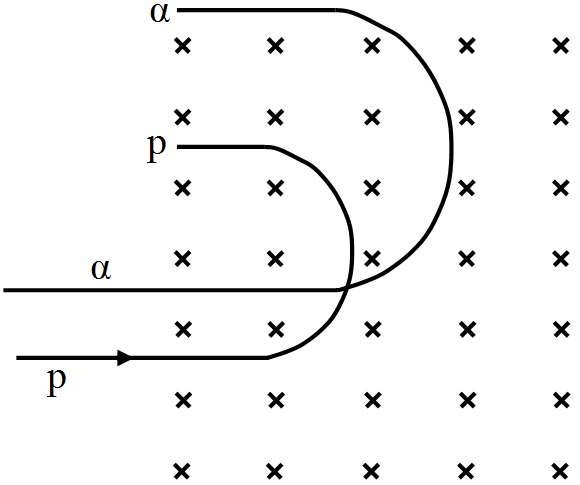
$\text{r}=\frac{\text{mv}}{\text{qB}}$
$\text{r}\propto\frac{\text{m}}{q}$ for same $\upsilon$ and B.
$\frac{\text{r}_\text{p}}{\text{r}_\alpha}=\frac{(\text{m/q})_\text{p}}{(\text{m/q})_\alpha}$
$=\frac{(\text{m}_p/e)}{((4\text{m}_\text{p})/2\text{e})}=\frac{1}{2}$ View full question & answer→Question 1093 Marks
A charged particle enters into a uniform magnetic field and experiences an upward force as indicated in the figure. What is the charge sign on the particle?
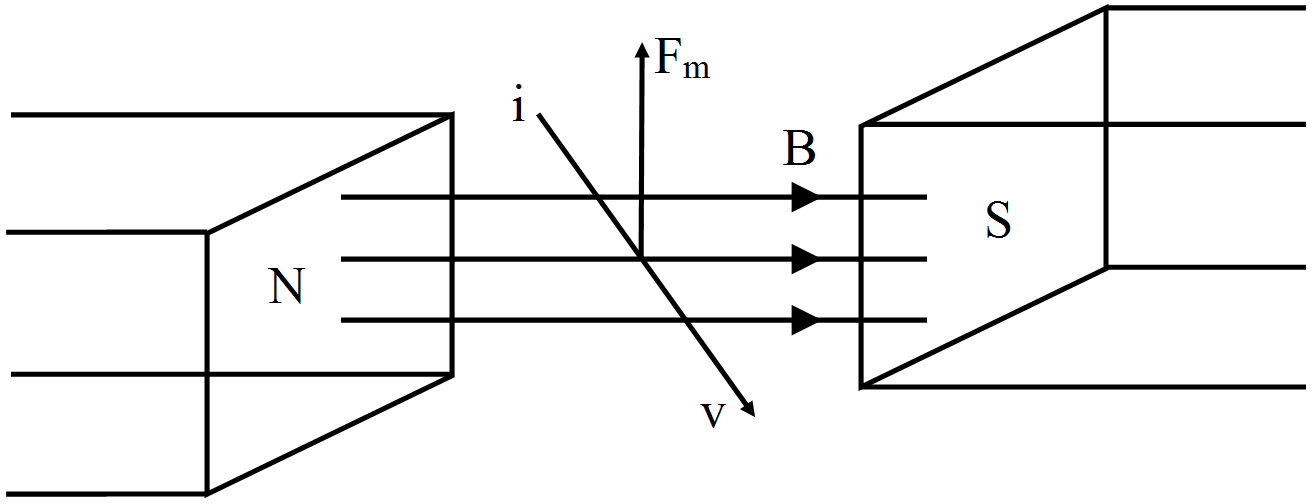
AnswerPositive Charge: By Fleming left hand rule the direction of current is along positive Z-axis. By vector method $\vec{\text{F}_\text{m}}=\text{q}\vec{\upsilon}\times\vec{\text{B}}$ $\text{F}_\text{m}\hat{\text{j}}=\text{q}\upsilon\hat{\text{k}}\times\text{B}\hat{\text{i}}$ $\text{F}_\text{m}\hat{\text{j}}=\text{q}{\text{v}}\text{B}\hat{\text{j}}$ This shows that q is positive.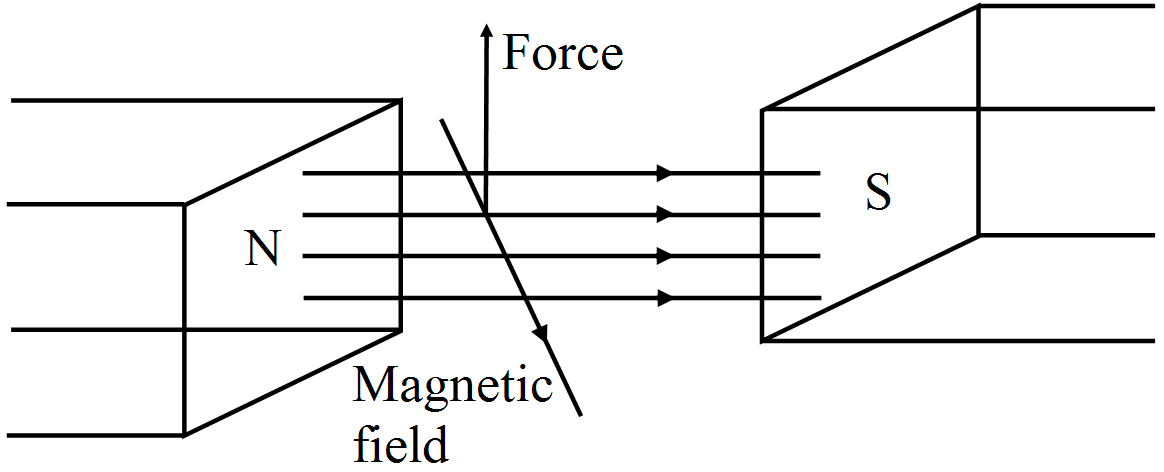
View full question & answer→Question 1103 Marks
An ammeter and a milliammeter are converted from the same galvanometer. Out of the two, which current measuring instrument has a higher resistance?
AnswerShunt resistance $\text{S}=\frac{\text{I}_\text{g}}{\text{I-I}_\text{g}}\text{G}\approx\frac{\text{I}_\text{g}}{\text{I}}\text{G}$
Clearly, smaller the value of range, larger is the shunt resistance.
Obviously, milliammeter will have a larger shunt resistance and
hence it will have a higher resistance.
$\frac{1}{\text{R}_\text {A}}=\frac{1}{\text{G}}+\frac{1}{\text{S}}$
Higher the $S,$ higher the $R_A$ for given $G.$
View full question & answer→Question 1113 Marks
A current loop of arbitrary shape lies in a uniform magnetic field $B.$ Show that the net magnetic force acting on the loop is zero.
Answer
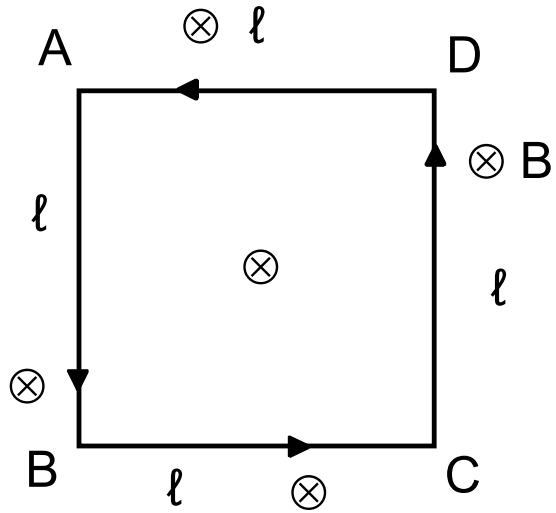
$F_1 =$ Force on $\text{AD}=\text{i}\ell\text{B}$ inwards
$F_2 =$ Force on $\text{BC}=\text{i}\ell\text{B}$ inwards
They cancel each other
$F_3 =$ Force on $\text{CD}=\text{i}\ell\text{B}$ inwards
$F_4 =$ Force on $\text{AB}=\text{i}\ell\text{B}$ inwards
They also cancel each other.
So the net force on the body is $0.$ View full question & answer→Question 1123 Marks
Write the expression for the force on a charge moving in a magnetic field.Use this expression to define the SI unit of magnetic field.
AnswerForce on a charge (q) moving in a magnetic field B with velocity $\vec{\text{v}}$ making an angle $\theta$ (with the direction of magnetic field $(\vec{\text{B}})$ is given by,$\text{F}_\text{m}=\text{qvB}\sin\theta$
when $\theta=90^\circ\Rightarrow\sin\theta=1,$so
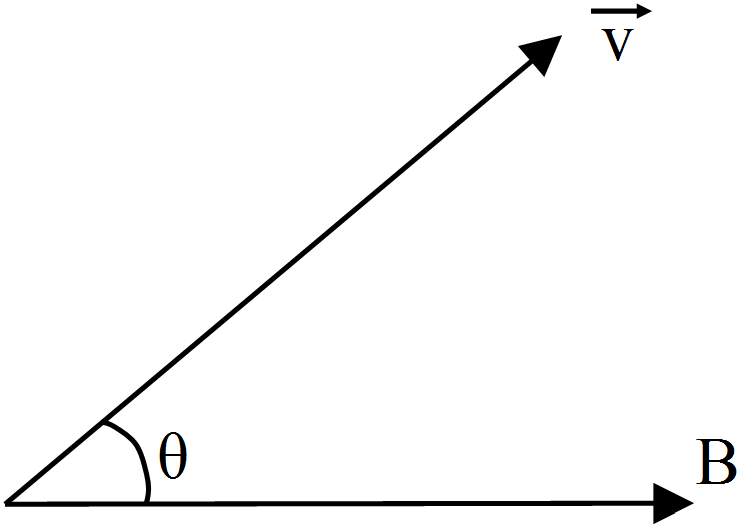
$\text{F}_\text{m}=\text{qvB}$
$\text{or}\ \text{B}=\frac{\text{F}_\text{m}}{\text{q}^\text {v}}$
$\text{If}\ \text{v}=1\ \text{m/s},\text{B}=\frac{\text{F}_\text{m}}{\text{q}}\ \text{newton/ coulomb}$
SI unit of magnetic field is telsa.
Thus, 1 tesla is the magnetic field in which a charged particle moving with velocity 1m/ s perpendicular to velocity experiences a force of 1 newton/ coulomb. View full question & answer→