Question
Define the current sensitivity of a galvanometer. Write its $SI$ unit.
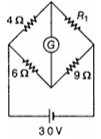
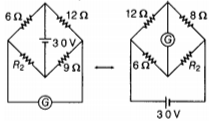
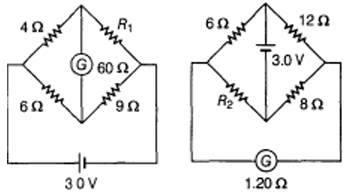
Figure shows two circuits each having a galvanometer and a battery of $3 V$ .
When the galvanometer in each arrangement do not show any deflection, obtain the ratio $R_1 / R_2$.
Image

Answer

Current sensitivity of a galvanometer is defined as the deflection produced in the galvanometer when a unit current flows through it.
The $SI$ unit of current sensitivity is rad. $A ^{-1}$. Current sensitivity is expressed as $\frac{\theta}{I}=\frac{N A B}{K}$ where $N , A , B$ and $K$ are number of turns, cross $-$ sectional area, magnetic field intensity and galvanometer's constant respectively.
Image
For balanced Wheatstone bridge, there will be no deflection in the galvanometer.
$\therefore \frac{4}{R_1}=\frac{6}{9}$
$\Rightarrow R_1=\frac{4 \times 9}{6}=6 \Omega$
Image
For the equivalent circuit. when the Wheatstone bridge is balanced, there will be no deflection in the galvanometer.
$\therefore \frac{12}{8}=\frac{6}{R_2}$
$\Rightarrow R_2=\frac{6 \times 8}{12}=4 \Omega$
$\therefore \frac{R_1}{R_2}=\frac{6}{4}=\frac{3}{2}$

Need a full question paper?

Generate a complete, print-ready paper with questions like this in minutes — across 16+ boards, with answer keys.

Start Generating Free

Similar questions

Name the parts of the electromagnetic spectrum which is:
  1. Suitable for radar systems used in aircraft navigation.
  2. Used to treat muscular strain.
  3. Used as a diagnostic tool in medicine.
Write in brief, how these waves can be produced.
A straight wire of length l can slide on two parallel plastic rails kept in a horizontal plane with a separation d. The coefficient of friction between the wire and the rails is $\mu.$ If the wire carries a current i, what minimum magnetic field should exist in the space in order to slide the wire on the rails?
A difference of $2.3\ eV$ separates two energy levels in an atom. What is the frequency of radiation emitted when the atom make a transition from the upper level to the lower level?
Find the radius and energy of a $He^+$ ion in the states $(a) n = 1, (b) n = 4$ and $(c) n = 10.$
The neutron separation energy is defined as the energy required to remove a neutron from the nucleus. Obtain the neutron separation energies of the nuclei ${ }_{20}^{41} Ca$ and ${ }_{13}^{27} Al$ from the following data:
$ m \left({ }_{20}^{40} C a\right)=39.962591 u$
$m \left({ }_{20}^{41} C a\right)=40.962278 u$
$m \left({ }_{13}^{26} A l\right)=25.986895 u$
$m \left({ }_{13}^{27} A l\right)=26.981541 u $
What is the basic difference between the atom and molecule of a diamagnetic and a paramagnetic material? Why are elements with even atomic number more likely to be diamagnetic?
Using photon picture of light, show how Einstein’s photoelectric equation can be established. Write two features of photoelectric effect which cannot be explained by wave theory.
The nucleus $^{235}_{92}\text{Y},$ initially at rest, decays into $^{231}_{90}\text{X}$ by emitting an $\alpha-$particle
$^{235}_{92}\text{Y}\xrightarrow{ \ \ \ \ \ \ \ \ } \ ^{231}_{90}\text{X}+ \ ^4_2\text{He}+\text{energy}.$
The binding energies per nucleon of the parent nucleus, the daughter nucleus and $\alpha-$particle are $7.8\ MeV, 7.835\ MeV$ and $7.07\ MeV,$ respectively. Assuming the daughter nucleus to be formed in the unexcited state and neglecting its share in the energy of the reaction, find the speed of the emitted $\alpha-$particle. $($Mass of $\alpha-$ particle $= 6.68 \times 10^{–27}kg).$
If a charge is placed at rest in an electric field, will its path be along a line of force? Discuss the situation when the lines of force are straight and when they are curved.
The following table shows some measurements of the decay rate of a radionuclide sample. Find the disintegration constant.
Time (min) lnR (Bq)
36 5.08
100 3.29
164 1.54
218 0