Questions

3 Marks Question

Take a timed test

8 questions · self-marked practice — reveal the answer and mark yourself.

Question 13 Marks
Using Bohr's postulates, obtain the expression for the total energy of the electron in the stationary states of the hydrogen atom. Hence draw the energy level diagram showing how the line spectra corresponding to Balmer series occur due to transition between energy levels.
Answer
Suppose m be the mass of an electron and $v$ be its speed in nth orbit of radius $r$.
The centripetal force for revolution is produced by electrostatic attraction between electron and nucleus.
or,
$\frac{m v^2}{r}=\frac{1}{4 \pi \varepsilon_0} \frac{(Z e)(e)}{r^2} \ldots(i)$
$m v^2=\frac{1}{4 \pi \varepsilon_0} \frac{Z e^2}{r}$
So, Kinetic energy $[K]=\frac{1}{2} m v^2$
$K=\frac{1}{4 \pi \varepsilon_0} \frac{Z e ^2}{2 r}$
Potential energy $=\frac{1}{4 \pi \varepsilon_0} \frac{(Z e)(-e)}{r}$
$=-\frac{1}{4 \pi \varepsilon_0} \frac{Z e^2}{r}$
total energy
$ E = KE + PE =\frac{1}{4 \pi \epsilon_0} \frac{Z e ^2}{2 r}+\left(-\frac{1}{4 \pi \varepsilon_0} \frac{Z e ^2}{r}\right)$
$E =-\frac{1}{4 \pi \varepsilon_0} \frac{Z e ^2}{2 r}$
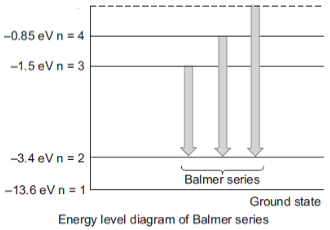
Image ​​​​​​​
View full question & answer
Question 23 Marks
Define the current sensitivity of a galvanometer. Write its $SI$ unit.
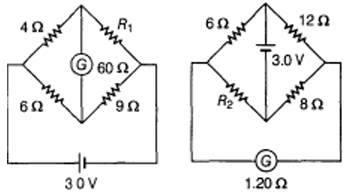
Figure shows two circuits each having a galvanometer and a battery of $3 V$ .
When the galvanometer in each arrangement do not show any deflection, obtain the ratio $R_1 / R_2$.
Image
Answer
Current sensitivity of a galvanometer is defined as the deflection produced in the galvanometer when a unit current flows through it.
The $SI$ unit of current sensitivity is rad. $A ^{-1}$. Current sensitivity is expressed as $\frac{\theta}{I}=\frac{N A B}{K}$ where $N , A , B$ and $K$ are number of turns, cross $-$ sectional area, magnetic field intensity and galvanometer's constant respectively.
Image
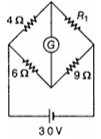
For balanced Wheatstone bridge, there will be no deflection in the galvanometer.
$\therefore \frac{4}{R_1}=\frac{6}{9}$
$\Rightarrow R_1=\frac{4 \times 9}{6}=6 \Omega$
Image
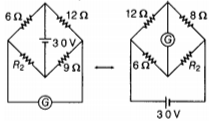
For the equivalent circuit. when the Wheatstone bridge is balanced, there will be no deflection in the galvanometer.
$\therefore \frac{12}{8}=\frac{6}{R_2}$
$\Rightarrow R_2=\frac{6 \times 8}{12}=4 \Omega$
$\therefore \frac{R_1}{R_2}=\frac{6}{4}=\frac{3}{2}$
View full question & answer
Question 33 Marks
How is the mutual inductance of a pair of coils affected when:
i. separation between the coils is increased?
ii. the number of turns of each coil is increased?
iii. A thin iron sheet is placed between the two coils, other factors remaining the same?
Answer
i. Mutual inductance (M) decreases because the quantity of flux linking to a coil due to the other one will decrease.
ii. M increases because as the number of turns increase, the overall flux density also increases and hence the mutual inductance will also increase.
iii. M increases because iron is ferromagnetic in nature hence, it will increase the flux density.
View full question & answer
Question 43 Marks
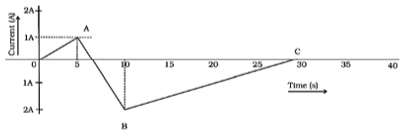
$A ($current vs time$)$ graph of the current passing through a solenoid is shown in Figure. For which time is the back electromotive force $(u)$ a maximum. If the back emf at $t = 3s$ is $e,$ find the back emf at $t = 7 s, 15s,$ and $40s. OA, AB,$ and $BC$ are straight line segments.
Image
Answer
The maximum back electromotive force $(u)$ will be maximum when there is a maximum rate of change of magnetic flux which is directly proportional to the rate of change of current.
Maximum change or rate of current will be where $(t - I)$ graph for the solenoid makes a maximum angle with time axis which is in part $AB$
So the maximum back $\text{e.m.f}$. will occur between $5 s$ to $10 s$. As the back $\text{e.m.f.}$ at $t = 3 s$ it is e $($given$)$
Rate of change of current at $t =3 s-$ slope of $OA$ graph with time axis
So the rate of change of current at $3 s=\frac{1}{5} A / s$
So back electromotive force at $t =3 s=L \times \frac{1}{5}=\frac{L}{5}=e \ ($given$)$
$\because e=L \cdot \frac{d I}{d t}$ and $L =$ constant for the solenoid.
Similarly back $\text{e.m.f. u}$ between $5$ to $10 \sec.$
$u_1=L\left(\frac{-3}{5}\right)=-3 \frac{L}{5}=-3 e$
back $\text{e.m.f.}$ between $10$ to $30 \sec$
$u_2=L \frac{[0-(-2)]}{(30-10)}=\frac{+2 L}{20}=\frac{+1}{2} \frac{L}{5}$
$u_2=+\frac{1}{2} e$
So back $\text{e.m.f}$. at $7 \sec =-3 e$
Back $\text{e.m.f.}$ at $15 \sec =+\frac{1}{2} e$
At $40 \sec$ graph is along the time axis, i.e. its slope with time axis is zero.
So, $\frac{d I}{d t}=0$
Or back $\text{e.m.f}$. at $40 \sec =0$
View full question & answer
Question 53 Marks
A parallel beam of light of wavelength $600 \ nm$ is incident normally on a slit of width $0.2 \ mm$. If the resulting diffraction pattern is observed on a screen $1 \ m$ away, find the distance of
$a$. first minimum, and
$b$. second maximum, from the central maximum.
Answer
$a$. Using the theory of diffraction fringes $\sin \theta=\frac{n \lambda}{a}$
$\frac{x}{D}=\frac{n \lambda}{a}$
$ n =1$
$a =0.2 \times 10^{-3} m$
$D = 1 \ m$
$\lambda=600 \times 10^{-9} m$
$x =\frac{1 \times 600 \times 10^{-9} \times 1}{0.2 \times 10^{-3}}$
$= 3 \ mm$ ;
so the distance of first minima is $3 \ mm$.
$b. \sin \theta=\left(n-\frac{1}{2}\right) \frac{\lambda}{a}$
$\frac{x}{D}=\left(n-\frac{1}{2}\right) \frac{\lambda}{a}$
$n=2$
$=\frac{3 \times 600 \times 10^{-9} \times 1}{2 \times 0.2 \times 10^{-3}}$
$=4.5 \ mm$
View full question & answer
Question 63 Marks
The neutron separation energy is defined as the energy required to remove a neutron from the nucleus. Obtain the neutron separation energies of the nuclei ${ }_{20}^{41} Ca$ and ${ }_{13}^{27} Al$ from the following data:
$ m \left({ }_{20}^{40} C a\right)=39.962591 u$
$m \left({ }_{20}^{41} C a\right)=40.962278 u$
$m \left({ }_{13}^{26} A l\right)=25.986895 u$
$m \left({ }_{13}^{27} A l\right)=26.981541 u $
Answer
Given that,
Mass $m \left({ }_{20}^{40} Ca \right)=39.962591 u$
Mass $m \left({ }_{20}^{41} Ca \right)=40.962278 u$
Mass $m \left({ }_{13}^{26} A l\right)=25.986895 u$
Mass $m \left({ }_{13}^{27} A l\right)=26.981541 u$
We know that,
Removal of one neutron $\left({ }_0^1 n\right)$ from ${ }_{20}^{41} Ca$ leads to the formation of ${ }_{20}^{40} Ca$,
${ }_{20}^{41} Ca \rightarrow{ }_{20}^{40} Ca +{ }_0^1 n$
The mass defect of this reaction is given by,
$\Delta m = m \left({ }_{20}^{40} Ca \right) u + m \left({ }_0^1 n \right) u - m \left({ }_{20}^{41} Ca \right) u$
$=39.962591 u +1.008665 u =40.962278 u =0.008978 u $
We have, $1 a.m.u =913.5 MeV / c ^2$
Hence the energy required to remove neutron removal is given by,
$E =\Delta mc ^2=0.008978 \frac{ MeV }{ c ^2} \times 31.5 c ^2=8.363007 MeV$
We know that,
Removal of one neutron ${ }_0^1 n$ from ${ }_{13}^{27} A l$ leads to the formation of ${ }_{13}^{26} A l$,
${ }_{13}^{27} Al \rightarrow{ }_{13}^{26} Al +\frac{1}{0} n$
The mass defect of this reaction is given by,
$\Delta m=m\left({ }_{13}^{26} A l\right)+m\left({ }_0^1 n\right) u-m\left({ }_{13}^{27} A l\right) u$
$=25.986895 u +1.008665 u -26.981541 u =0.014019 u $
We have, $1 a.m.u =913.5 MeV / c ^2$
Hence the energy required to remove neutron removal,
$E =\Delta mc ^2=0.014019 \frac{ MeV }{ c ^2} \times 931.5 c ^2=13.059 MeV$
Hence, Energy required for removal of neutron is given by,
${ }_{21}^{41} Ca =8.363007 MeV$
${ }_{13}^{26} A l=13.059 MeV $
View full question & answer
Question 73 Marks
Consider a thin target $\left(10^{-2} m\right.$ square, $10^{-3} m$ thickness $)$ of sodium, which produces a photocurrent of $100 \mu A$ when a light of intensity $100 W / m ^2(\lambda=660 nm)$ falls on it. Find the probability that a photoelectron is produced when a photon strikes a sodium atom. $[$Take density of $Na =0.97 \ kg / m ^3 ].$
Answer
$6 \times 10^{26} Na$ atoms weights $23 \ kg $.
Volume of target $=\left(10^{-4} \times 10^{-3}\right)=10^{-7} m^3$
Density of sodium $=( d )=0.97 \ kg / m ^3$
Volume of $6 \times 10^{26} Na$ atoms $=\frac{23}{0.97} m^3=23.7 m^3$
Volume occupied of $1 Na$ atom
$=\frac{23}{0.97 \times 6 \times 10^{25}} m^3=3.95 \times 10^{-26} m^3$
No. of sodium atoms in the target
$=\frac{10^{-7}}{3.95 \times 10^{-26}}=2.53 \times 10^{18}$
Energy per $s \ nh \nu=10^{-4} J \times 100=10^{-2} W$
$h \nu($ for $\lambda=660 nm)=\frac{1234.5}{600}$
$=2.05 eV =2.05 \times 1.6 \times 10^{-19}=3.28 \times 10^{-19} J$
$n=\frac{10^{-2}}{3.28 \times 10^{-19}}=3.05 \times 10^{16} / s$
$n=\frac{1}{3.2} \times 10^{17}=3.1 \times 10^{16}$
If $P$ is the probability of emission per atom, per photon, the number of photoelectrons emitted/second $=P \times 3.1 \times 10^{16} \times 2.53 \times 10^{18}$
Current is given by $=P \times 3.1 \times 10^{+16} \times 2.53 \times 10^{18} \times 1.6 \times 10^{-19} A$
$=P \times 1.25 \times 10^{+16} AT $ his must equal $100 \mu A$
$P=\frac{100 \times 10^{-6}}{1.25 \times 10^{+16}}$
$\therefore P=8 \times 10^{-21}$
Thus the probability of photoemission by a single photon on a single atom is very much less than $1$.
It is due to the reason the absorption of two photons by an atom is negligible.
View full question & answer
Question 83 Marks
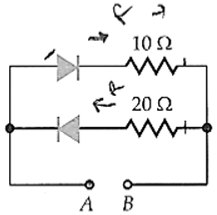
A battery of V may be connected across points A and B, as shown in the figure. Find the current drawn from the battery if the positive terminal is connected to
i. the point A and
ii. the point B
Assume that the resistance of each diode is zero in forward bias and infinity in reverse bias. 
Image
Answer
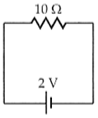
i. When the positive terminal of the battery is connected to point $A$, diode $D_1$ gets forward biased and offers zero resistance and diode $D_2$ gets reverse biased and offers infinite resistance. The given circuit reduces to the equivalent circuit shown in the figure.
Image

$\therefore$ Current drawn from the battery,
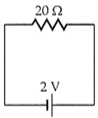
ii. When the positive terminal of the battery is connected to point $B$, the diode $D_1$ gets reverse biased and offers infinite resistance, and diode $D_2$ gets forward biased and offers zero resistance. The given circuit reduces to the equivalent circuit shown in the figure.
Image

$\therefore$ Current drawn from the battery,
$ I=\frac{2 V}{20 \Omega}=0.1 A $

View full question & answer
3 Marks Question - Physics STD 12 Science Questions - Vidyadip