Question
Define the current sensitivity of a galvanometer. Write its S.I. unit.
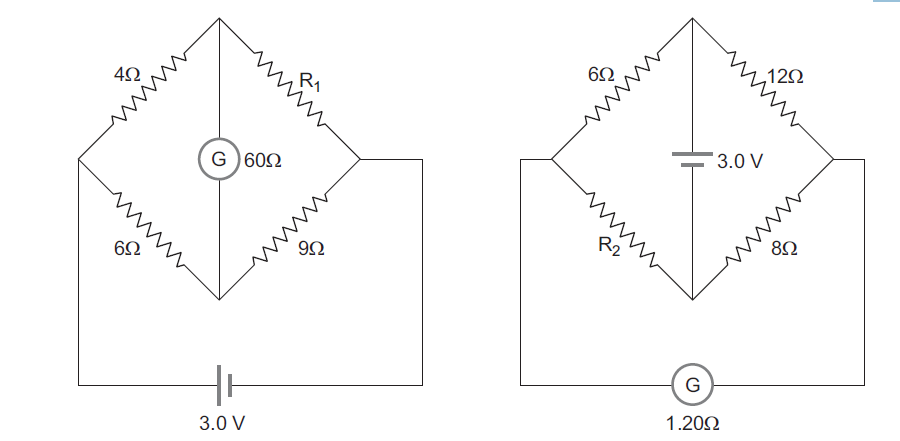
Figure shows two circuits each having a galvanometer and a battery of 3 V. When the galvanometers in each arrangement do not show any deflection, obtain the ratio R/ R2.

Answer

Ratio of deflection produced in the galvanometer to the current flowing through it.
Current sensitivity $\text{S}_{i} = \frac{\theta}{\text{I}}$
S.I. unit of current sensitivity Si is division/ampere or radian/ampere.
For balanced Wheatone bridge, if no current flows through the galvanometer
$\frac{4}{\text{R}_{1}} = \frac{6}{9}\Rightarrow\text{R}_{1} = \frac{4\times9}{6} =6\Omega$
For another current
$\frac{6}{12} = \frac{\text{R}_{2}}{8}\Rightarrow\text{R}_{2} = \frac{6\times8}{12} = 4\Omega$
$\therefore\frac{\text{R}_{1}}{\text{R}_{2}} = \frac{6}{4} = \frac{3}{2}.$

Need a full question paper?

Generate a complete, print-ready paper with questions like this in minutes — across 16+ boards, with answer keys.

Start Generating Free

Similar questions

What are isotopes? Explain with an example how the average mass can be obtained from the relative proportions of different isotopes of the same element.
An inductor L of inductance XL is connected in series with a bulb B and an ac source. How would brightness of the bulb change when (i) number of turns in the inductor is reduced, (ii) an iron rod is inserted in the inductor and (iii) a capacitor of reactance XC = XL is inserted in series in the circuit. Justify your answer in each case.
In a p-n junction, a potential barrier of 250meV exists across the junction. A hole with a kinetic energy of 300meV approaches the junction. Find the kinetic energy of the hole when it crosses the junction if the hole approached the junction.
  1. From the p-side.
  2. From the n-side.
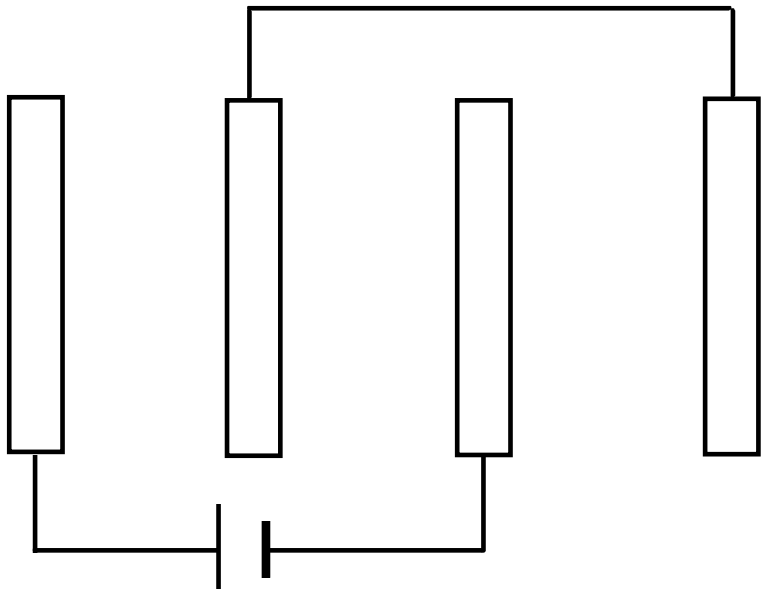
Each of the plates shown in figure has surface area $\Big(\frac{96}{\in_0}\Big)\times10^{-12}\text{Fm}$ on one side and the separation between the consecutive plates is 4.0mm. The emf of the battery connected is 10 volts. Find the magnitude of the charge supplied by the battery to each of the plates connected to it.

Answer the following:
  1. In what way is diffraction from each slit related to the interference pattern in a double slit experiment?
  2. When a tiny circular obstacle is placed in the path of light from a distant source, a bright spot is seen at the centre of the shadow of the obstacle. Explain, why.
  3. How does the resolving power of a microscope depend on (i) the wavelength of the light used and (ii) the medium used between the object and the objective lens?
A mixture contains 1 mole of helium (Cp = 2.5R, Cv = 1.5R) and 1 mole of hydrogen (Cp= 3.5R, C= 2.5R). Calculate the values of Cp, Cv and $\gamma$ for the mixture.
A light ray is incident at an angle of 45° with the normal to a $\sqrt{2}\text{cm}$ thick plate $(\mu = 2.0)$. Find the shift in the path of the light as it emerges out from the plate.
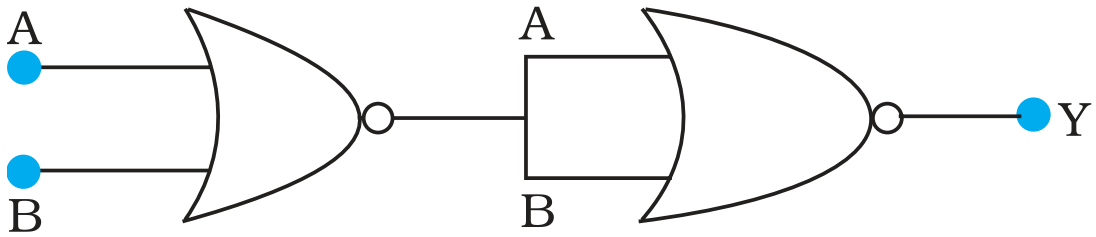
Write the truth table for circuit given in Fig. 14.47 below consisting of NOR gates and identify the logic operation (OR, AND, NOT) which this circuit is performing.

(Hint: A = 0, B = 1 then A and B inputs of second NOR gate will be 0 and hence Y=1. Similarly work out the values of Y for other combinations of A and B. Compare with the truth table of OR, AND, NOT gates and find the correct one.)

The near vision of an average person is 25cm. To view an object with an angular magnification of 10, what should be the power of the microscope?
Two neutral particles are kept 1m apart. Suppose by some mechanism some charge is transferred from one particle to the other and the electric potential energy lost is completely converted into a photon. Calculate the longest and the next smaller wavelength of the photon possible.