Question
What are isotopes? Explain with an example how the average mass can be obtained from the relative proportions of different isotopes of the same element.

Answer

The atoms for which atomic number Z is same but atomic mass number A is different then such type of atoms are called the isotopes of each other.
Almost every element is a mixture of many isotopes. The relative abundance of different isotopes differs from element to element.
→For example :
(i) Chlorine has two isotopes having masses $34.98 u$ and $36.98 u$. The relative abundances of these isotopes are $75.4 \%$ and $24.6 \%$.
Average mass of Chlorine
$\begin{array}{l}
=\frac{75.4 \times 34.98+24.6 \times 36.98}{100} \\
=35.47 u
\end{array}$
This mass is almost equal to the atomic mass of chlorine.
(ii) Hydrogen also has three isotopes. Their masses are $1.0078 u, 2.0141 u$ and $3.0160 u$.
The nucleus of the lightest atom of hydrogen has a relative abundance of $99.985 \%$, is called proton but there is no neutron.
The other two isotopes of hydrogen are called deuterium (mass $=2.0141 u$ ) and tritium (mass $=3.0160 u$ ).
Tritium nuclei being unstable, do not occur naturally and are produced artificially in laboratories.
The relative abundance of deuterium is so small (relative abundance of hydrogen is $99.985 \%$ ) that the masses of deuterium and tritium are neglected when calculating the average mass of hydrogen.
Hydrogen $\left({ }_1 H ^1\right)$ nucleus has only one proton and do not have neutrons.
Mass of proton (mass of ${ }_1 H ^{ 1}$ )
$\begin{array}{l}
=\frac{1.0078 \times 99.985}{100} \\
=1.00727 u \\
=1.00727 \times 1.660539 \times 10^{-27} kg \\
=1.67262 \times 10^{-27} kg
\end{array}$
This value is equal to the value obtained by subtracting the mass of an electron from the mass of a hydrogen atom.

Need a full question paper?

Generate a complete, print-ready paper with questions like this in minutes — across 16+ boards, with answer keys.

Start Generating Free

Similar questions

The guru of a yogi lives in a Himalyan cave, 1000km away from the house of the yogi. The yogi claims that henever he think.a about hi a guru, the guru unmediately knows about it. Calculate the minimum possible time interval between the yogi thinking about the guru and the euni knowing about it.
A rectangular wire loop of sides 8cm and 2cm with a small cut is moving out of a region of uniform magnetic field of magnitude 0.3T directed normal to the loop. What is the emf developed across the cut if the velocity of the loop is 1 cms–1 in a direction normal to the:

  1. Longer side,
  2. shorter side of the loop?

For how long does the induced voltage last in each case?
How many time constants will elapse before the current in a charging RC circuit drops to half of its initial value? Answer the same question for a discharging RC circuit.
A charged particle having a charge of -2.0 × 10⁻⁶C is placed close to a nonconducting plate having a surface charge density 4.0 × 10⁻⁵Cm-2. Find the force of attraction between the particle and the plate.
A mosquito is sitting on an L.P. record disc rotating on a turn table at $33\frac{1}{3}$ revolutions per minute. The distance of the mosquito from the centre of the turn table is 10cm. Show that the friction coefficient between the record and the mosquito is greater than $\frac{\pi^2}{81}.$ Take g =10 m/s2.
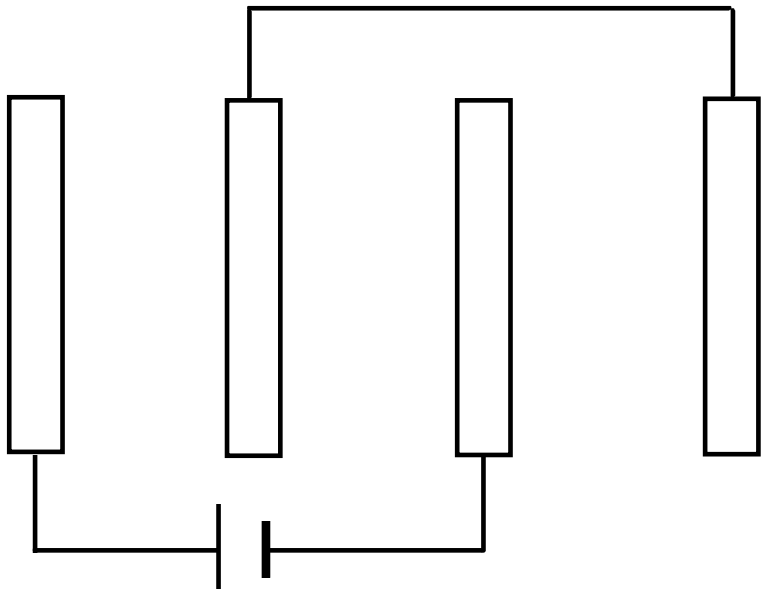
Each of the plates shown in figure has surface area $\Big(\frac{96}{\in_0}\Big)\times10^{-12}\text{Fm}$ on one side and the separation between the consecutive plates is 4.0mm. The emf of the battery connected is 10 volts. Find the magnitude of the charge supplied by the battery to each of the plates connected to it.

In a chamber, a uniform magnetic field of 6.5 G (1 G = 10–4 T) is maintained. An electron is shot into the field with a speed of 4.8 × 10⁶ m s–1 normal to the field. Explain why the path of the electron is a circle. Determine the radius of the circular orbit.
(e = 1.6 × 10–19 C, me = 9.1×10⁻³¹ kg)
A uniform tube closed at one end, contains a pellet of mercury 10cm long. When the tube is kept vertically with the closed-end upward, the length of the air column trapped is 20cm. Find the length of the air column trapped when the tube is inverted so that the closedend goes down. Atmospheric pressure = 75cm of mercury.
  1. A rod of length l is moved horizontally with a uniform velocity ‘v’ in a direction perpendicular to its length through a region in which a uniform magnetic field is acting vertically downward. Derive the expression for the emf induced across the ends of the rod.
  2. How does one understand this motional emf by invoking the Lorentz force acting on the free charge carriers of the conductor? Explain.
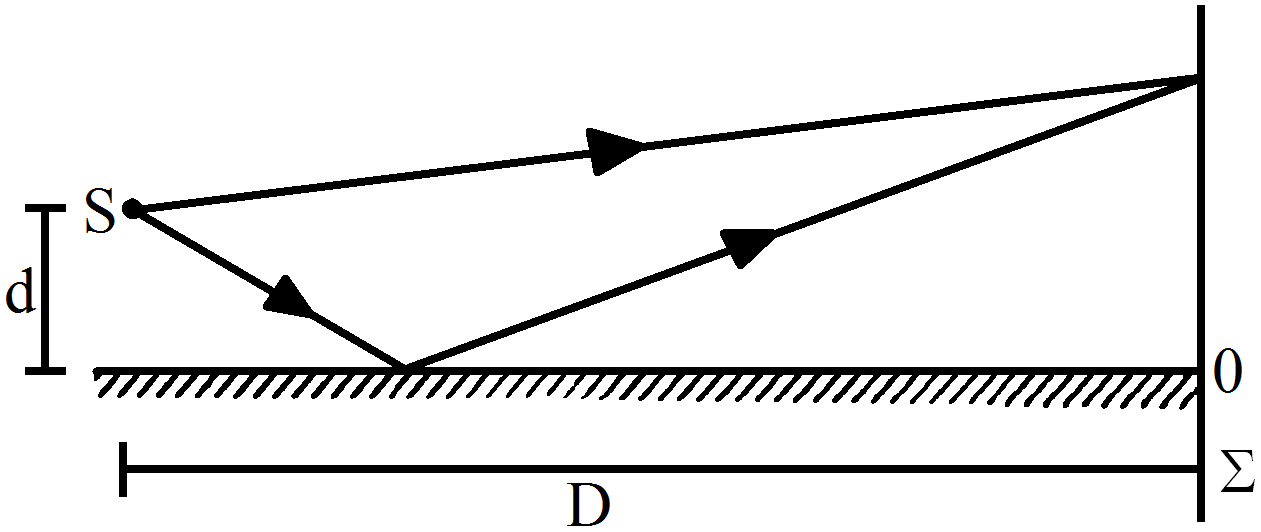
A narrow slit S transmitting light of wavelength $\lambda$ is placed a distance d above a large plane mirror as shown in figure (17-E1). The light coming directly from the slit and that coming after the reflection interfere at a screen $\sum$ placed at a distance D from the slit.

  1. What will be the intensity at a point just above the mirror, i.e., just above O?
  2. At what distance from 0 does the first maximum occur?