Question
Define the different terms used for the composition of a nucleus.

Answer

• The Composition of nucleus :
(i) Atomic number $( Z )$ :
The number of electrons in the neutral atom is called the atomic number.
OR
The number of protons in the neutral atom is called the atomic number.
(ii) Mass number (A) :
The sum of the number of protons and neutrons in the nucleus of the atom is called the atomic mass number A .
Both protons and neutrons are present in the nucleus hence it is known by the common name of nucleon.
The total number of nucleons in the nucleus of an atom is called atomic mass number A .
$\therefore A = Z + N$
(iii) Neutron number ( N $)$ :
The number of neutrons present in the nucleus of an atom is called the neutron number N .
(iv) Nuclide :
The type of nucleus is called nuclide and is represented by symbol ${ }_Z X^A$.
Where X is the chemical symbol of element, $Z =$ atomic number and A is atomic mass number.
For example :
Nuclide of gold ${ }_{79} A u^{197}$
in which 197 nucleons, 79 protons and 118 neutrons are there.

Need a full question paper?

Generate a complete, print-ready paper with questions like this in minutes — across 16+ boards, with answer keys.
Start Generating Free

Similar questions

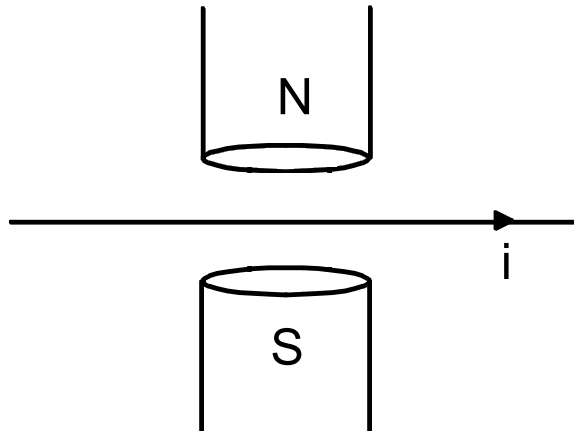
A magnetic field of strength 1.0T is produced by a strong electromagnet in a cylindrical region of radius 4.0cm, as shown in the figure. A wire, carrying a current of 2.0A, is placed perpendicular to and intersecting the axis of the cylindrical region. Find the magnitude of the force acting on the wire.
When $1.0 \times 10^{12}$ electrons are transferred from one conductor to another, a potential difference of 10V appears between the conductors. Calculate the capacitance of the two-conductor system.
$^{228}Th$ emits an alpha particle to reduce to $^{224}Ra.$ Calculate the kinetic energy of the alpha particle emitted in the following decay:
$\text{ }^{228}\text{Th}\rightarrow\text{ }^{224}\text{Ra}^*+\alpha$
$\text{ }^{224}\text{Ra}^*\rightarrow\text{ }^{224}\text{Ra}+\gamma(217\text{kev}).$
Atomic mass of $^{228}Th$ is 228.028726u, that of $^{224}Ra$ is 224.020196u and that of $\text{ }^4_2\text{He}$ is 4.00260u.
Suppose the glass of the previous problem is covered by a jar and the air inside the jar is completely pumped out.
  1. What will be the answers to the problem?
  2. Show that the answers do not change if a glass of different shape is used provided the height, the bottom area and the volume are unchanged.
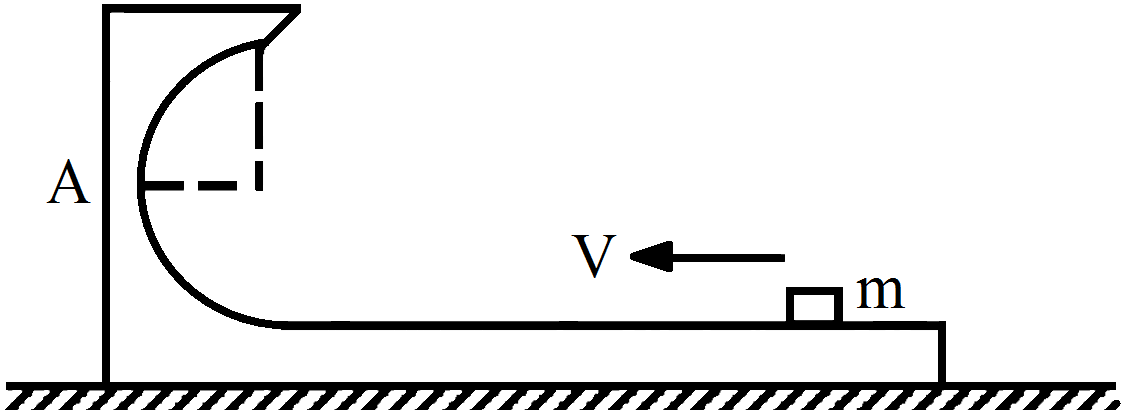
Figure shows a small block of mass m which is started with a speed v on the horizontal part of the bigger block of mass M placed on a horizontal floor. The curved part of the surface shown is semicircular. All the surfaces are frictionless. Find the speed of the bigger block when the smaller block reaches the point A of the surface.
A simple microscope has a magnifying power of 3.0 when the image is formed at the near point (25cm) of a normal eye.
  1. What is its focal length?
  2. What will be its magnifying power if the image is formed at infinity?
The focal lengths of a convex lens for red, yellow and violet rays are 100cm, 98cm and 96cm respectively. Find the dispersive power of the material of the lens.
During a heavy rain, hailstones of average size 1.0cm in diameter fall with an average speed of 20m/s. Suppose 2000 hailstones strike every square meter of a 10m × 10m roof perpendicularly in one second and assume that the hailstones do not rebound. Calculate the average force exerted by the falling hailstones on the roof. Density of a hailstone is $900kg/m^3.$
A cell of emf E and internal resistance r is connected across an external resistance R. Plot a graph showing the variation of P.D. across R, verses R.
When a block of mass M is suspended by a long wire of length L, the elastic potential energy stored in the wire is $\frac{1}{2}\times$ stress × strain × volume. Show that it is equal to $\frac{1}{2}\text{Mgl}$ where l is the extension. The loss in gravitational potential energy of the Mass-earth sustem is Mgl. does the remaining $\frac{1}{2}\text{Mgl}$ energy go?