Question
When $1.0 \times 10^{12}$ electrons are transferred from one conductor to another, a potential difference of 10V appears between the conductors. Calculate the capacitance of the two-conductor system.

Answer

Given that Number of electron $= 1 \times 10^{12}$
Net charge $Q = 1 \times 10^{12} \times 1.6 \times 10^{-19} = 1.6 \times 10^{-7}C  $
$\therefore$ The net potential difference = 10L.
$\therefore$ Capacitance $\text{C}=\frac{\text{q}}{\text{v}}$
$=\frac{1.6\times10^{-7}}{10}=1.6\times10^{-8}\text{F}.$

Need a full question paper?

Generate a complete, print-ready paper with questions like this in minutes — across 16+ boards, with answer keys.

Start Generating Free

Similar questions

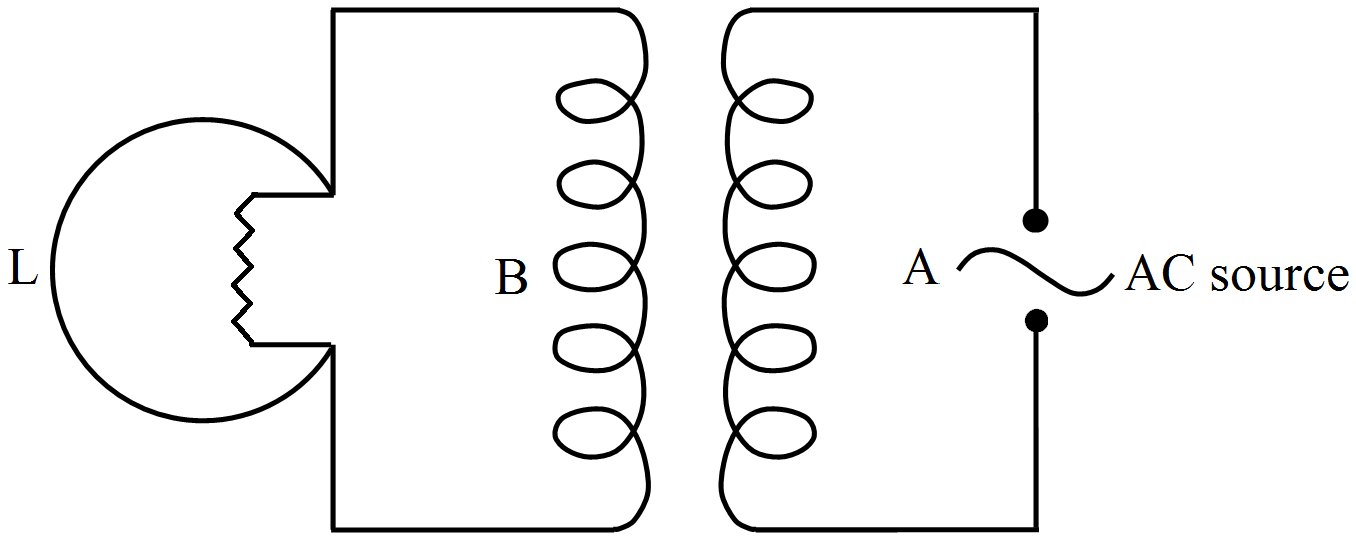
In the given diagram, a coil B is connected to low voltage bulb L and placed parallel to another coil A as shown. Explain the following observations:
  1. Bulb lights.
  2. Bulb gets dimmer if the coil B moves upwards.
Figure shows a 11.7ft wide ditch with the approach roads at an angle of 15° with the horizontal. With what minimum speed should a motorbike be moving on the road so that it safely crosses the ditch?
Assume that the length of the bike is 5ft, and it leaves the road when the front part runs out of the approach road.
A string of length L fixed at both ends vibrates in its fundamental mode at a frequency v and a maximum amplitude A.
  1. Find the wavelength and the wave number k.
  2. Take the origin at one end of the string and the X-axis along the string. Take the Y-axis along the direction of the displacement. Take t = 0 at the instant when the middle point of the string passes through its mean position and is going towards the positive y-directian. Write the equation describing the standing wave:
Define the term 'resolving power' of an astronomical telescope. How does it get affected on?
  1. Increasing the aperture of the objective lens?
  2. Increasing the wavelength of the light used?
Justify your answer in each case.
A swimmer wishes to cross a 500m wide river flowing at 5km/h. His speed with respect to water is 3km/h.
  1. If he heads in a direction making an angle 0 with the flow, find the time he takes to cross the river.
  2. Find the shortest possible time to cross the river.
Suppose an attractive nuclear force acts between two protons which may be written as $\text{F}=\text{Ce}^{-\text{kr}}/\text{r}^2.$
  1. Write down the dimensional formulae and appropriate SI units of C and k.
  2. Suppose that $k = 1$ fermi$^{-1}$ and that the repulsive electric force between the protons is just balanced by the attractive nuclear force when the separation is 5 fermi. Find the value of C.
What is the energy of a hydrogen atom in the first excited state if the potential energy is taken to be zero in the ground state?
  1. Monochromatic light of wavelength 589 nm is incident from air on a water surface. If $\mu$ for water is 1.33, find the wavelength, frequency and speed of the refracted light.
  2. A double convex lens is made of a glass of refractive index 1.55, with both faces of the same radius of curvature. Find the radius of curvature required, if the focal length is 20 cm.
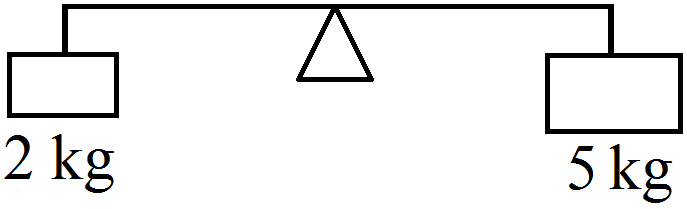
A light rod of length 1m is pivoted at its centre and two masses of 5kg and 2kg are hung from the ends as shown in figure. Find the initial angular acceleration of the rod assuming that it was horizontal in the beginning.
The guru of a yogi lives in a Himalyan cave, 1000km away from the house of the yogi. The yogi claims that henever he think.a about hi a guru, the guru unmediately knows about it. Calculate the minimum possible time interval between the yogi thinking about the guru and the euni knowing about it.