Question
Define the following terms :
  1. Antiseptic
  2. Cationic detergent
  3. Broad spectrum antibiotic

Answer

  1. Antiseptics are the chemicals which either kill or prevent growth of microbes on living tissues.
  2. Cationic detergents are quarternary ammonium salts of amines with acetates, chlorides or bromides as anions/detergents whose cationic part is involved in cleansing action.
  3. Antibiotics which kill or inhibit a wide range of Gram-positive and Gram-negative bacteria.

Need a full question paper?

Generate a complete, print-ready paper with questions like this in minutes — across 16+ boards, with answer keys.
Start Generating Free

Similar questions

Write the name and structures of the monomers of the following polymers:
  1. Buna $– S.$
  2. Neoprene.
  3. Nylon$-6,6.$
An organic compound gives hydrogen on reacting with sodium metal. It also gives iodofom test and the end product of its oxidation is ethanoic acid. Name the compound and give the equation of these reactions.
How would you account for the following situations?
  1. The transition metals generally form coloured compounds.
  2. With $3d^4$​​​​​​​ configuration, $Cr^{2+}$ acts as a reducing agent but $Mn^{3+}$​​​​​​​ acts as an oxidising agent. (Atomic Numbers, $Cr = 24, Mn = 25$).
  3. The actinoids exhibit a larger number of oxidation states than the corresponding lanthanoids.
Define the following terms:
  1. Sorption.
  2. Zeta potential.
  3. Kraft temperature.
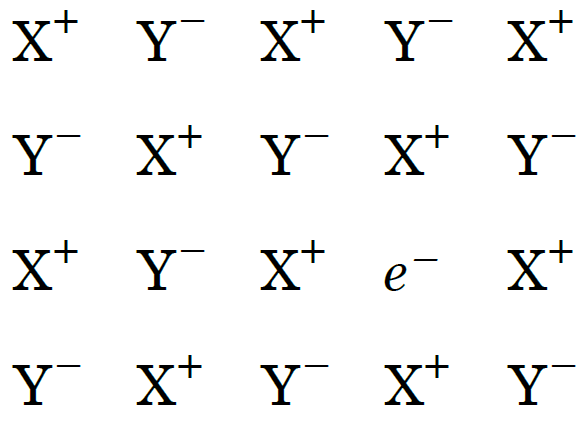
Examine the given defective crystal:
Answer the following questions:
  1. Is the above defect stoichiometric or non-stoichiometric?
  2. write the term used for the electron occupied site.
  3. Give an example of the compound which shows this type of defect.
Explain the displacement of diazonium group of benzene diazonium salt by halide or cyanide ion with equation. $\#\#\#$ Short note on Sandmeyer reaction and Gattermann reaction.
For the complex $[NiCI_4]^{2-},$ write
  1. The IUPAC name.
  2. The hybridization type.
  3. The shape of the complex.
$($Atomic no. of $Ni = 28)$
Why are different colours observed in octahedral and tetrahedral complexes for the same metal and same ligands?
Write only equations to obtain 1º, 2º and 3° alcohols from aldehydes and ketones.
Write a note on esterification of alcohols and phenols.