Question
Examine the given defective crystal:
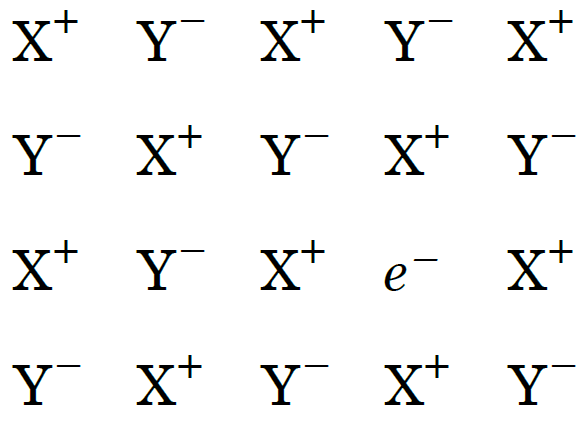
Answer the following questions:
  1. Is the above defect stoichiometric or non-stoichiometric?
  2. write the term used for the electron occupied site.
  3. Give an example of the compound which shows this type of defect.
Answer

  1. Non–Stoichiometric defect.
  2. F–Centre/Farbe Centre.
  3. NaCl is heated in an atmosphere of Na vapour/LiCl is heated in an atmosphere of Li vapour/KCl is heated in an atmosphere of K vapour.

Need a full question paper?

Generate a complete, print-ready paper with questions like this in minutes — across 16+ boards, with answer keys.

Start Generating Free

Similar questions

$100\ g$ of liquid $A ($molar mass $140\ g\ mol^{–1})$ was dissolved in $1000\ g$ of liquid $B ($molar mass $180\ g\ mol^{–1}).$ The vapour pressure of pure liquid $B$ was found to be $500$ torr. Calculate the vapour pressure of pure liquid $A$ and its vapour pressure in the solution if the total vapour pressure of the solution is $475$ Torr.
Write the products formed when $CH_3CHO$ reacts with the following reagents:
  1. $HCN$.
  2. $H_2N—OH$.
  3. $CH_3CHO$ in the presence of dilute $NaOH$.
How much electricity will be required to obtain 1.5 gram on copper in 3 hours in an electrolytic cell of aqueous solution of copper sulphate? (Atomic mass of Cu = 63.5 )

Predict the products of the following reactions:
A green solution of potassium manganate turns purple when $CO_2$ gas is passed through the solution.
  1. For the complex $[Fe(CN)_6]^{3–}$, write the hybridization type, magnetic character and spin nature of the complex.
(At. number: Fe=26).
  1. Draw one of the geometrical isomers of the complex $[Pt(en)_2Cl_2]^{2+}$ which is optically active.
Write a note on halogenation of phenol.
Calculate the emf of the following cell at $298 K .$
$\ce{2Cr(s) + 3Fe^{2+}(0.1 M) \rightarrow 2Cr^{3+}(0.01M) + 3Fe(s)}$
Given, $E_{c r^{3+} / c r}^o=-0.74 V, E_{F e^{2+} / F e}^o=-0.44 V$
Identify the product of the following reaction:$ \ \ \ \ \ \ \ \ \ \text{CH}_3\\ \ \ \ \ \ \ \ \ \ \ \ \ \ \text{|}\\\text{CH}_3-\text{C}-\text{CH}_2-\text{Br}\xrightarrow{\stackrel{{}}{\hbox{Na}}\stackrel{{}}{\hbox{OH}}}\\ \ \ \ \ \ \ \ \ \ \ \ \ \ \text{|} \ \ \ \ \ \ \ \ \ \ \ \ \ \ \ \ \ \ \ \ \ \ \ \ \ \ \ \ \ \Delta\\ \ \ \ \ \ \ \ \ \ \text{CH}_3$
Assign appropriate reasons for the following statement:
Addition of $Cl_2$ to $KI$ solution gives it a brown colour but excess of $Cl_2$ turns it colourless.