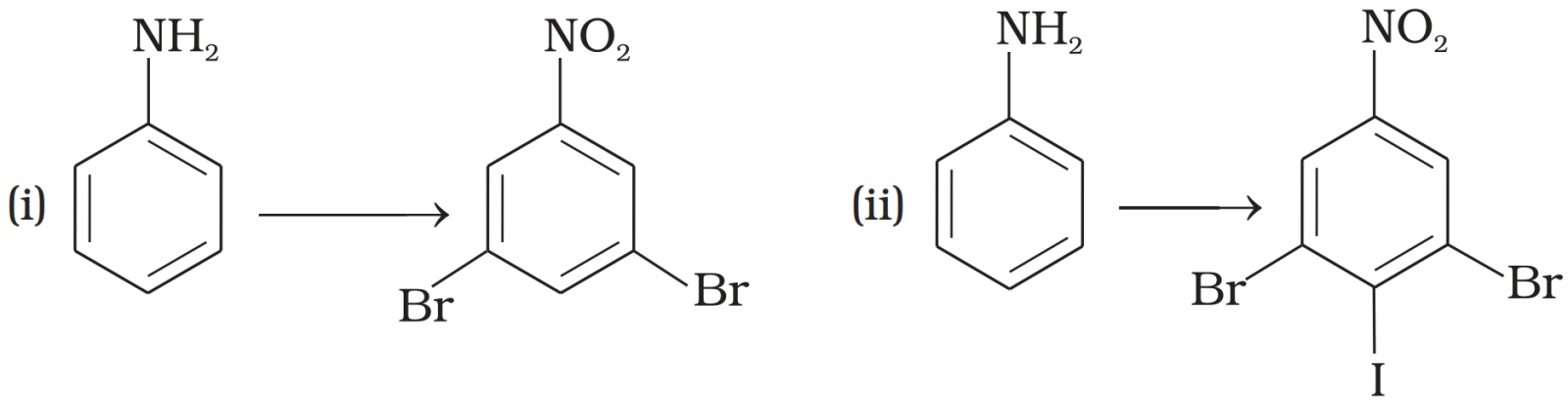
Question
  1. Define the following terms:
  1. Co-enzymes.
  2. Mutation in biomolecules.
  3. Nucleotides.
  1. List four main functions of carbohydrates in organisms.

Answer

  1.  
  1. Co-enzymes: The non proteinous components which increase the activity of enzymes are called co- enzymes.
  2. Mutation in biomolecules: It is a chemical change in DNA molecule that could lead to synthesis of proteins with altered amino acid sequence e.g sickel cell anaemia is caused by mutation.
  3. Nucleotide: is a species which contains a phosphate unit, a sugar unit, and any one of the pyrimdine nitrogen bases or purines. e.g Ribonucleotide, deoxy -ribonucleotides.
  1.  
  1. They support plant structure, e.g cellulose.
  2. They produce energy necessary for functioning of living body and doing work.
  3. They are used to store chemical energy in the form of glycogen in liver. Starch is main storage polysaccharide of plants.
  4. Cellulose present in grass and plants acts as a food for various grazing animals.

Need a full question paper?

Generate a complete, print-ready paper with questions like this in minutes — across 16+ boards, with answer keys.

Start Generating Free

Similar questions

Explain the structure of fructose.
The rate constant for the decomposition of $N_2O_5$ at various temperatures is given below:
$T/^\circ C$ $0$ $20$ $40$ $60$ $80$
$105 \times k/s-1$ $0.0787$ $1.70$ $25.7$ $178$ $2140$
Draw a graph between ln $k$ and $1/T$ and calculate the values of $A$ and $E_a$. Predict the rate constant at $30^\circ$ and $50^\circ C.$
$i.$ Tert$-$Butylamine cannot be prepared by the action of $NH_3$ on tert$-$butyl bromic. Explain why?
$ii.$ Suggest a convenient method for the preparation of tert$-$butylamine.
Describe the differences in the properties of lanthanoids and actinoids.

How will you carry out the following conversions?
Match the items of Columns I and II and mark the correct option.
  Column I   Column II
$(A)$ Its partial hydrolysis does not change oxidation state of central atom $(1)$ $He$
$(B)$ It is used in modern diving apparatus $(2)$ $XeF_6$
$(C)$ It is used to provide inert atmosphere for filling electrical bulbs $(3)$ $XeF_4$
$(D)$ Its central atom is in $sp^3d^2$ hybridisation $(4)$ $Ar$
  1. $A (1) B (4) C (2) D (3)$
  2. $A (1) B (2) C (3) D (4)$
  3. $A (2) B (1) C (4) D (3)$
  4. $A (1) B (3) C (2) D (4)$
What is called a battery? Explain its characteristics and describe dry cell and mercury cell.
Match the items of Columns I and II and mark the correct option.
  Column I   Column II
$(A)$ $H_2SO_4$ $(1)$ Highest electron gain enthalpy
$(B)$ $CCl_3NO_2$ $(2)$ Chalcogen
$(C)$ $Cl_2$ $(3)$ Tear gas
$(D)$ Sulphur $(4)$ Storage batteries
  1. $A (4) B (3) C (1) D (2)$
  2. $A (3) B (4) C (1) D (2)$
  3. $A (4) B (1) C (2) D (3)$
  4. $A (2) B (1) C (3) D (4)$

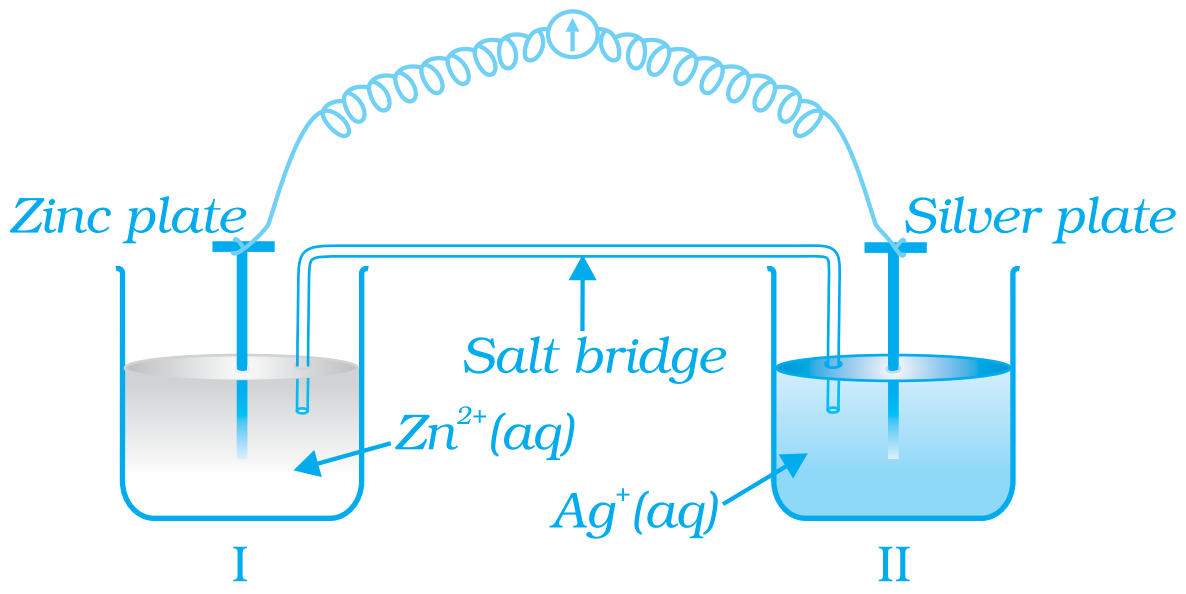
Consider and answer the questions (i) to (vi) given below.
  1. Redraw the diagram to show the direction of electron flow.
  2. Is silver plate the anode or cathode?
  3. What will happen if salt bridge is removed?
  4. When will the cell stop functioning?
  5. How will concentration of $Zn^{2+}$^ ions and $Ag^+$^ ions be affected when the cell functions?
  6. How will the concentration of$ Zn^{2+}$^ ions and $Ag^+$^ ions be affected after the cell becomes ‘dead’?
Explain the various methods of preparation of $CHCl _3$ and its chemical properties.