Question
Explain the structure of fructose.

Answer

self

Need a full question paper?

Generate a complete, print-ready paper with questions like this in minutes — across 16+ boards, with answer keys.
Start Generating Free

Similar questions

  1. Account for the following:
  1. Transition metals form large number of complex compounds.
  2. The lowest oxide of transition metal is basic whereas the highest oxide is amphoteric or acidic.
  3. $E^\circ $ value for the $Mn^{3+}/Mn^{2+}$ couple is highly positive (+1.57 V) as compare to $Cr^{3+}/Cr^{2+}. 56/1/1 9.$
  1. Write one similarity and one difference between the chemistry of lanthanoid and actinoid elements.

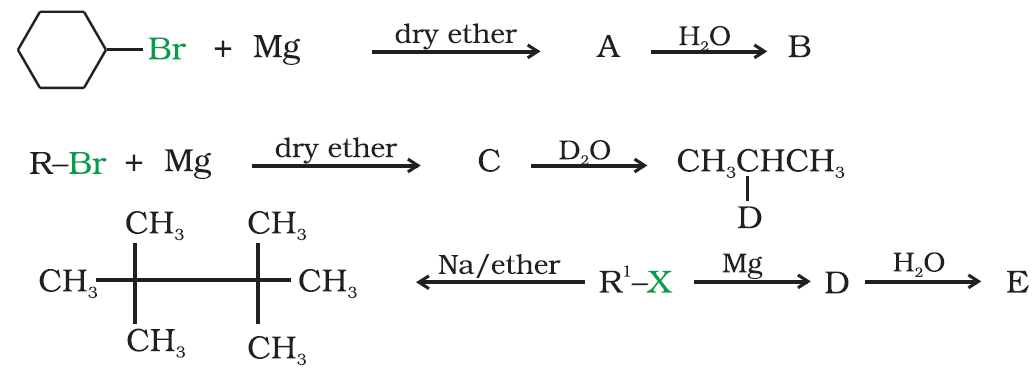
Identify A, B, C, D, E, R and $R^1$ in the following:
Explain the limitations of valence bound theory.
  1. Account for the following:
  1. Thermal stability of water is much higher than that of $H_2S$.
  2. Anhydrous aluminium chloride acts as a catalyst.
  3. White phosphorus is more reactive than red phosphorus.
  1. Draw the structures of (i) $H_3PO_3$​​​​​​​ and (ii) $XeOF_4$​​​​​​​.
Write the rate law for a first order reaction. Justify the statement that half life for a first order reaction is independent of the initial concentration of the reactant.
  1. Complete the following chemical equations:
  1. $Cu + HNO_3 (dilute) →$
  2. $XeF_4 + O_2F_2 \rightarrow $
  1. Explain the following observations:
  1. Phosphorus has greater tendency for catenation than nitrogen.
  2. Oxygen is a gas but sulphur a solid.
  3. The halogens are coloured. Why?
Answer the following questions:
Give reasons:
  1. d-block elements exhibit more oxidation states than f-block elements.
  2. Orange solution of potassium dichromate turns yellow on adding sodium hydroxide to it.
  3. Zirconium (Z = 40) and Hafnium (Z = 72) have almost similar atomic radii.
(a) Differentiate between
a. Nucleotide and Nucleoside
b. Amylose and Amylopectin
(b) Write a reaction which shows that all the carbon atoms in glucose are linked in a straight chain.
(c) Write two differences between DNA and RNA.
(d) Amino acids can be classified as $\alpha-, \beta-, \gamma-, \delta-$ and so on depending upon the relative position of the amino group with respect to the carboxyl group. Which type of amino acids forms a polypeptide chain in proteins?
(e) What are any two good sources of vitamin A?
(f) What is anomeric carbon?
(g) What is the difference between a glycosidic linkage and a peptide linkage?
Sodium has a bcc structure with nearest neighbour distance 365.9pm. Calculate its density (Atomic mass of sodium = 23).
Explain different types of isomerism in amines.