Question
  1. Define the following terms:
  1. Molarity.
  2. Molal elevation constant(Kb).
  1. A solution containing 15 g urea (molar mass = $60 g\ mol^{–1}$​​​​​​​) per litre of solution in water has the same osmotic pressure (isotonic) as a solution of glucose (molar mass = $180 g\ mol^{–1}​​​​​​​$) in water. Calculate the mass of glucose present in one litre of its solution.
Answer

  1.  
  1. Molarity is defined as number of moles of solute dissolved in one litre of solution.
  2. It is equal to elevation in boiling point of 1 molal solution.
  1. For isotonic solutions: $\pi$ urea = $\pi$ glucose
$\frac{\text{W}_\text{urea}}{\text{M}_\text{urea}\times\text{V}_{s}}=\frac{\text{W}_{Glucose}}{\text{M}_{Glucose}\times\text{V}_{s}}$ (As volume of solution is same)

$ \frac{\text{W}_{urea}}{\text{M}_{urea}}=\frac{\text{W}_{Glucose}}{\text{M}_{Glucose}}$ or $ \frac{\text{15g}}{\text{60g mol}^{-1}}=\frac{\text{W}_{Glucose}}{\text{180g mol}^{-1}}$

$\text{W}_{Glucose}=\frac{\text{15g}\times\text{180g mol}^{-1}}{\text{60g mol}^{-1}}=\text{45g}$

Need a full question paper?

Generate a complete, print-ready paper with questions like this in minutes — across 16+ boards, with answer keys.

Start Generating Free

Similar questions

  1. Give reasons for the following:
  1. Sulphur in vapour state shows paramagnetic behaviour.
  2. N-N bond is weaker than P-P bond.
  3. Ozone is thermodynamically less stable than oxygen.
  1. Write the name of gas released when Cu is added to
  1. dilute $HNO_3$
  2. conc. $HNO_3$
  1. Assign reasons for the following:
  1. The acid strengths of acids increase in the order.
$HF < HCl < HBr < HI.$
  1. The lower oxidation state becomes more stable with increasing atomic number in Group $13.$
  2. $H_3PO_2$ behaves as a monoprotic acid.
  1. Draw the structures of the following compounds:
  1. $SF_4.$
  2. $XeF_2.$
Why the reactivity of chlorobenzene towards nucleophilic substitution increase when electron withdrawing group ( $- NO _2$ ) is attached to the ortho and para positions? Explain.
  1. When concentrated sulphuric acid was added to an unknown salt present in a test tube a brown gas (A) was evolved. This gas intensified when copper turnings were added to this test tube. On cooling, the gas (A) changed into a colourless solid (B).
  1. Identify (A) and (B).
  2. Write the structures of (A) and (B).
  3. Why does gas (A) change to solid on cooling?
  1. Arrange the following in the decreasing order of their reducing character:
HF, HCl, HBr, HI
  1. Complete the following reaction:
$\text{XeF}_4+\text{SbF}_5\xrightarrow{\ \ \ \ \ \ \ \ }$
Describe the reactions of carboxylic acids in which C-OH bond is broken.

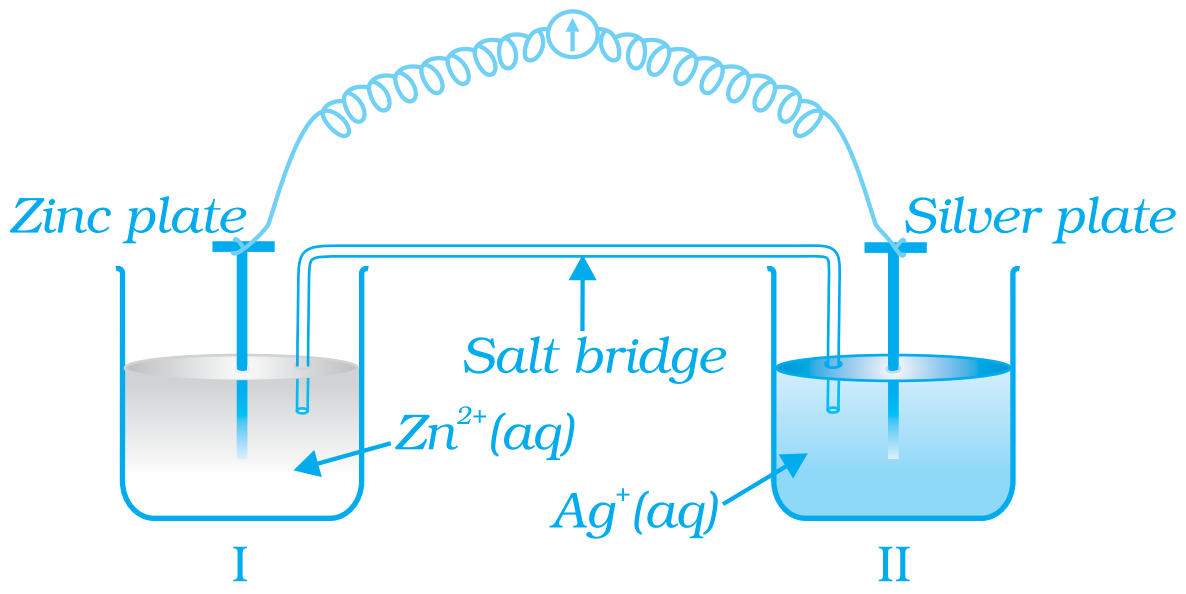
Consider and answer the questions (i) to (vi) given below.
  1. Redraw the diagram to show the direction of electron flow.
  2. Is silver plate the anode or cathode?
  3. What will happen if salt bridge is removed?
  4. When will the cell stop functioning?
  5. How will concentration of $Zn^{2+}$^ ions and $Ag^+$^ ions be affected when the cell functions?
  6. How will the concentration of$ Zn^{2+}$^ ions and $Ag^+$^ ions be affected after the cell becomes ‘dead’?
$(i).$ Illustrate the following reactions giving suitable example in each case:
$a.$ Ammonolysis
$b.$ Coupling reaction
$c.$ Acetylation of amines
$(ii).$ Describe Hinsberg method for the identification of primary, secondary and tertiary amines. Also, write the chemical equations of the reactions involved.
Explain the collision principle of any chemical reaction.
Match the terms given in Column I with the units given in Column II.
 
Column I
 
Column II
i.
$∧_m$
a.
$S cm^{-1}$
ii.
$E_{Cell}$
b.
$m^-$
iii.
$K$
c.
$S cm^2 mol^{-1}$
iv.
$G^*$
d.
$V$
Match the items of Column I with items of Column II and assign the correct code:
 
Column I
 
Column II
(A)
Cyanide process
(1)
Ultrapure Ge
(B)
Froth Floatation process
(2)
Dressing of ZnS
(C)
Electolytic reduction
(3)
Extraction of Al
(D)
Zone refinning
(4)
Extraction of Au
 
 
(5)
Purification of Ni
  1. A (4) B (2) C (3) D (1)
  2. A (2) B (3) C (1) D (5)
  3. A (1) B (2) C (3) D (4)
  4. A (3) B (4) C (5) D (1)