Question
Match the terms given in Column I with the units given in Column II.
 
Column I
 
Column II
i.
$∧_m$
a.
$S cm^{-1}$
ii.
$E_{Cell}$
b.
$m^-$
iii.
$K$
c.
$S cm^2 mol^{-1}$
iv.
$G^*$
d.
$V$

Answer

 
Column I
 
Column II
i.
$∧_m$
c.
$S cm^2 mol^{-1}$
ii.
$E_{Cell}$
d.
$V$
iii.
$K$
a.
$S cm^{-1}$
iv.
$G^*$
b.
$m^-$

Need a full question paper?

Generate a complete, print-ready paper with questions like this in minutes — across 16+ boards, with answer keys.

Start Generating Free

Similar questions

a. Amongst the following, the most stable complex is:
i. $\left[ Fe \left( H _2 O \right)_6\right]^{3+}$
ii. $\left[ Fe \left( NH _3\right)_6\right]^{3+}$
iii. $\left[ Fe \left( C _2 O _4\right)_3\right]^{3-}$
iv. $\left[ FeCl _6\right]^{3+}$
b. What will be the correct order for the wavelength of absorption in the visible region for the following:
$
\left[Ni\left(NO_2\right)_6\right]^{4-},\left[Ni\left(NH_3\right)_6\right]^{2+},\left[Ni\left(H_2 O\right)_6\right]^{2+}
$
Attempt any five of the following:
(a) Aldopentoses named ribose and 2-deoxyribose are found in nucleic acids. What is their relative configuration?
(b) What are the three components of nucleic acids?
(c) Name the sugar present in milk. How many monosaccharide units are present in it? What are such oligosaccharides called?
(d) Is nucleotide and nucleoside the same? What are their roles?
(e) Why cannot vitamin C be stored in our body?
(f) During curdling of milk, what happens to sugar present in it?
(g) Account for the following:
a. There are 5-OH groups in glucose.
b. Glucose is a reducing sugar
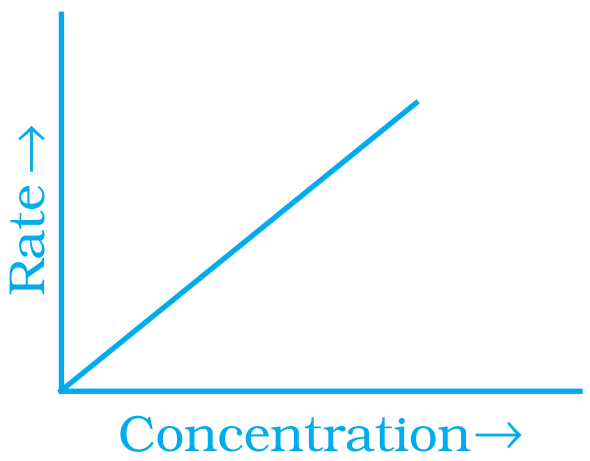
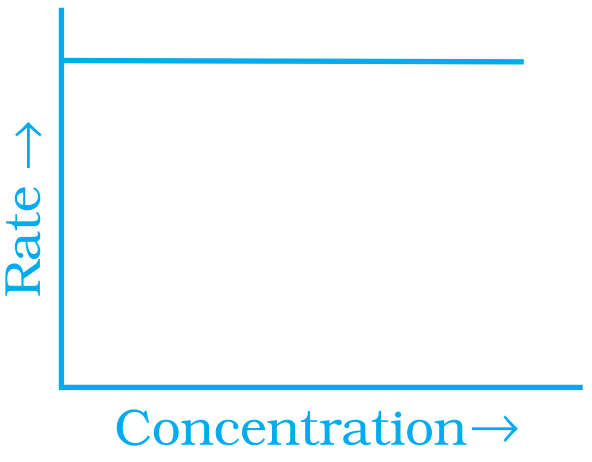
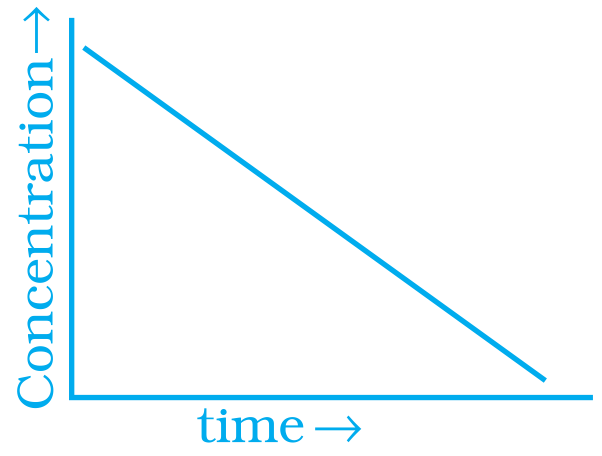
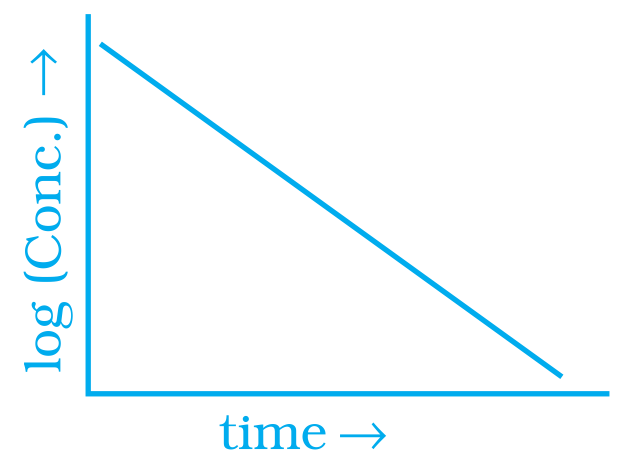
Match the graph given in Column I with the order of reaction given in Column II. More than one item in Column I may link to the same item of Column II.
 
Column I
 
Column II
(i)
 
 
(ii)
(a)
$I^{st}$ order
(iii)
(b)
Zero order
(iv)
   
Primary alkyl halide C4H9Br (a) reacted with alcoholic KOH to give compound (b). Compound (b) is reacted with HBr to give (c) which is an isomer of (a). When (a) is reacted with sodium metal it gives compound (d), C8H18 which is different from the compound formed when n-butyl bromide is reacted with sodium. Give the structural formula of (a) and write the equations for all the reactions.
An element has fcc structure with a cell edge 200pm. Calculate the density of element, if $200\ g$ of the element contains $24 \times 1023$ atoms.
i. How will you convert:
a. Nitrobenzene to phenol,
b. Aniline to chlorobenzene
Answer the following questions:
Draw the structures of chromate and dichromate ions.
Using crystal field theory, draw energy level diagram, write the electronic configuration of the central metal atom/ion and determine the magnetic moment value in the following:
i. $\left[ CoF _6\right]^{3-},\left[ Co \left( H _2 O \right)_6\right]^{2+},\left[ Co ( CN )_6\right]^{3-}$
ii. $\left[ FeF _6\right]^{3-},\left[ Fe \left( H _2 O \right)_6\right]^{2+},\left[ Fe ( CN )_6\right]^{4-}$
How does colour appear in coordination compounds? Its explanation is based on crystal field theory.
Explain the following reactions of phenol :
(i) Nitration
(ii) Gatterman aldehyde synthesis
(iii) Fries rearrangement
(iv) Reaction with mercuric acetate.