Question
Define the following with an example of each:
  1. Polysaccharides.
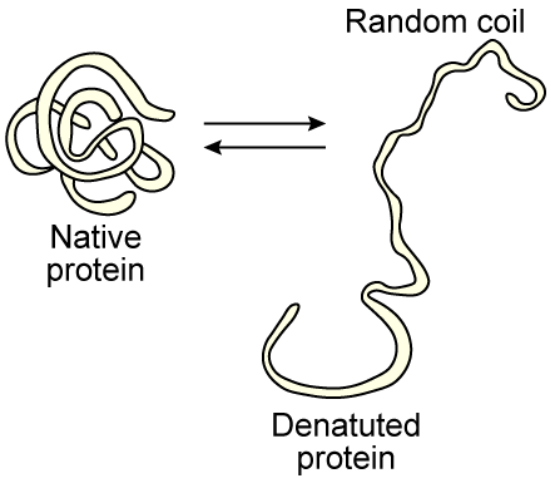
  2. Denatured protein.
  3. Essential amino acids.

Answer

  1. Carbohydrates which yield a large number of monosaccharide units on hydrolysis are called polysaccharides. Starch, cellulose, glycogen and gums are most common examples.
  2. When native protein is subjected to physical change such as change in temperature or a chemical change such as change in pH, its H-bonds are disturbed. This disturbance unfolds the globules and uncoils the helix. As a result, the protein loses its biological activity.
Loss of biological activity by the protein is called denaturation.

  1. Amino acids which cannot be synthesised inside our body and must be obtained through the diet are called essential amino acids. Examples: Valine, leucine, isoleucine.

Need a full question paper?

Generate a complete, print-ready paper with questions like this in minutes — across 16+ boards, with answer keys.

Start Generating Free

Similar questions

Give reason for the following:
Noble gases are mostly inert.
Calculate the potential for half-cell containing
$0.10M K_2Cr_2O_7 (aq), 0.20M Cr^{3+}(aq)$ and $1.0 \times 10^{-4}M H^+(aq)$. The half cell reaction is
$\text{Cr}_2\text{O}_7^{2-}(\text{aq})14\text{H}^+(\text{aq})+6\text{e}^-\xrightarrow{ \ \ \ \ \ \ \ \ \ \ }2\text{Cr}^{3+}(\text{aq})+7\text{H}_2\text{O}(\text{l})$
and the standard electrode potential is given as $E^\circ = 1.33V$.
Write the equations of the reactions of forming primary amines by the following methods:
(a) Hydrolysis of alkyl isocyanide
(b) Reductive amination of carbonyl compounds
(c) Alkaline hydrolysis of alkyl isocyanate
Explain mechanism of nucleophilic addition reaction of aldehydes and ketones with figure.
How are the following conversions carried out?
Propanol to propan-2-ol
Write the chemistry of recharging the lead storage battery, highlighting all the materials that are involved during recharging.
How does a solid catalyst enhance the rate of combination of gaseous molecules?
Vapour pressure of water at $293$ K is $17.535$ mm Hg. Calculate the vapour pressure of water at $293$ K when $25$ g of glucose is dissolved in $450$ g of water.
Write one difference in each of the following:
  1. Write the dispersed phase and dispersion medium of milk.
  2. Write one similarity between physisorption and chemisorption.
  3. Write the chemical method by which $Fe(OH)_3$ sol is prepared from $FeCl_3.$
Give reason to explain why $ClF_3$ exists but $FCl_3$ does not exist.