Question
Give reason to explain why $ClF_3$ exists but $FCl_3$ does not exist.

Answer

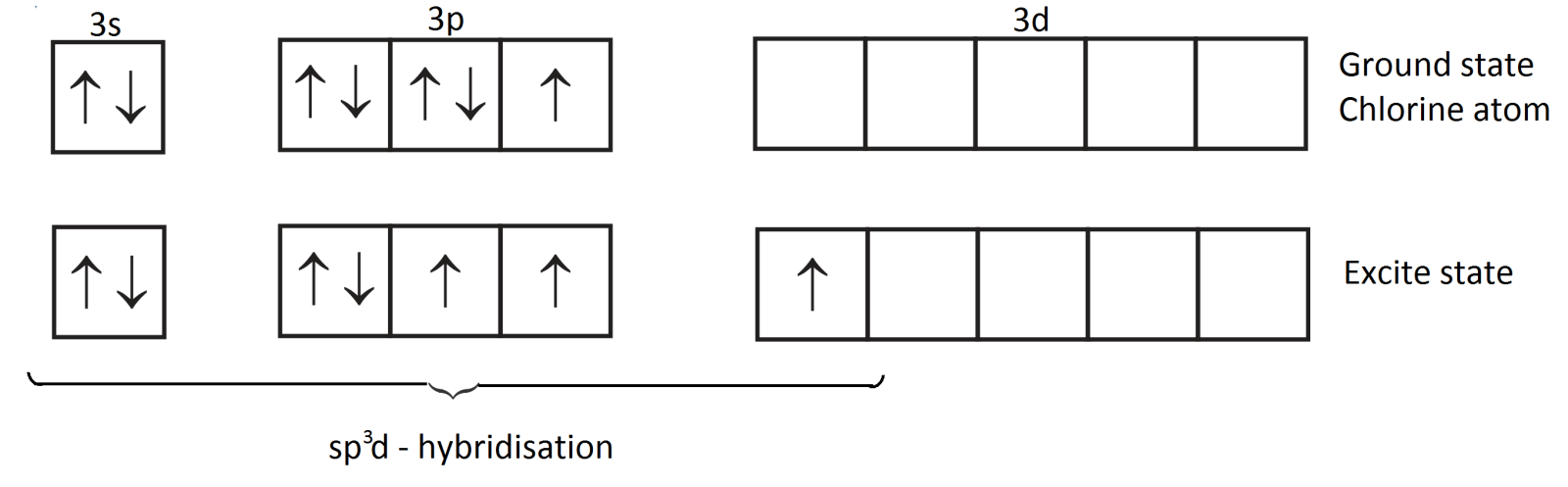
$ClF_3$ is known because chlorine can exhibit $+3$ oxidation state due to promotion of

Each of the three singly occupied orbitals overlap with p-orbital of each of three fluorine atoms to form $ClF_3($trigonal bipyramidal geometry, T-shaped molecule$).$
No $($i-orbitals are present in the valency shell of fluorine and thus excitation is not possible. Fluorine, therefore, does not exhibit positive oxidation state and so the formation of $FCl_3$ is not possible.

Need a full question paper?

Generate a complete, print-ready paper with questions like this in minutes — across 16+ boards, with answer keys.
Start Generating Free

Similar questions

An optically active compound having molecular formula C6H12O6 is found in two isomeric forms (A) and (B) in nature. When (A) and (B) are dissolved in water, they show the following equilibrium.
$(\text{A})\ \ \ \ \rightleftharpoons\ \ \ \ \text{Equilibrium mixture}\ \ \ \ \rightleftharpoons\ \ \ \ \text{(B)}\\ [\alpha]_{\text{D}}=111^\circ\ \ \ \ \ \ \ \ \ \ \ \ \ \ 52.2^\circ\ \ \ \ \ \ \ \ \ \ \ \ \ \ \ \ \ \ \ \ \ \ \ \ \ \ 19.2^\circ$
  1. What are such isomers called?
  2. Can they be called enantiomers? Justify your answer.
  3. Draw the cyclic structure of isomer (A).
Give three points of difference between physisorption and chemisorption.
Define the term 'amorphous'. Give a few examples of amorphous solids.
Explain abnormal molar Tasses. Also explain association and dissociation of Solute.
If one strand of a DNA has the sequence -ATGCTTCA-, what is the sequence of the bases in the complementary strand?
How would you account for the following:
Transition metals sometimes exhibit very low oxidation state such as $+1$ and $0$.
Do the vital functions of the body such as digestion get affected during fever? Explain your answer.
For the complex $[NiCI_4]^{2-},$ write
  1. The IUPAC name.
  2. The hybridization type.
  3. The shape of the complex.
$($Atomic no. of $Ni = 28)$
Heptane and Octane form an ideal solution. At $373\ K$, the vapour pressures of the two liquid components are $105.2$ kPa and $46.8$ kPa respectively. What will be the vapour pressure of a mixture of $26.0\ g$ of heptane and $35\ g$ of octane?

Complete the following reactions:
  1.  
  1. $(\text{C}_6\text{H}_5\text{CH}_2)_2\text{Cd}+2\text{CH}_3\text{COCl}\xrightarrow{\ \ \ \ \ \ \ }$
  2. $\text{CH}_3-\text{CH}-\text{COOH}\xrightarrow[(\text{ii})\ \text{H}_2\text{O}]{\ \ \ \ \ \ {(\text{i})\ \text{Br}_2/ \text{ Red P}_4} \ \ \ \ \ \ \ }$