Question
Define the ionisation energy. What is the value of it for hydrogen atom?

Answer

Ionisation Energy : In any atom, that minimum energy of electron given to it for transition, so that it go out from the atom, this required energy is called ionisation energy. Ionisation energy of hydrogen atom is 13.6 eV .

Need a full question paper?

Generate a complete, print-ready paper with questions like this in minutes — across 16+ boards, with answer keys.
Start Generating Free

Similar questions

If the solenoid in question 5.3 is free to turn about the vertical direction and a uniform horizontal magnetic field of 0.25 T is applied, then what is the magnitude of torque on the solenoid when its axis makes an angle of$30^{\circ}$ with the direction of applied field?
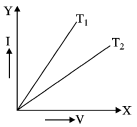
I-V graph at two different temperatures $T _1$ and $T _2$ for a metallic wire. Which temperature is greater and why? Image
Electric charge is distributed in a small volume. The electric flux passing through a total charge enclosed by a spherical surface of radius 10 cm is 10 Vm . Then what will be the flux associated with a concentric sphere of radius 20 cm ?
When a nucleus at rest emits a beta particle, it is found that the velocities of the recoiling nucleus and the beta particle are not along the same straight line. How can this be possible in view of the principle of conservation of momentum?
The separation between the consecutive dark fringes in a Young's double slit experiment is 1.0mm. The screen is placed at a distance of 2.5m from the slits and the separation between the slits is 1.0mm. Calculate the wavelength of light used for the experiment.
Kinetic energy of a neutron of mass 1.6 x $10^{-27}$ kg is 0.04 eV. Calculate de-Broglie wavelength of neutron.
The temperatures of the junctions of a bismuth-silver thermocouple are maintained at 0°C and 0.001°C. Find the thermo-emf (Seebeck emf) developed. For bismuth-silver, a = -46 × 10-6V°C-1 and b = -0.48 × 10⁻⁶V°C-2.
The susceptibility of magnesium at 300K is 1.2 × 10-5. At what temperature will the susceptibility increase to 1.8 × 10-5?
Use Kirchhoff's rules to obtain conditions for the balance condition in a Wheatstone bridge.
If an object far away from a convex mirror moves towards the mirror, the image also moves. Does it move faster, slower or at the same speed as compared to the object?