Question
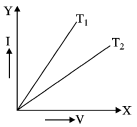
I-V graph at two different temperatures $T _1$ and $T _2$ for a metallic wire. Which temperature is greater and why? Image

Answer

Slope of graph at the temperature $T_2$ is less. Hence resistance will be more at this temperature. With increase in temperature, resistance also increases. Hence, $T_2$ is greater.

Need a full question paper?

Generate a complete, print-ready paper with questions like this in minutes — across 16+ boards, with answer keys.
Start Generating Free

Similar questions

Give definition of the smallest unit of energy, ev (electron volt) and give its explanation.
Is it true that the reaction of a gravitational force is always gravitational, of an electromagnetic force is always electromagnetic and so on?
The distance of the field point, on the equatorial plane of a small electric dipole is halved. By what factor does the electric field due to the dipole change?
An electric dipole of length 2 cm, when placed with its axis making an angle of $60^\circ$with a uniform electric field, experiences a torque of $8\sqrt{3}$ Nm. Calculate the potential energy of the dipole, if it has a charge of $\pm4\text{nC}.$
What are the effects on the depletion layer when the diode is connected in forward bias and reverse bias condition?
A telescope has been adjusted for relaxed eye. You are asked to adjust it for least distance of distinct vision, then how will you change the distance between two lenses?
How magnetic field lines are drawn? Write their four characteristics.
A parallel-plate capacitor is filled with a dielectric material of resistivity ρ and dielectric constant K. The capacitor is charged and disconnected from the charging source. The capacitor is slowly discharged through the dielectric. Show that the time constant of the discharge is independent of all geometrical parameters like the plate area or separation between the plates. Find this time constant.
Is it necessary to have two waves of equal intensity to study interference pattern? Will there be an effect on clarity if the waves have unequal intensity?
An electric bulb marked 220V, 100W will get fused if it is made to consume 150W or more. What voltage fluctuation will the bulb withstand?