Question
Define the magnifying power of a compound microscope when the final image is formed at infinity. Why must both the objective and the eyepiece of a compound microscope has short focal lengths? Explain.
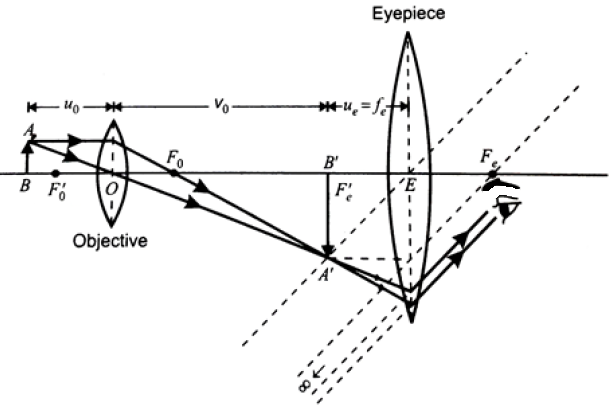
Answer


When the final image is formed at infinity.
When the final image is formed at infinity, the angular magnification due to the eyepiece is
$\text{m}_e=D/\text{f}_e$
Thus, the total magnification when the image is formed at infinity can be defined as the product of magnification of objective lens and eyepiece. i.e
m = mome = (L/fo) (D/fe)
From the above the equation, we can see that to achieve a large magnification of a small object, the objective and eyepiece should have small focal lengths.

Need a full question paper?

Generate a complete, print-ready paper with questions like this in minutes — across 16+ boards, with answer keys.

Start Generating Free