Gujarat BoardEnglish MediumSTD 12 SciencePhysicsELECTROMAGNETIC INDUCTION2 Marks
Question
Explain Magnetic flux with figure.
✓
Answer
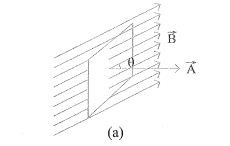
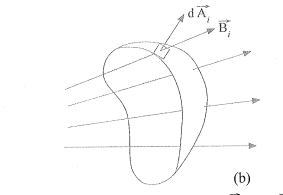
• Magnetic Flux : →Number of magnetic field lines passing perpendicularly through a surface kept in magnetic field is called Magnetic flux $\left(\phi_{ B }\right.$ ) linked with that surface. →In figure (a), Magnetic flux passing through plane having area A placed in a uniform magnetic field $\vec{B}$ can be given as follows. $\phi_{ B }=\overrightarrow{ B } \cdot \overrightarrow{ A }= BA \cos \theta$ Where, $\overrightarrow{ A }=$ Area Vector which is shown perpendicular to plane. $\theta$ is angle between $\overrightarrow{ A }$ and $\overrightarrow{ B }$ →Unit : W $b$ (weber) OR Tm² →Dimensions : $M ^1 L^2 T^{-2} A^{-1}$ →As shown in figure (b), when $\vec{B}$ and $\vec{A}$ have different magnitudes and directions at different parts of plane (when there is non-uniform magnetic field and curved surface), then magnetic flux passing through surface can be obtained in following manner : $\begin{aligned} \therefore \phi_{ B } & =\overrightarrow{ B }_1 \cdot d \overrightarrow{ A _1}+\overrightarrow{ B _2} \cdot d \overrightarrow{ A _2}+\ldots . . \\ & =\sum_{\text {all }} \overrightarrow{ B _i} \cdot d \overrightarrow{ A _i} \end{aligned}$ It means summation of magnetic flux passing through all surface elements. Where $\overrightarrow{d A_i}$ is $i^{\text {th }}$ area element and $\overrightarrow{ B }_i$ magnetic field at area element $d \overrightarrow{ A _i}$.
Need a full question paper?
Generate a complete, print-ready paper with questions like this in minutes — across 16+ boards, with answer keys.