Question
Define the term capacitive reactance. Show graphically the variation of capacitive reactance with frequency of applied alternating voltage.

An ac voltage $\text{V = V}_0\sin\omega\text{t}$ is applied across a pure capacitor of capacitance C. Find an expression for current flowing through it. Show mathematically the current flowing through it leads the applied voltage by angle $\frac{\pi}{2}.$

Answer

Capacitive Reactance: The opposition offered by a capacitor alone to the flow of alternating current through it is called the capacitive reactance.

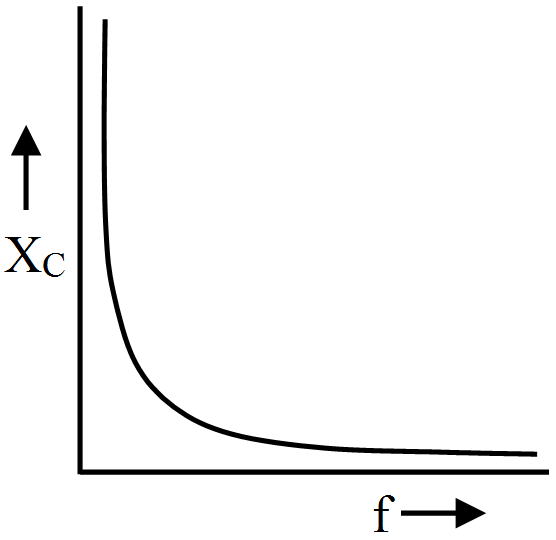
It is denoted by XC Its value is $\text{X}_{\text{C}}=\frac{1}{\omega\text{C}}=\frac{1}{2\pi\text{fC}}$

The graph of variation of capacitive reactance with frequency is shown in figure.

Phase Difference between Current and Applied voltage in Purely Capacitive Circuit:
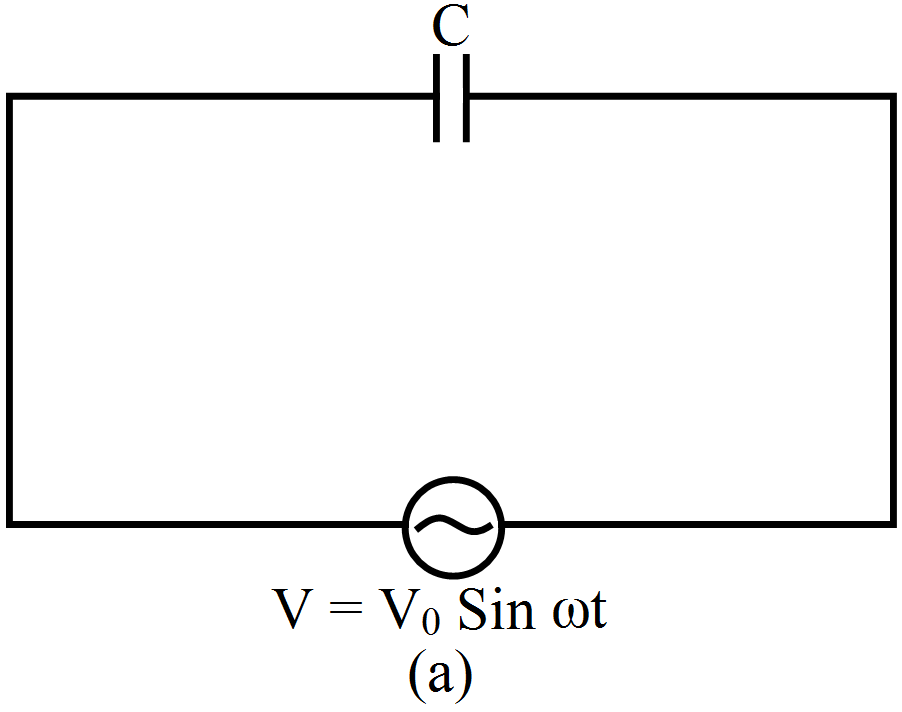
Circuit Containing Pure Capacitance: Consider a capacitor of capacitance C; connected to an alternating voltage source as shown.

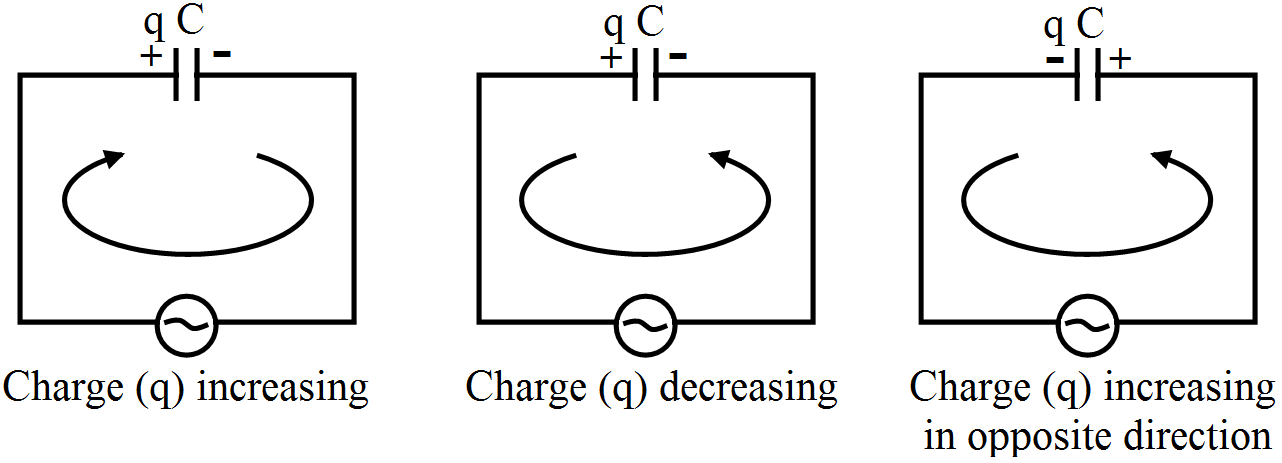
As ac voltage changes in magnitude and direction periodically with a definite frequency; therefore the plates of capacitor get charged, discharged and charged in opposite direction, discharged continuously (Fig. b). Therefore the flow of alternating current in the circuit is maintained. The instantaneous voltage,

$\text{V = V}_0\sin\omega\text{t} \ ...(\text{i})$

Let q be the charge on capacitor and i, the current in the circuit at any instant, then instantaneous potential difference,

$\text{V}=\frac{\text{q}}{\text{c}} \ ...(\text{ii})$

$\text{q}=\text{CV}_0\sin\omega\text{t}$
The instantaneous current,

$\text{i}=\frac{\text{dq}}{\text{dt}}=\frac{\text{d}}{\text{dt}}(\text{CV}_{\text{0}}\sin\omega\text{t})=\text{CV}_{0}\frac{\text{d}}{\text{dt}}(\sin\omega\text{t})$

$=\text{CV}_{0}\omega\cos\omega\text{t}$

$\text{i}=\frac{\text{V}_0}{\Big(\frac{1}{\omega\text{C}}\Big)}\cos\omega\text{t}=\frac{\text{V}_0}{\frac{1}{\omega\text{C}}}\sin\Big(\omega\text{t}+\frac{\pi}{2}\Big)$

$\text{i}=\text{I}_0\sin\Big(\omega\text{t}+\frac{\pi}{2}\Big) \ ...(\text{iii})$

where $\text{i}_0=\frac{\text{V}_0}{\Big(\frac{1}{\omega\text{C}}\Big)}$ = Peak value of A.C. ...(iv)

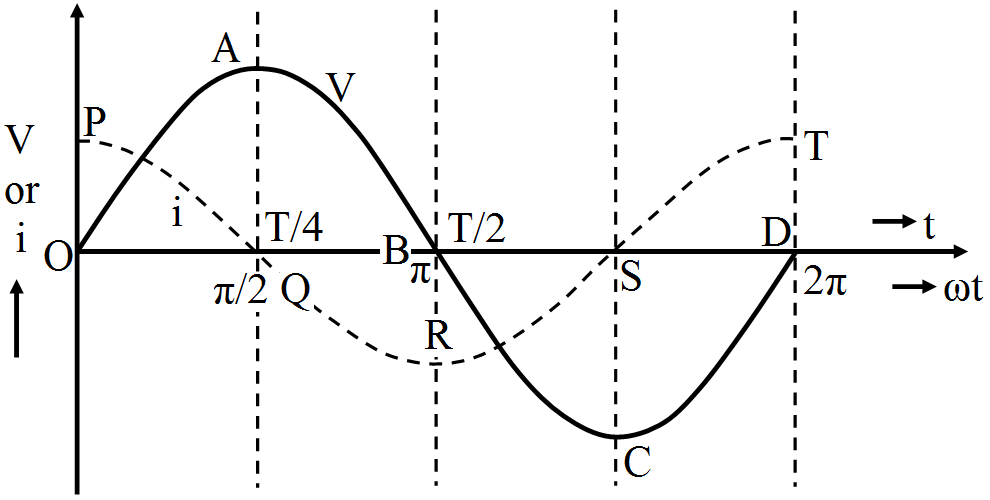
Also comparing (i) and (iii), we note that the current leads the applied emf by an angle $\frac{\pi}{2}$ This is shown graphically in fig. (c).
Need a full question paper?

Generate a complete, print-ready paper with questions like this in minutes — across 16+ boards, with answer keys.

Start Generating Free

Similar questions

The $\text{K}_\alpha$ X-rays of aluminium (Z = 13) and zinc (Z = 30) have wavelengths 887pm and 146pm respectively. Use Moseley's law $\sqrt{\text{v}}=\text{a}(\text{z-b})$ to find the wavelengths of the $\text{K}_\alpha$ X-ray of iron (Z = 26).
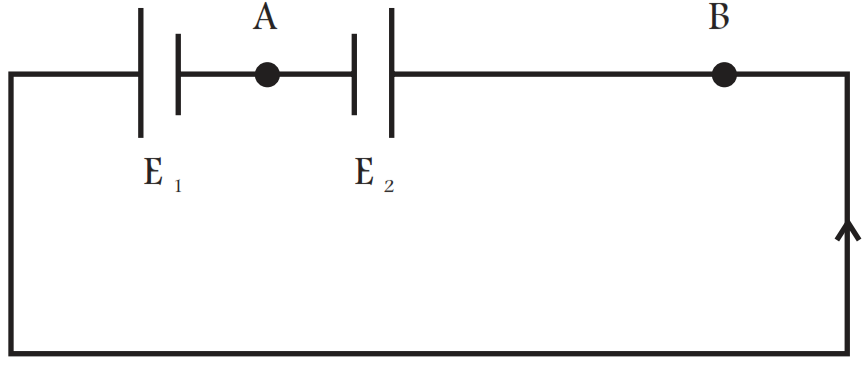
The circuit in Fig. shows two cells connected in opposition to each other. Cell E1 is of emf 6V and internal resistance 2Ω; the cell E2 is of emf 4V and internal resistance 8Ω. Find the potential difference between the points A and B.

Consider a metal ring kept (supported by a cardboard) on top of a fixed solenoid carrying a current I (see Fig). The centre of the ring coincides with the axis of the solenoid. If the current in the solenoid is switched off, what will happen to the ring?
The flux of magnetic field through a closed conducting loop changes with time according to the equation, $\phi=\text{at}^2+\text{bt}+\text{c}.$
  1. Write the SI units of a, band c.
  2. If the magnitudes of a, b and c are 0.20, 0.40 and 0.60 respectively, find the induced emf at t = 2s.
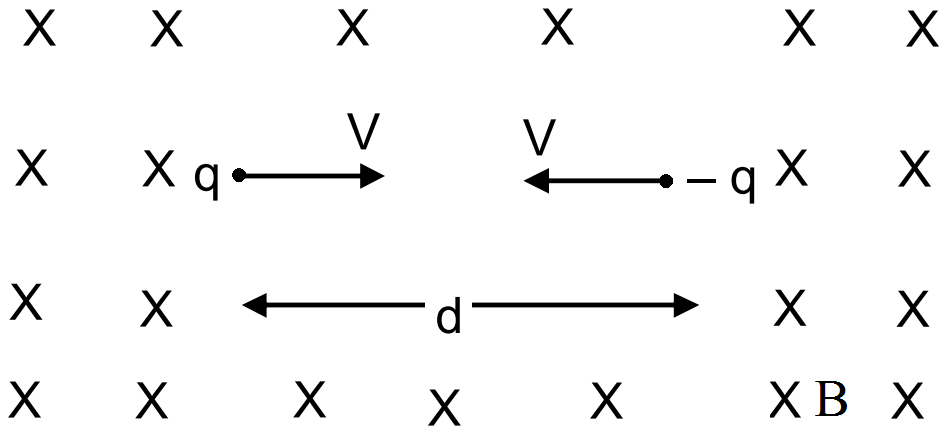
Two particles, each with mass m are placed at a separation d in a uniform magnetic field B, as shown in the figure. They have opposite charges of equal magnitude q. At time t = 0, the particles are projected towards each other, each with a speed v. Suppose the Coulomb force between the charges is switched off.
  1. Find the maximum value vm of the projection speed, so that the two particles do not collide.
  2. What would be the minimum and maximum separation between the particles if $\text{v}=\text{v}_{\text{m}}\sqrt{2}?$
  3. At what instant will a collision occur between the particles if v = 2vm?
  4. Suppose v = 2vm and the collision between the particles is completely inelastic. Describe the motion after the collision.

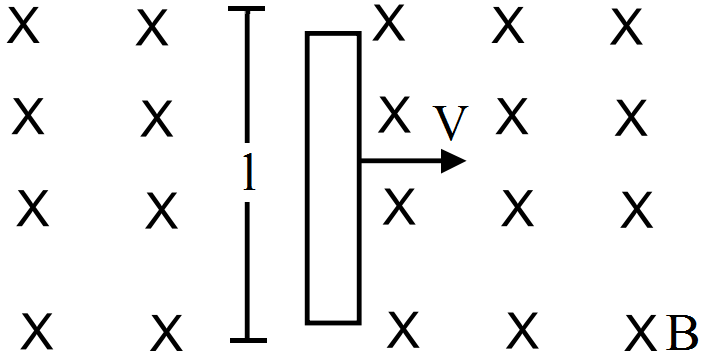
A conducting wire of length l, lying normal to a magnetic field B, moves with a velocity v, as shown in the figure.
  1. Find the average magnetic force on a free electron of the wire.
  2. Due to this magnetic force, electrons concentrate at one end, resulting in an electric field inside the wire. The redistribution stops when the electric force on the free electrons balances the magnetic force. Find the electric field developed inside the wire when the redistribution stops.
  3. What potential difference is developed between the ends of the wire?

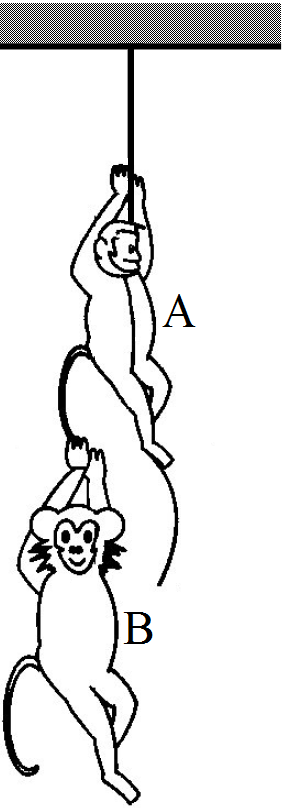
The monkey B shown in figure is holding on to the tail of the monkey A which is climbing up a rope. The masses of the monkeys A and B are 5kg and 2kg respectively. If A can tolerate a tension of 30N in its tail, what force should it apply on the rope in order to carry the monkey B with it? Take g = 10m/s2

Draw a labelled circuit diagram of a common emitter amplifier using a p-n-p transistor. Define the term voltage gain and write an expression for it. Explain how the input and output voltages are out of phase by 180° for a common-emitter transistor amplifiers.
A bullet of mass 20g moving horizontally at a speed of 300m/s is fired into a wooden block of mass 500g suspended by a long string. The bullet crosses the block and emerges on the other side. If the centre of mass of the block rises through a height of 20.0cm, find the speed of the bullet as it emerges from the block.
  1. Define mutual inductance and write its S.I. unit.
  2. Derive an expression for the mutual inductance of two long co-axial solenoids of same length wound one over the other.
  3. In an experiment, two coils c1 and c2 are placed close to each other. Find out the expression for the emf induced in the coil c1 due to a change in the current through the coil c2.