Question
Define the term capacitive reactance. Show graphically the variation of capacitive reactance with frequency of applied alternating voltage. An ac voltage $\text{V = V}_0\sin\omega\text{t}$ is applied across a pure capacitor of capacitance C. Find an expression for current flowing through it. Show mathematically the current flowing through it leads the applied voltage by angle $\frac{\pi}{2}.$
Answer


Capacitive Reactance: The opposition offered by a capacitor alone to the flow of alternating current through it is called the capacitive reactance.
It is denoted by $X_C$ Its value is $\text{X}_{\text{C}}=\frac{1}{\omega\text{C}}=\frac{1}{2\pi\text{fC}}$
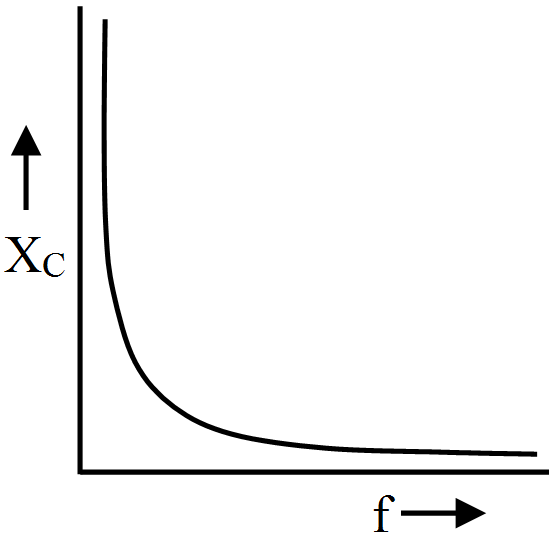
The graph of variation of capacitive reactance with frequency is shown in figure.
Phase Difference between Current and Applied voltage in Purely Capacitive Circuit:

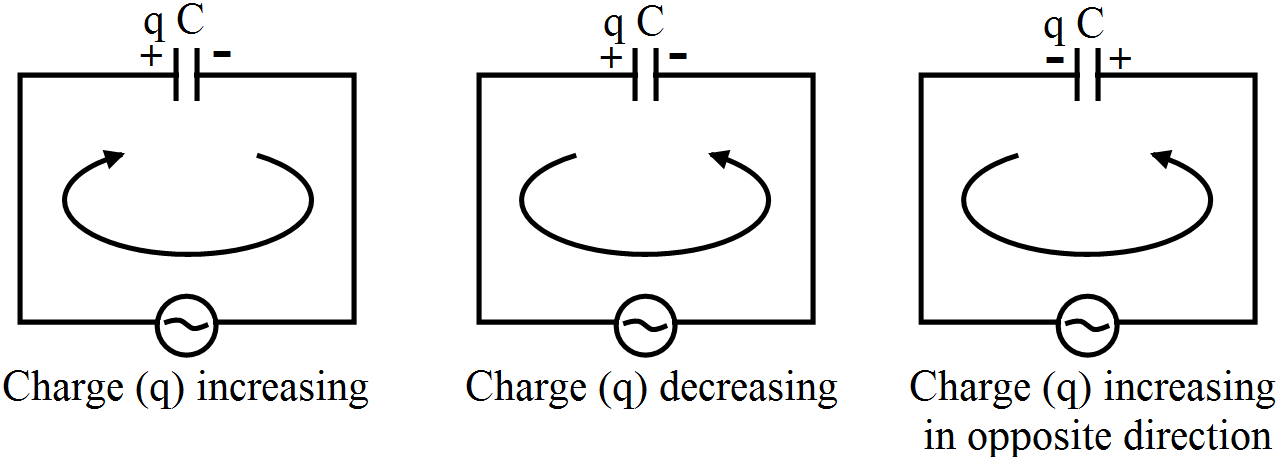
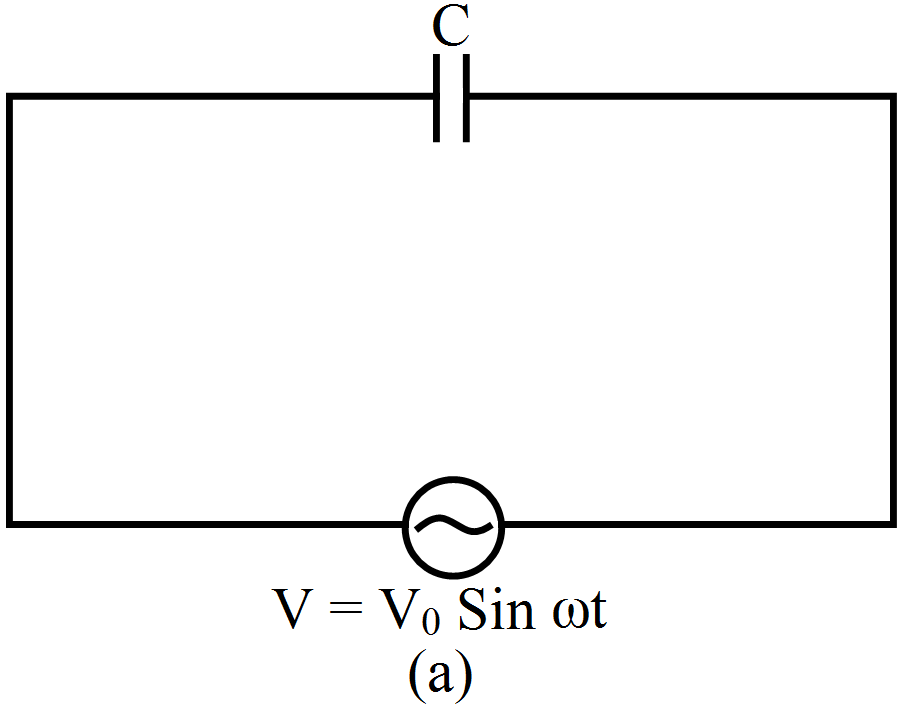
Circuit Containing Pure Capacitance: Consider a capacitor of capacitance C; connected to an alternating voltage source as shown.
As ac voltage changes in magnitude and direction periodically with a definite frequency; therefore the plates of capacitor get charged, discharged and charged in opposite direction, discharged continuously (Fig. b). Therefore the flow of alternating current in the circuit is maintained. The instantaneous voltage,
$\text{V = V}_0\sin\omega\text{t} \ ...(\text{i})$
Let q be the charge on capacitor and i, the current in the circuit at any instant, then instantaneous potential difference,
$\text{V}=\frac{\text{q}}{\text{c}} \ ...(\text{ii})$
$\text{q}=\text{CV}_0\sin\omega\text{t}$

The instantaneous current,
$\text{i}=\frac{\text{dq}}{\text{dt}}=\frac{\text{d}}{\text{dt}}(\text{CV}_{\text{0}}\sin\omega\text{t})=\text{CV}_{0}\frac{\text{d}}{\text{dt}}(\sin\omega\text{t})$
$=\text{CV}_{0}\omega\cos\omega\text{t}$
$\text{i}=\frac{\text{V}_0}{\Big(\frac{1}{\omega\text{C}}\Big)}\cos\omega\text{t}=\frac{\text{V}_0}{\frac{1}{\omega\text{C}}}\sin\Big(\omega\text{t}+\frac{\pi}{2}\Big)$
$\text{i}=\text{I}_0\sin\Big(\omega\text{t}+\frac{\pi}{2}\Big) \ ...(\text{iii})$
where $\text{i}_0=\frac{\text{V}_0}{\Big(\frac{1}{\omega\text{C}}\Big)}$ = Peak value of A.C. ...(iv)
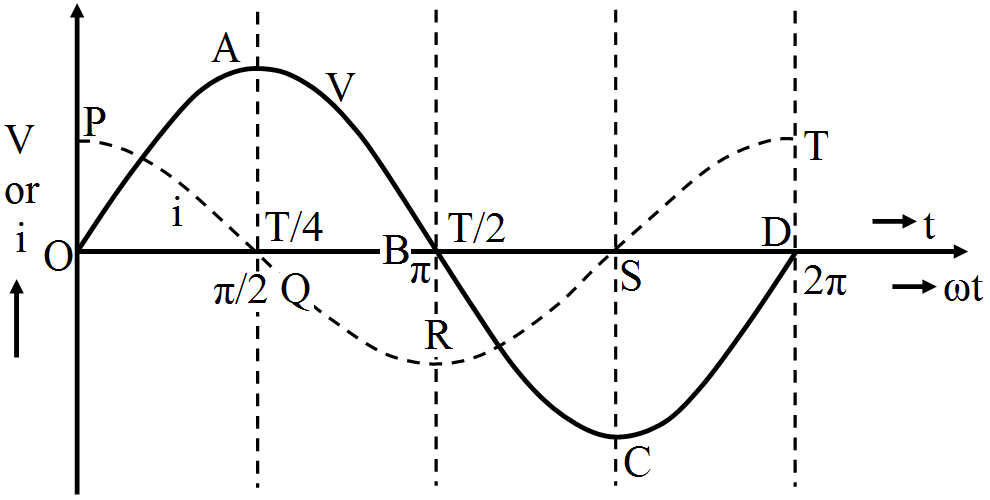
Also comparing (i) and (iii), we note that the current leads the applied emf by an angle $\frac{\pi}{2}$ This is shown graphically in fig. (c).

Need a full question paper?

Generate a complete, print-ready paper with questions like this in minutes — across 16+ boards, with answer keys.

Start Generating Free

Similar questions

A radio can tune in to any station in the 7.5 MHz to 12 MHz band. What is the corresponding wavelength band?
Suppose a 'n' - type wafer is created by doping Si crystal having $5 \times 10^{28} atoms/m^3$ with 1ppm concentration of As. On the surface 200 ppm Boron is added to create ‘P’ region in this wafer. Considering $n_i = 1.5 \times 10^{16}m^{-3}.$
  1. Calculate the densities of the charge carriers in the n & p regions.
  2. Comment which charge carriers would contribute largely for the reverse saturation current when diode is reverse biased.
The conductivity of an intrinsic samiconductor depends on temperature as $\sigma=\sigma_0\text{ e}^{\frac{-\Delta\text{E}}{2\text{kT}}}$ where $\sigma_0$ is a constant. Find the temperature at which the conductivity pf an intrinsic germanium semiconductor will be double of its value at T = 300K. Assume that the gap for germanium is 0.650eV and remains constant as the temperature is increased.
A compound microscope consists of an objective lens of focal length 2.0 cm and an eyepiece of focal length 6.25 cm separated by a distance of 15 cm. How far from the objective should an object be placed in order to obtain the final image at (a) the least distance of distinct vision (25 cm), and (b) at infinity? What is the magnifying power of the microscope in each case?
$a.$ Derive an expression for the energy stored in a parallel plate capacitor of capacitance $C$ when charged up to voltage $V$. How is this energy stored in the capacitor?
$b.$ A capacitor of capacitance $1 \mu F$ is charged by connecting a battery of negligible internal resistance and emf $10 V$ across it. Calculate the amount of charge supplied by the battery in charging the capacitor fully.
What is meant by power of lens? Explain this.
Two cells of same emf E but internal resistance $r_1$ and $r_2$ are connected in series to an external resistor R (Fig). What should be the value of R so that the potential difference across the terminals of the first cell becomes zero.
A paisa coin is made up of Al-Mg alloy and weighs 0.75g. It has a square shape and its diagonal measures 17mm. It is electrically neutral and contains equal amounts of positive and negative charges.
Treating the paisa coins made up of only Al, find the magnitude of equal number of positive and negative charges. What conclusion do you draw from this magnitude?
Using Huygens’ Principle, draw a diagram to show propagation of a wavefront originating from a monochromatic point source. Explain briefly.
  1. State the working principle of a potentiometer. With the help of the circuit diagram, explain how a potentiometer is used to compare the emf’s of two primary cells. Obtain the required expression used for comparing the emfs.
  2. Write two possible causes for one sided deflection in a potentiometer experiment.