Question
$a.$ Derive an expression for the energy stored in a parallel plate capacitor of capacitance $C$ when charged up to voltage $V$. How is this energy stored in the capacitor?
$b.$ A capacitor of capacitance $1 \mu F$ is charged by connecting a battery of negligible internal resistance and emf $10 V$ across it. Calculate the amount of charge supplied by the battery in charging the capacitor fully.
Answer

$a.$ Work done in adding a charge $dq = dW$
$= Vdq$
$=\frac{q}{c} d q$
$\therefore$ Total Amount of work $(W)$ in charging a capacitor
$ W =\int d W=\frac{1}{C} \int_0^Q q d q$
$W=\frac{Q^2}{2 C}$
$=\frac{(C V)^2}{2 C}=\frac{1}{2} C V^2$
The electrostatic Energy/ potential energy is stored in the electric field between the plates.
$b. C =1 \mu F=1 \times 10^{-6} F ; V =10$ volt
$Q=C V$
$=1 \times 10^{-6} \times 10$
$=10^{-5} \text { coulomb }$
hence, the amount of charge supplied by the battery in charging the capacitor fully is $10^{-5}$ coulomb.

Need a full question paper?

Generate a complete, print-ready paper with questions like this in minutes — across 16+ boards, with answer keys.

Start Generating Free

Similar questions

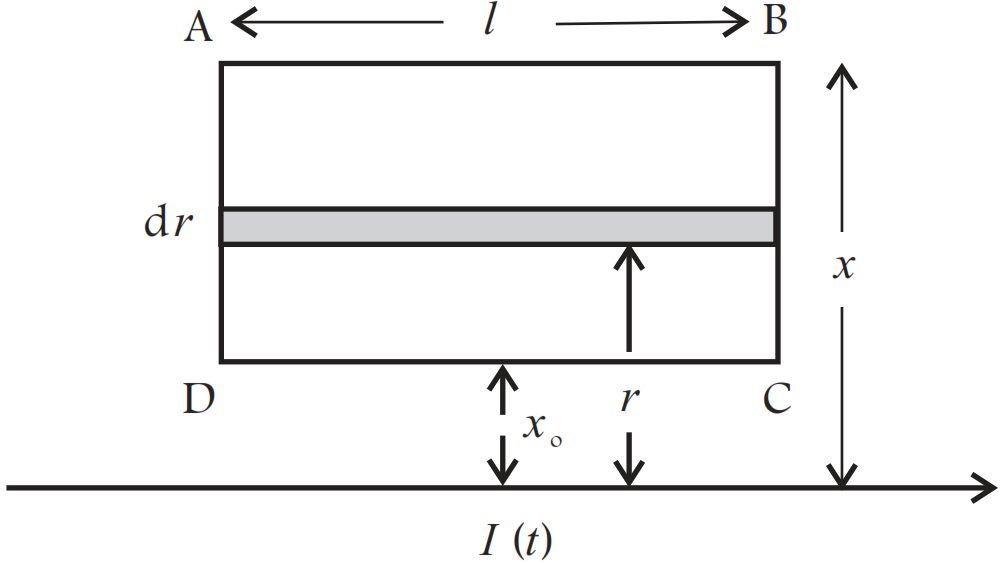
Consider an infinitely long wire carrying a current I (t), with $\frac{\text{dI}}{\text{dt}}=\lambda=\text{constant}$. Find the current produced in the rectangular loop of wire ABCD if its resistance is R (Fig).

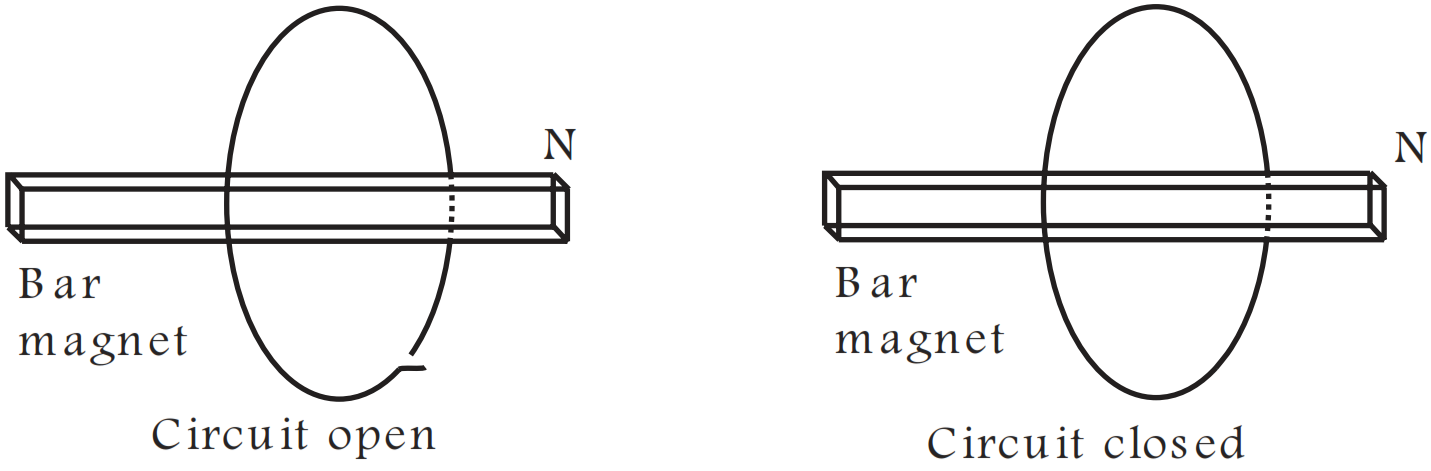
Consider a magnet surrounded by a wire with an on/off switch S (Fig). If the switch is thrown from the off position (open circuit) to the on position (closed circuit), will a current flow in the circuit? Explain.
A magnetic field set up using Helmholtz coils (described in Exercise 4.16) is uniform in a small region and has a magnitude of 0.75 T. In the same region, a uniform electrostatic field is maintained in a direction normal to the common axis of the coils. A narrow beam of (single species) charged particles all accelerated through 15 kV enters this region in a direction perpendicular to both the axis of the coils and the electrostatic field. If the beam remains undeflected when the electrostatic field is $9.0 \times 10^{–5} V m^{–1}$, make a simple guess as to what the beam contains. Why is the answer not unique?
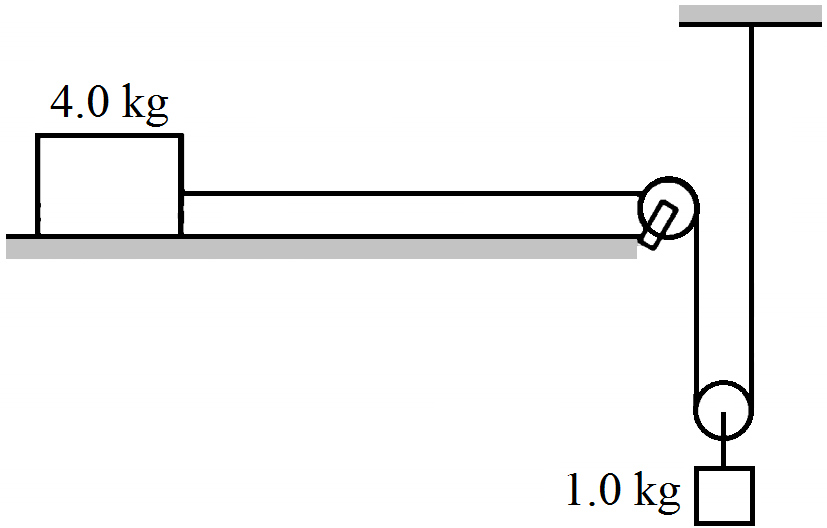
Consider the situation shown in figure. The system is released from rest and the block of mass 1.0kg is found to have a speed 0.3m/s after it has descended through a distance of 1m. Find the coefficient of kinetic friction between the block and the table.
Two charged particles placed at a separation of 20cm exert 20N of Coulomb force on each other. What will be the force if the separation is increased to 25cm?
$a.$ Use Huygen's geometrical construction to show how a plane wavefront at $t = 0$ propagates and produces a wavefront at a later time.
$b.$ Verify, using Huygen's principle, Snell's law of refraction of a plane wave propagating from a denser to a rarer medium.
$c.$ Illustrate with the help of diagrams the action of
$i.$ convex lens and
$ii.$ concave mirror, on a plane wavefront incident on it.
A particle of mass m and charge q is released from the origin in a region in which the electric field and magnetic field are given by
$\overrightarrow{\text{B}}=-\text{B}_0\overrightarrow{\text{j}}$ and $\overrightarrow{\text{E}}=\text{E}_0\overrightarrow{\text{k}}.$ Find the speed of the particle as a function of its z-coordinate.
Suppose the $19\Omega$ resistor of the previous problem is disconnected. Find the current through $P_2Q_2$ in the two situations:
  1. Both the wires move towards right.
  2. If $P_1Q_1$ moves towards left but $P_2Q_2$ moves towards right.
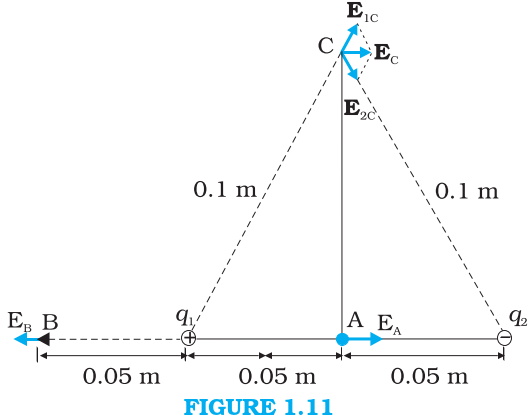
Two point charges $q_1$ and $q_2$, of magnitude $+10^{-8} C$ and $-10^{-8} C$, respectively, are placed $0.1 m$ apart. Calculate the electric fields at points A, B and C shown in Fig. 1.11.
Image
If the tension in the cable supporting an elevator is equal to the weight of the elevator, the elevator may be:
  1. Going up with increasing speed.
  2. Going down with increasing speed.
  3. Going up with uniform speed.
  4. Going down with uniform speed.