Question
  1. Define the term ‘isomers’.
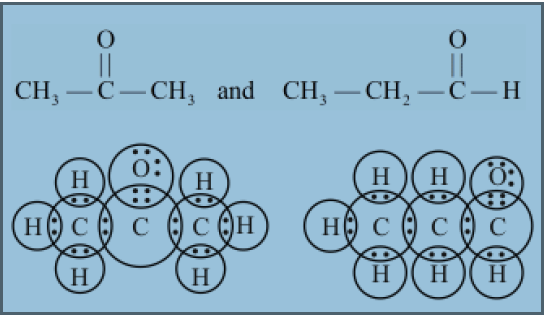
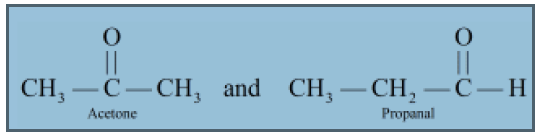
  2. Draw two possible isomers of the compound with molecular formula $\text{C}_3\text{H}_6\text{O}$ and write their names.
  3. Give the electron dot structure of the above two compounds.
Answer

  1. Molecules having same molecular formula but different structural formula are known as isomers.
  2. Two possible isomers of the compound with molecular formula $\text{C}_3\text{H}_6\text{O}$:
  1. Electron dot structure:

Need a full question paper?

Generate a complete, print-ready paper with questions like this in minutes — across 16+ boards, with answer keys.

Start Generating Free

Similar questions

What are the three R’s to save the environment? Explain with one example of each.
An organism X having breathing organs A lives on land. When organism X goes under water, it cannot survive for a long time unless carrying an oxygen cylinder. On the other hand, the organism Y having breathing organs B always lives in water and if taken out of water, it dies after a short while. A third organism Z having breathing organs C and D which lives on the banks of ponds, lakes and rivers can survive on land as well as in water equally well.
  1. What could organism X be? Name the breathing organs A.
  2. What could organism Y be? Name the breathing organs B.
  3. What could organism Z be? Name the breathing organs C and D.
  4. Out of X, Y and Z, which organism is.
  1. Amphibian,
  2. Aquatic,
  3. Terrestrial?
A student has three concave mirrors A, B and C of focal lengths 20 cm, 15 cm and 10 cm, respectively. For each concave mirror, he performs the experiment of image formation for three values of object distance of 30 cm, 10 cm and 20 cm.
Give reasons for the following:
i. For the three object distances, identify the mirror which will form an image equal in size to that of object. Find at least one value of object distance.
ii. Out of the three mirrors, identify the mirror which would be preferred to be used for shaving purpose.
iii. For the mirror B, draw ray diagram for image formation for any two given values of object distance.
  1. State Fleming’s left hand rule.
  2. Write the principle of working of an electric motor.
  3. Explain the function of the following parts of an electric motor.
  1. Armature.
  2. Brushes.
  3. Split ring.
Mendeleev predicted the existence of certain elements not known at that time and named two of them as eka - aluminium, and eka - silicon.
  1. Name the element which has taken the place of (i) eka - aluminium, and (ii) eka - silicon.
  2. Mention the period/ periods of these elements in the modern periodic table.
  3. Write the group/ groups of these elements in the modern periodic table.
  4. Classify these elements as metals, non - metals or metalloids.
  5. How many valence electrons are present in the atoms of each of these elements?​​​​​​
How do carbohydrates, proteins and fats get digested in human beings?
Write the equations for the reactions of:
  1. Magnesium with dilute hydrochloric acid.
  2. Aluminium with dilute hydrochloric acid.
  3. Zinc with dilute hydrochloric acid.
  4. Iron with dilute hydrochloric acid.
Name the products formed in each case. Also indicate the physical states of all the substances involved.
QUESTION A red-brown metal X forms a salt $XSO _4$. When hydrogen sulphide gas is passed through an aqueous solution of $XSO _4$, then a black precipitate of XS is formed alongwith sulphuric acid solution.
a. What could the salt $XSO _4$ be?
b. What is the colour of salt $XSO _4$ ?
c. Name the black precipitate XS.
d. By using the formula of the salt obtained in (a) above, write an equation of the reaction which takes place when hydrogen sulphide gas is passed through its aqueous solution.
e. What type of chemical reaction takes place in this case?
  1. A student suffering from myopia is not able to see distinctly the objects placed beyond 5 m. List two possible reasons due to which this defect of vision may have arisen. With the help of ray diagrams, explain.
  1. Why the student is unable to see distinctly the objects placed beyond 5 m from his eyes.
  2. The type of the corrective lens used to restore proper vision and how this defect is corrected by the use of this lens.
  1. If, in this case, the numerical value of the focal length of the corrective lens is 5 m, find the power of the lens as per the new Cartesian sign convention.
How could the Modern Periodic Table remove various anomalies of Mendeléev’s Periodic Table?