Question
  1. A student suffering from myopia is not able to see distinctly the objects placed beyond 5 m. List two possible reasons due to which this defect of vision may have arisen. With the help of ray diagrams, explain.
  1. Why the student is unable to see distinctly the objects placed beyond 5 m from his eyes.
  2. The type of the corrective lens used to restore proper vision and how this defect is corrected by the use of this lens.
  1. If, in this case, the numerical value of the focal length of the corrective lens is 5 m, find the power of the lens as per the new Cartesian sign convention.
Answer

Two possible reasons due to which this defect of vision may have arisen are:
  1. Increase in curvature of the lens.
  2. Increase in length of the eyeball.
  1.  
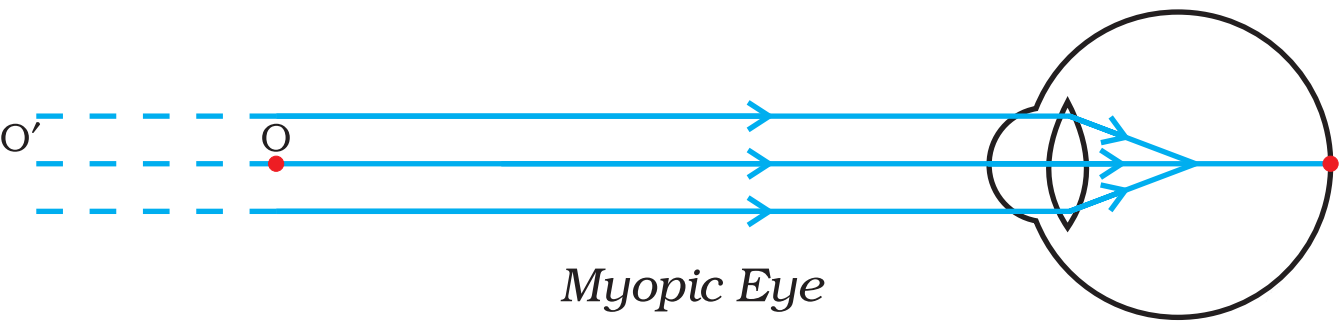
  1. A myopic eye has its far point nearer than infinity. It forms the image of a distant object in front of its retina as shown in the figure given below. In the given case student's far point is 5 m. So, image of the object placed beyond 5 m from his eyes is formed in front of the retina and hence appears blurred. That is why the student is unable to see distinctly the objects placed beyond 5 m from his eyes.
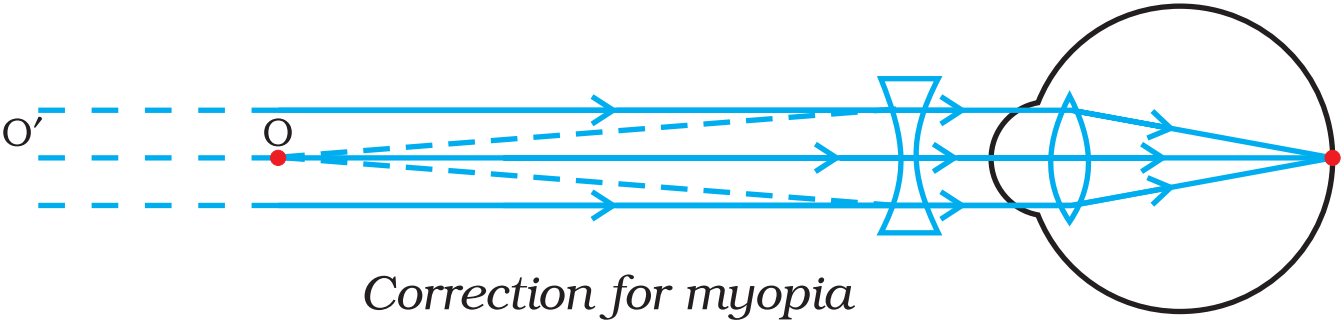
  1. Since a concave lens has an ability to diverge incoming rays, it is used to correct this defect of vision. The image is allowed to form at the retina by using a concave lens of suitable power as shown in the given figure.
  1. Power of the required corrective lens $(\text{P})=\frac{1}{\text{f}\text{(in m)}}$
$\text{P}=-\frac{1}{5}$

$\text{P} = -0.2\text{D}$

Hence, the power of corrective lens is -0.2D.

Need a full question paper?

Generate a complete, print-ready paper with questions like this in minutes — across 16+ boards, with answer keys.

Start Generating Free

Similar questions

Draw the structures for the following compounds.
  1. Ethanoic acid
  2. Bromopentane
  3. Butanone
  4. Hexanal.
Are structural isomers possible for bromopentane?
A person first crossed pure-bred pea plants having round-yellow seeds with pure-bred pea plants having wrinkled-green seeds and found that only A-B type of seeds were produced in the $F_1$ generation. When $F_1$ generation pea plants having A-B type of seeds were cross-bred by self-pollination, then in addition to the original round-yellow and wrinkled-green seeds, two new varieties A-D and C-B type of seeds were also obtained.
  1. What are A-B type of seeds?
  2. State whether A and B are dominant traits or recessive traits.
  3. What are A-D type of seeds?
  4. What are C-B type of seeds?
  5. Out of A-B and A-D types of seeds, which one will be produced in (i) minimum numbers, and (ii) maximum numbers, in the $F_2$ generation?
The gland X which is located just below the brain in the human head secretes a chemical substance Y which controls the development of ones and muscles in the body of a person. Secretion of too little of substance Y as well as the secretion of too much of substance Y by the gland X leads to abnormal development of the body of a person.
  1. Name the gland X.
  2. What is the chemical substance Y?
  3. What happens if too little of substance Y is secreted?
  4. What happens if too much of substance Y is secreted?
  5. Name the system of glands in the human body of which gland X is a part.
P is a cell (or group of cells) in the human body which is sensitive to a particular type of stimulus and conveys the messages to CNS through nerves Q. On the other hand, R is a part of the human body which can respond to a stimulus according to the instructions sent from the CNS through nerves S.
  1. What is P? Name five organs which contain cells (or group of cells) like P.
  2. Name the nerves Q.
  3. What is R? Give two examples of R.
  4. Name nerves S.
  5. How do messages travel through the nerves Q and S?
Draw the labelled diagram of an A.C. generator. With the help of this diagram, explain the construction and working of an A.C. generator.
  1. List the parts of the human eye that control the amount of light entering into it. Explain how they perform this function.
  2. Write the function of retina in human eye.
  3. Do you know that the corneal-impairment can be cured by replacing the defective cornea with the cornea of the donated eye? How and why should we organise groups to motivate the community members to donate their eyes after death?
A group of students measured the pH of some substances they found in their homes. Their results are given in the following table:
Sabstance pH Sabstance pH
Apples 3.0 Salt 7.0
Baking soda 8.5 Sugar 7.0
Black coffee 5.0 Toothpaste 9.0
Houshold ammonoa 12.0 Vinegar 3.0
Lemon juoce 2.5 Wasimg soda 11.5
Milk 6.0    
  1. What would the students have used to measure the pH?
  2. Which solution is the most acidic (c) Which solution is the most alkaline?
  3. Which solutions are neutral?
  4. Which solution can be used to treat wasp stings?
  5. Which solution can be used to treat bee stings?
Draw the electron-dot structures of the following compounds and state the type of bonding in each case:
i. KCl
ii. $NH _3$
iii. CaO
iv. $N _2$
v. $CaCl _2$
What do you mean by multiple covalent bonding? Explain with the help of examples.
Three $2\Omega$ resistors, A, B and C, are connected as shown in Figure. Each of them dissipates energy and can withstand a maximum power of 18W without melting. Find the maximum current that can flow through the three resistors?