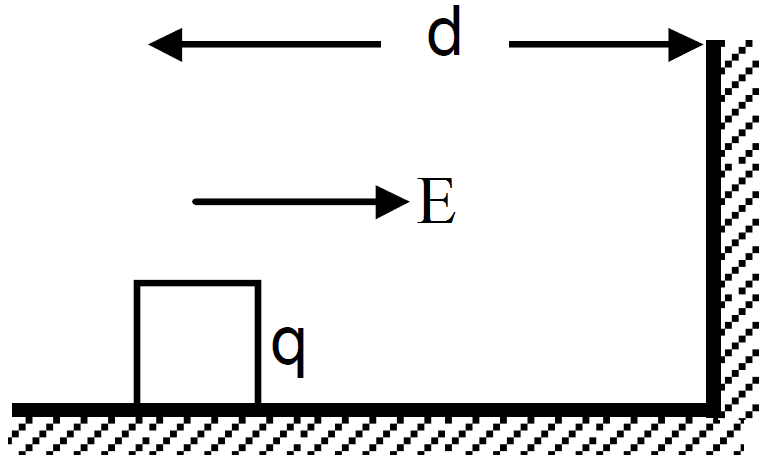
Question
Define the term ‘linearly polarised light’.
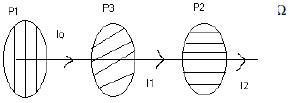
When’ does the intensity of transmitted light become maximum, when a polaroid sheet is rotated between two crossed polaroids?

Answer

When the vibrations of the electric field vector $(\overrightarrow{\text{E}})$ are confined to only one direction then light is called linearly polarized light.Intensity of transmitted light is maximum when the Polaroid sheet makes an angle of $45^0$ with the pass axis.
Alternate Answer

Need a full question paper?

Generate a complete, print-ready paper with questions like this in minutes — across 16+ boards, with answer keys.

Start Generating Free

Similar questions

Explain Ohm's law.
A cylindrical metallic wire is stretched to increase its length by 5%. Calculate the percentage change in its resistance.
Can there be a potential difference between two adjacent conductors carrying the same charge?
Explain the observation of Hallwachs and Lenard for the photoelectric effect.
Define the ionisation energy. What is the value of it for hydrogen atom?
Light is incident from glass $(\mu=1.5)$ to air. Sketch the variation of the angle of deviation $\delta$ with the angle of incident i for 0 < i < 90°.
In a factory it is desired to lift 2000kg of metal through a distance of 12m in 1 minute. Find the minimum horsepower of the engine to be used.
Two identical phase connected waves, each of intensity $I _0$, are producing interference patterns. Write the value of the resultant intensity at the places of (i) constructive interference, (ii) destructive interference
(a) Calculate the potential at a point $P$ due to a charge of $4 \times 10^{-7} C$ located $9 cm$ away.
(b) Hence obtain the work done in bringing a charge of $2 \times 10^{-9} C$ from infinity to the point P. Does the answer depend on the path along which the charge is brought?
A block of mass m containing a net positive charge q is placed on a smooth horizontal table which terminates in a vertical wall as shown in figure. The distance of the block from the wall is d. A horizontal electric field E towards right is switched on. Assuming elastic collisions (if any) find the time period of the resulting oscillatory motion. Is it a simple harmonic motion?