Question
Define the term ‘linearly polarised light’.
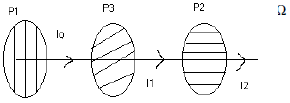
When’ does the intensity of transmitted light become maximum, when a polaroid sheet is rotated between two crossed polaroids?

Answer

When the vibrations of the electric field vector $(\overrightarrow{\text{E}})$ are confined to only one direction then light is called linearly polarized light.

Intensity of transmitted light is maximum when the Polaroid sheet makes an angle of 450 with the pass axis.

Alternate Answer

Need a full question paper?

Generate a complete, print-ready paper with questions like this in minutes — across 16+ boards, with answer keys.

Start Generating Free

Similar questions

With the help of suitable diagram explain the real depth and apparent depth.
Derive an expression for the electric potential at any point along the axial line of an electric dipole?
It is heard sometime that mercury is used in defining the temperature scale because it expands uniformly with temperature. If the temperature scale is not yet defined, is it logical to say that a substance expands uniformly with temperature?
An electron is not deflected while passing through any field. Is it possible that there is no magnetic field present at that place? Explain.
A variable resistor R, electromotive force and internal resistance $r$ are joined as shown in the given figure across the ends of the cell. Draw graph to show (i) terminal voltage and (ii) current $I$ as a function of $R$.
Image
Think over the experiment number 2 of Faraday and Henry and tell :
(a) What will you do to obtain more deflection in the galvanometer?
(b) How will you show the presence of current in the absence of a galvanometer?
Find the neutral temperature and inversion temperature of a copper-iron thermocouple if the reference junction is kept at 0°C. Use the data in the table.
 
Metal with
a
b
lead (Pb)
$\mu\text{V}/^\circ\text{C}$
$\mu\text{V}/^\circ(\text{C})^2$
Aluminium
-0.47
0.003
Bismuth
-43.7
-0·47
Copper
2.76
0·012
Gold
2.90
0.0093
Iron
16.6
-0.030
Nickel
19.1
-0.030
Platinum
-1.79
-0.035
Silver
2.50
0.012
Steel
10.8
-0.016
 
Explain simple microscope. Obtain the equation of magnification for the image formed at near point.
a. Show that the time period (T) of oscillations of a freely suspended magnetic dipole of magnetic moment (m) in a uniform magnetic field (B) is given by $T=2 \pi \sqrt{\frac{I}{m B}}$, where I is a moment of inertia of the magnetic dipole.
b. Identify the following magnetic materials:
i. A material having susceptibility $\left(\chi_m\right)=-0.00015$.
ii. A material having susceptibility $\left(\chi_m\right)=10^{-5}$.
How resistivity of material depends on its temperature. Write its empirical formula.