Question
Define the term orbital speed. Establish a relation for orbital speed of a satellite orbiting very close to the surface of the earth. Find the ratio of this orbital speed and escape speed.
Answer

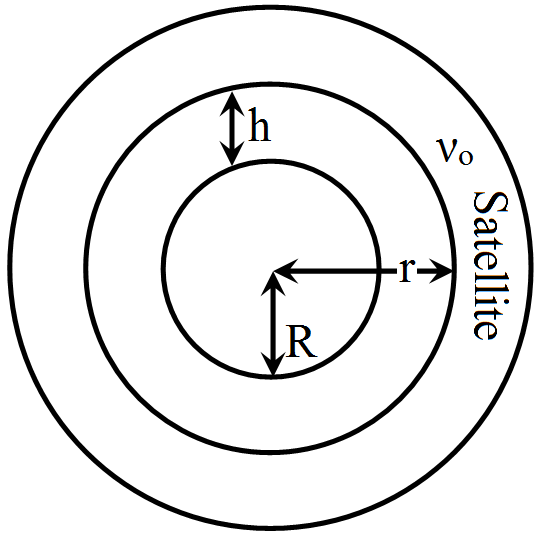
Orbital speed: It is the minimum speed required to put the satellite into given orbit around the earth.
 M = mass of earth R = radius of earth m = mass of satellite $v_0$ = orbital velocity of satellite h = height of satellite above surface of earth. r = R + h According to Newton's law of gravitation, $\text{F} = \frac{\text{GMm}}{\text{r}^2}$ Centripetal force $\text{F} = \frac{\text{mv}_{\text{o}}}{\text{r}}$ In equilibrium, gravitational pull provides the required centripetal force. $\frac{\text{mv}^2_{\text{o}}}{\text{r}}=\frac{\text{GMm}}{\text{r}^2}$ $\Rightarrow\text{v}_{\text{o}}=\sqrt{\frac{\text{GM}}{\text{r}}}$ $\text{v}_{\text{o}}=\sqrt{\frac{\text{gR}^2}{\text{r}}}=\sqrt{\frac{\text{gR}^2}{\text{R+h}}}$ $\text{for h }<<\text{R}$ $\text{R}+\text{h}\approx\text{R}$ $\therefore\text{v}_{\text{o}}=\sqrt{\text{gR}}$ $\Rightarrow\text{v}_{\text{e}}=\sqrt{2\text{gR}}$ $\frac{\text{v}_{\text{o}}}{\text{v}_{\text{e}}}=\frac{1}{\sqrt{2}}$

Need a full question paper?

Generate a complete, print-ready paper with questions like this in minutes — across 16+ boards, with answer keys.
Start Generating Free

Similar questions

A parallel-plate capacitor of plate area A and plate separation d is charged to a potential difference V and then the battery is disconnected. A slab of dielectric constant K is then inserted between the plates of the capacitor so as to fill the space between the plates. Find the work done on the system in the process of inserting the slab.
Obtain an expression for the acceleration due to gravity on the surface of the earth in terms of man of the earth and its radius. Discuss the variation of acceleration due to gravity with altitude and depth. If a body is taken to a height equal to $\frac{\text{R}}{4}$ from the surface of the earth then find percentage decrease in the weight of the body? Where R is radius of the earth.
An object falling through a fluid is observed to have acceleration given by a = g - bv where g = gravitational acceleration and b is constant. After a long time of release, it is observed to fall with constant speed. What must be the value of constant speed?
The motion of a particle executing simple harmonic motion is described by the displacement function, $x ( t )= A$ $\cos \left(\omega_t+\omega\right)$.
If the initial $(t=0)$ position of the particle is 1 cm and its initial velocity is $\omega cm / s$, what are its amplitude and initial phase angle? The angular frequency of the particle is $\pi s ^{-1}$. If instead of the cosine function, we choose the sine function to describe the $SHM : x = B \sin (\omega t+a)$, what are the amplitude and initial phase of the particle with the above initial conditions.
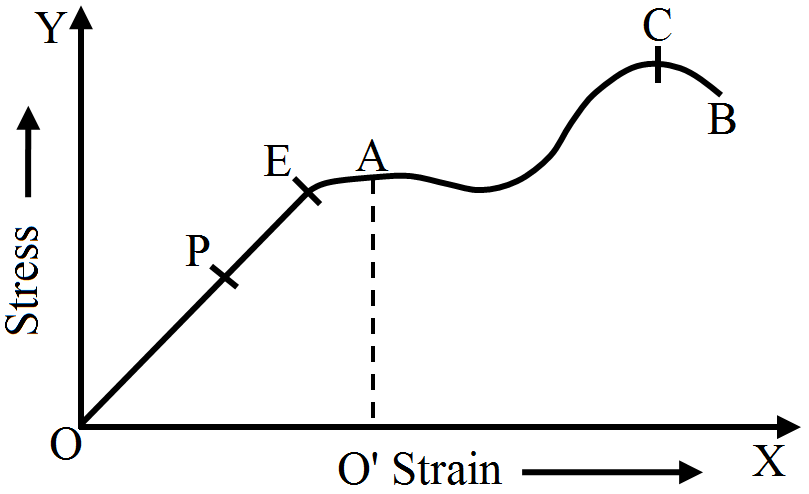
The Stress-Strain graph for a metal wire is shown in the figure upto the point E. The wire returns to its original state O along the curve EPO when it is gradually unloaded. Point B corresponds to the fracture of the wire:
  1. Upto what point of the curve is Hooke's law obeyed?
  2. Which point on the curve corresponds to the elastic limit or yield point of the wire?
  3. Indicate the elastic and plastic regions of the Stress-Strain graph.
  4. Describe what happens when the wire is loaded upto a stress corresponding to the point A on the graph, and then unloaded gradually. In particular, explain, the dotted curve.
  5. What is peculiar about the portion of the Stress-Strain graph from C to B? Upto what stress can the wire be subjected without causing fracture?
A box of 1.00m3 is filled with nitrogen at 1.5 atm at 300K. The box has a hole of an area 0.010 mm2. How much time is required for the pressure to reduce by 0.10atm, if the pressure outside is 1atm.
A motorcycle has to move with a constant speed on an overbridge which is in the form of a circular arc of radius R and has a total length L. Suppose the motorcycle starts from the highest point.
  1. What can its maximum velocity be for which the contact with the road is not broken at the highest point?
  2. If the motorcycle goes at speed $\frac{1}{\sqrt2}$ times the maximum found in part (a), where will it lose the contact with the road?
  3. What maximum uniform speed can it maintain on the bridge if it does not lose contact anywhere on the bridge?
The magnetic field existing in a region is given by $\overrightarrow{\text{B}}=\text{B}_0\Big(1+\frac{\text{x}}{\text{l}}\Big)\overrightarrow{\text{k}}.$ A square loop of edge land carrying a current i, is placed with its edges parallel to the x - y axes. Find the magnitude of the net magnetic force experienced by the loop.
Describe the method of determining coefficient of viscosity.
One mole of an ideal gas at standard temperature and pressure occupies $22.4 L$ (molar volume). What is the ratio of molar volume to the atomic volume of a mole of hydrogen? (Take the size of hydrogen molecule to be about $1\mathring{\text{A}}$). Why is this ratio so large?