Question
Define the term 'resolving power' of an astronomical telescope. How does it get affected on?
  1. Increasing the aperture of the objective lens?
  2. Increasing the wavelength of the light used?
Justify your answer in each case.

Answer

Resolving power (R.P) is the reciprocal of limit of angular resolution OR any other suitable definition.
  1. Increases:
Resolving power $ = \frac{\text{d}}{1.22\lambda}$

$\therefore$ R.P is directly proportional to ‘d’ (For a given $\lambda$)
  1. Decreases:
$\therefore$ R.P is inversely proportional to $'\lambda'$ (For a given d).

Need a full question paper?

Generate a complete, print-ready paper with questions like this in minutes — across 16+ boards, with answer keys.

Start Generating Free

Similar questions

Calculate the maximum kinetic energy of the beta particle emitted in the following decay scheme:
$\text{ }^{12}\text{N}\rightarrow{ }^{12}\text{C}^*+\text{e}^++\text{v}$
$\text{ }^{12}\text{C}^*\rightarrow\text{ }^{12}\text{C}+\gamma(4.43\text{MeV}).$
The atomic mass of $^{12}N$ is 12.018613u.
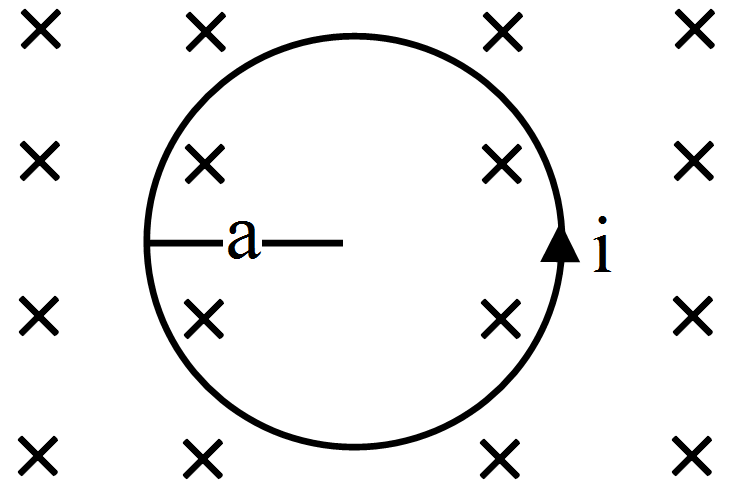
The shows a circular wire loop of radius a and carrying a current i, which is placed in a perpendicular magnetic field B.
  1. Consider a small part dl of the wire. Find the force on this part of the wire exerted by the magnetic field.
  2. Find the force of compression in the wire.
Two charged conducting spheres of radii a and b are connected to each other by a wire. What is the ratio of electric fields at the surfaces of the two spheres? Use the result obtained to explain why charge density on the sharp and pointed ends of a conductor is higher than on its flatter portions.
Consider a uniform electric field $E = 3 \times 10^3$ î N/C.
  1. What is the flux of this field through a square of 10 cm on a side whose plane is parallel to the yz plane?
  2. What is the flux through the same square if the normal to its plane makes a 60° angle with the x-axis?
  1. Monochromatic light of wavelength 589 nm is incident from air on a water surface. If $\mu$ for water is 1.33, find the wavelength, frequency and speed of the refracted light.
  2. A double convex lens is made of a glass of refractive index 1.55, with both faces of the same radius of curvature. Find the radius of curvature required, if the focal length is 20 cm.
A small telescope has an objective lens of focal length 144 cm and an eyepiece of focal length 6.0 cm. What is the magnifying power of the telescope? What is the separation between the objective and the eyepiece?
  1. Define ‘activity’ of a radioactive material and write its S.I. unit.
  2. Plot a graph showing variation of activity of a given radioactive sample with time.
  3. The sequence of stepwise decay of a radioactive nucleus is


If the atomic number and mass number of $D_2$ are 71 and 176 respectively, what are their corresponding values for D?
State Biot – Savart law. Deduce the expression for the magnetic field at a point on the axis of a current carrying circular loop of radius ‘R’, distant ‘x’ from the centre. Hence write the magnetic field at the centre of a loop.
Draw a graph showing the variation of binding energy per nucleon with mass number for different nuclei. Explain, with the help of this graph, the release of energy by the process of nuclear fusion.
A vessel contains water upto a height of 20cm and above it an oil upto another 20cm. The refractive indices of the water and the oil are 1.33 and 1.30 respectively. Find the apparent depth of the vessel when viewed from above.
