Question
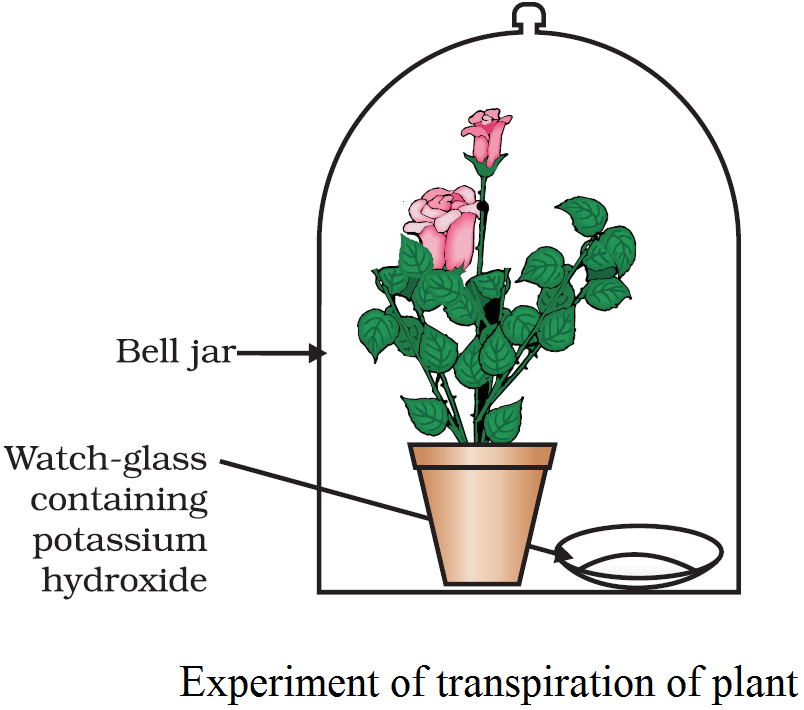
Define the term transpiration. Design an experiment to demonstrate this process.

Answer

Loss of water vapour through the stomatal openings of the leaves of a plant is termed as transpiration.
  1. Following experiment can be performed to demonstrate transpiration in a plant:
  2. Place a healthy growing plant on a horizontal and plane slab in the sun.
  3. Place a glass bell jar over the potted plant and seal its end to the slab by applying vaseline at its edges.
  4. Allow the set-up to remain in the sun for some time.
  5. Observe the presence of water droplets on the inner surface of the glass bell jar.
  6. This collection of water droplets is indicative of transpiration.

Need a full question paper?

Generate a complete, print-ready paper with questions like this in minutes — across 16+ boards, with answer keys.
Start Generating Free

Similar questions

How would you name the following compounds?
  1. $\text{CH}_3-\text{CH}_2-\text{Br}$
  2. $\ \ \ \ \ \ \ \ \text{H}\\\ \ \ \ \ \ \ \ \ \mid\\\text{H}-\text{C}=\text{O}$
  3. $\ \ \ \ \ \ \ \ \text{H}\ \ \ \ \ \text{H}\ \ \ \ \ \text{H}\ \ \ \ \ \text{H}\\\ \ \ \ \ \ \ \ \ \mid\ \ \ \ \ \ \mid\ \ \ \ \mid\ \ \ \ \ \mid\\\text{H}-\text{C}-\text{C}-\text{C}-\text{C}-\text{C}\equiv\text{C}-\text{H}\\\ \ \ \ \ \ \ \ \mid\ \ \ \ \mid\ \ \ \ \ \mid\ \ \ \ \ \ \mid\\\ \ \ \ \ \ \ \ \text{H}\ \ \ \ \ \text{H}\ \ \ \ \ \text{H}\ \ \ \ \ \text{H}$
An object is placed at a distance of 100cm from a converging lens of focal length 40cm.
  1. What is the nature of image?
  2. What is the position of image?
A convex lens produces an inverted image magnified three times of an object placed at a distance of 15cm from it. Calculate focal length of the lens.
Out of bacteria, spider, fish and chimpanzee, which organism has a better body design in evolutionary terms? Give reason for your answer.
What is meant by dominant genes and recessive genes? Give one example of each.
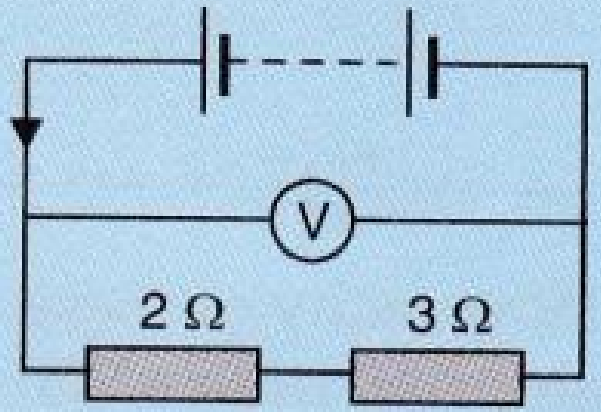
In the circuit shown below, the voltmeter reads 10V.
  1. What is the combined resistance?
  2. What current flows?
  3. What is the p.d. across $ 2 Ω$ resistor?
  4. What is the p.d. across $3 Ω$ resistor?
Explain how, sex is determined in human babies.
How would a pencil look like if you saw it through (a) a concave lens, and (b) a convex lens? (Assume the pencil is close to the lens). Is the image real or virtual?
The sea water contains water beetles, tadpole, fish and weeds.
  1. Write a food chain comprising all the given organisms?
  2. Which organisms in the food chain are (i) herbivore, and (ii) carnivores?
  3. Which organisms are (i) predators, and (ii) prey?
  4. Which organisms can trap solar energy to make food?
  5. Which organism is a secondary consumer?
A metal ‘X’ loses two electrons and a non-metal ‘Y’ gains one electron. Show the electron dot structure of compound formed between them. Is it ionic or covalent? Does it have high melting point or low? Will it conduct electricity in solid state or in aqueous solution and why? Will it be soluble in water?
How could the modern periodic law remove various anomalies of Mendeleev’s periodic table? Explain with examples.