How would a pencil look like if you saw it through (a) a concave lens, and (b) a convex lens? (Assume the pencil is close to the lens). Is the image real or virtual?
Download our app for free and get started
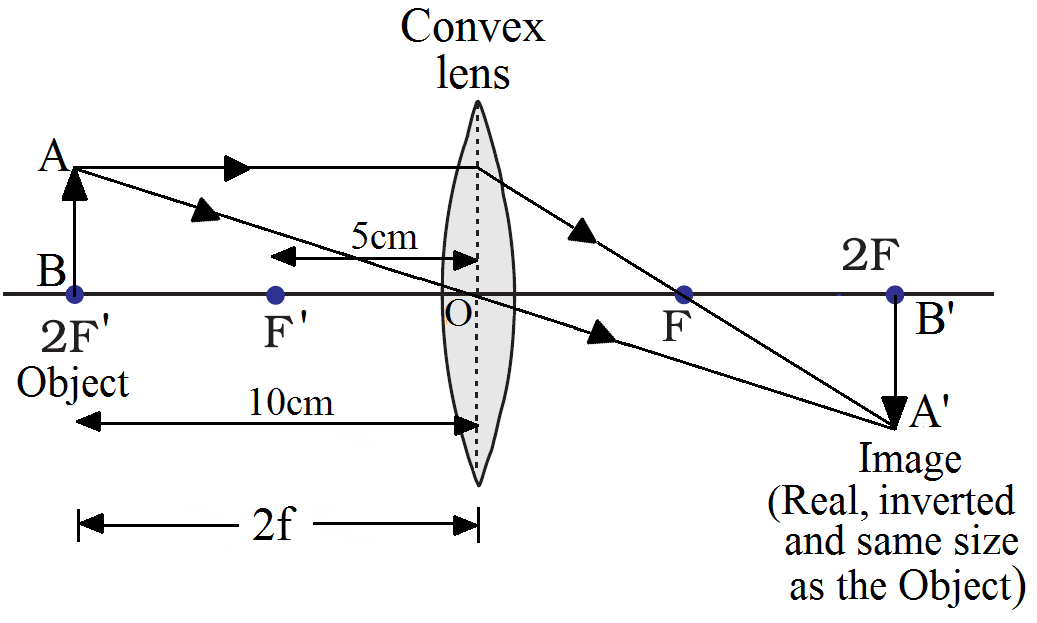
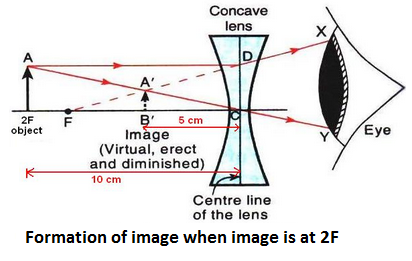
- Use of convex mirror: As rear-view mirror in vehicles.
Use of convex lens: For making simple camera.
Use of concave lens: As eye-lens in Galilean telescope.

Download our appand get started for free
Experience the future of education. Simply download our apps or reach out to us for more information. Let's shape the future of learning together!No signup needed.*
Similar Questions
- 1View SolutionTwo lenses A and B have power of (i) + 2 D and (ii) -4D respectively. What is the nature and focal length of each lens?
- 2View SolutionThe radius of curvature of a convex mirror used as a rear view mirror in a moving car is 2.0m. A truck is coming from behind it at a distance of 3.5m. Calculate (a) position, and (b) size, of the image relative to the size of the truck. What will be the nature of the image?
- 3a. What is the focal length of the lens used in sunglasses?View Solution
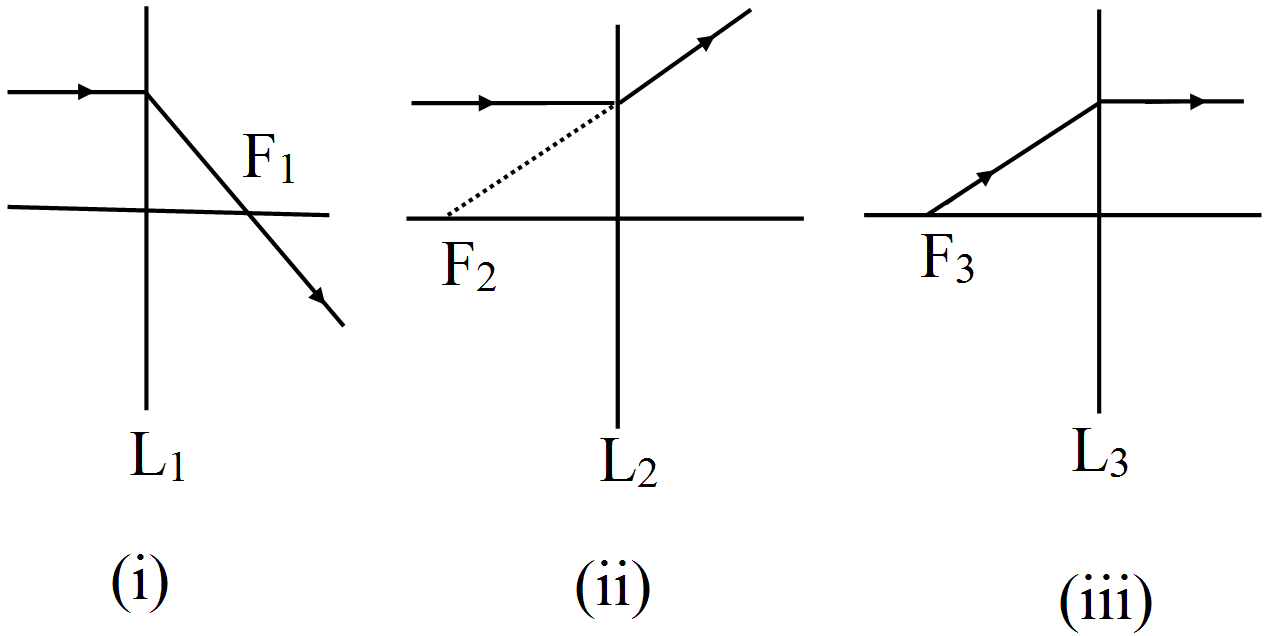
b. The following figures show the path of light rays through three lenses marked $L_1, L_2$, and $L_3$ and their focal points $F_1, F_2$, and $F_3$, respectively. Identify the nature of lenses.
- 4View SolutionA spherical mirror produces an image of magnification -1.0 on a screen placed at a distance of 30 cm from the pole of the mirror.
- Write the type of mirror in this case.
- What is the focal length of the mirror?
- What is the nature of the image formed?
- Draw the ray diagram to show the image formation in this case.
- 5View SolutionWhen an object is placed 10cm in front of lens A, the image is real, inverted, magnified and formed at a great distance. When the same object is placed 10cm in front of lens B, the image formed is real, inverted and same size as the object:
- What is the focal length of lens A?
- What is the focal length of lens B?
- What is the nature of lens A?
- What is the nature of lens B?
- 6View SolutionGiving reasons, state the ‘signs’ (positive or negative) which can be given to the following:
- Object distance (u) for a concave mirror or convex mirror.
- Image distances (v) for a concave mirror.
- Image distances (v) for a convex mirror.
- 7View SolutionTwo lenses have power of
- +2D
- –4D
- 8View SolutionState and explain the New Cartesian Sign Convention for spherical lenses.
- 9The refractive indices of water and glass are $\frac{3}{4}\text{ and }\frac{3}{2}$ respectively. Write the relation and find the value of refractive index of water with respect to glass and glass with respect to water.View Solution
- 10View SolutionAn object 2cm in size is placed 30cm in front of a concave mirror of focal length 15cm. At what distance from the mirror should a screen be placed in order to obtain a sharp image? What will be the nature and the size of the image formed? Draw a ray diagram to show the formation of the image in this case.