Question
Define the terms ‘stopping potential’ and ‘threshold frequency’ in relation to photoelectric effect. How does one determine these physical quantities using Einstein’s equation?

Answer

Stopping Potential: The minimum negative potential applied to the anode/plate for which photoelectric current become zero.
Threshold frequency: The minimum (cut-off) frequency of incident radiation, below which no emission of photoelectrons takes place.
By Einstein‟s Equation $\text{??}_{0} =\text{hv}− \phi_{o}$
For any given frequency $\text{?} > \text{v}_{0} , \text{v}_{0}$ can be determined.
Stopping Potential  $\text{?}_{0} =\bigg(\frac{\text{h}}{\text{e}}\bigg)\text{v}−\frac{\phi_{o}}{e}$
as $\phi_{0} = \text{hv}_{0}$
Threshold frequency, $\text{V}_{0} = \frac{\phi_0}{\text{h}}$.

Need a full question paper?

Generate a complete, print-ready paper with questions like this in minutes — across 16+ boards, with answer keys.
Start Generating Free

Similar questions

Consider two pairs of neutrons. In each pair, the separation between the neutrons is the same. Can the force between the neutrons have different magnitudes for the two pairs?
The index of refraction of fused quartz is 1.472 for light of wavelength 400nm and is 1.452 for light of wavelength 760nm. Find the speeds of light of these wavelengths in fused quartz.
A current$-$carrying circular coil of $100$ turns and radius $5.0\ cm$ produces a magnetic field of $6.0 \times 10^{-5}T$ at its centre. Find the value of the current.
Explain the parallel connection of capacitors.
Explain ground wave and sky wave.
Calculate the maximum kinetic energy of the beta particle emitted in the following decay scheme :
$\text{ }^{12}\text{N}\rightarrow{ }^{12}\text{C}^*+\text{e}^++\text{v}$
$\text{ }^{12}\text{C}^*\rightarrow\text{ }^{12}\text{C}+\gamma(4.43\ \text{MeV}).$
The atomic mass of $^{12}N$ is $12.018613u$.
A spy report about a suspected car reads as follows. "The car moved 2.00km towards east, made a perpendicular left turn, ran for 500m, made a perpendicular right turn, ran for 4.00km and stopped". Find the displacement of the car.
A circular coil of $16$ turns and radius $10 \ cm$ carrying a current of $0.75 A$ rests with its plane normal to an external field of magnitude $5.0 \times 10^{–2} T.$ The coil is free to turn about an axis in its plane perpendicular to the field direction. When the coil is turned slightly and released, it oscillates about its stable equilibrium with a frequency of $2.0 s^{–1}.$ What is the moment of inertia of the coil about its axis of rotation?
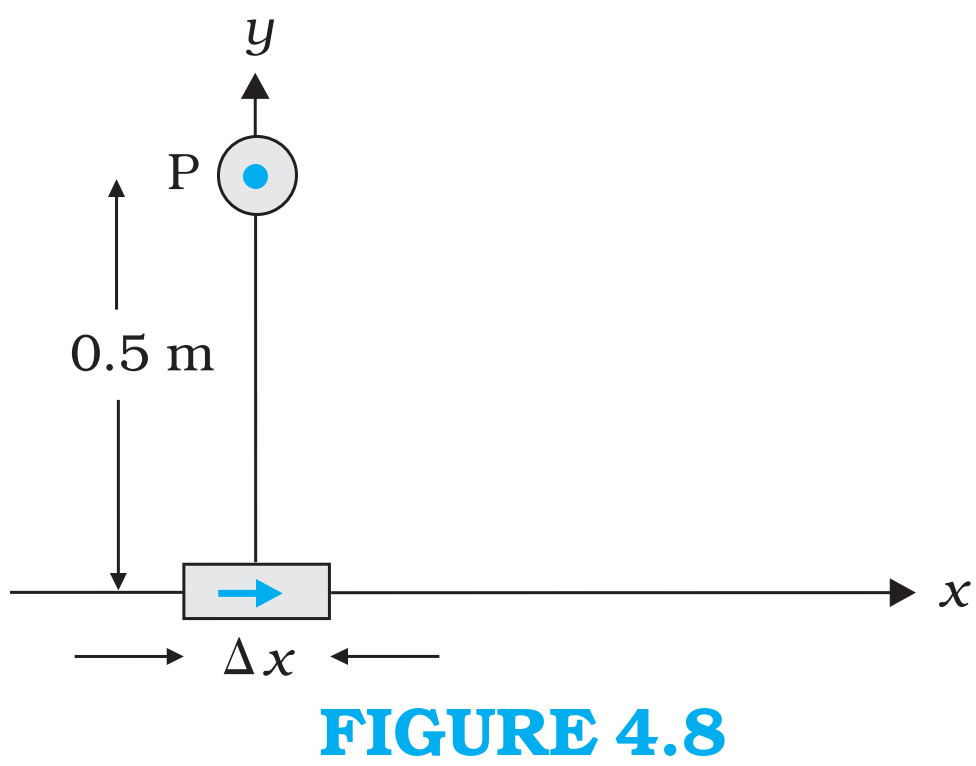
An element $\Delta l =\Delta x \hat{ i }$ is placed at the origin and carries a large current $I=10 A \ ($Fig. $4.8).$ What is the magnetic field on the $y$ axis at a distance of $0.5 m . \Delta x=1 \ cm$.
Image
“Gauss’s law in electrostatics is true for any closed surface, no matter what its shape or size is”. Justify this statement with the help of a suitable example.