Question
Explain the parallel connection of capacitors.

Answer

Image
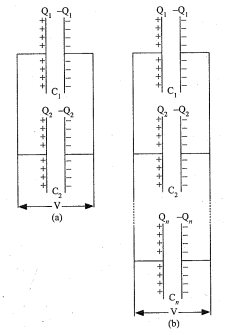
$\rightarrow$ As shown in the fig. $(a) $ two capacitors $C _1$ and $C _2$ are connected in parallel.
$\rightarrow$ For such connection, the $p.d$. across each capacitor is same, suppose its value is $V$ .
$\rightarrow$ The charge on the plate of capacitor $' 1\ '$ is $\left(+Q_1\right)$ and the charge on the plate of capacitor $ ' 2\ '$ is $\left(+Q_2\right)$
$\rightarrow Q=C V$ for first capacitor $Q_1=C_1 V$ and for second capacitor $Q _2= C _2 V$
$\rightarrow$ Hence, the total charge $( $charge of the equivalent capacitor$)$
$Q =Q_1+Q_2$
$\therefore Q =C_1 V+C_2 V$
$\therefore Q =V\left(C_1+C_2\right)$
$\therefore \frac{Q}{V} =C_1+C_2$
$\rightarrow$ Suppose, the equivalent capacitance for the given parallel connection is $C$ .
$\therefore C =\frac{ Q }{ V } \ldots$
$\therefore C = C _1+ C _2 ($From $(1)$ and $(2))$
$\rightarrow $ As shown in fig. $(b), C_1, C_2, C_3 \ldots . . C_n$ total n capacitors are connected in parallel. $P.d$. for each is $V$ and the charge on each capacitor is $Q _1, Q _2, Q _3 \ldots . . Q _n$
$\rightarrow$ Hence, the total charge,
$Q=Q_1+Q_2+Q_3+\ldots .+Q_n$
$\therefore Q = C _1 V+ C _2 V+ C _3 V+\ldots .+ C _n V$
$\therefore \frac{ Q }{ V }= C _1+ C _2+ C _3+\ldots . .+ C _n$
$\rightarrow$ Suppose, the equivalent capacitance for the given parallel connection is $C$ .
Where $\therefore C =\frac{ Q }{ V }$
$\rightarrow $ So, from eq $(3)$ and $(4),$
$\rightarrow C = C _1+ C _2+ C _3+\ldots . .+ C _n$
$\rightarrow$ Suppose, the capacitance of each capacitor is same and it is ' $C ^{\prime}$
$\therefore$ Equivalent capacitance,
$C _{e q} = C + C + C +\ldots . .+ C \text { (n times) }$
$\therefore \quad\left( C _{e q}\right. =n C )$

Need a full question paper?

Generate a complete, print-ready paper with questions like this in minutes — across 16+ boards, with answer keys.
Start Generating Free

Similar questions

The energy levels of an atom are as shown below:
  1. Which of them will result in the transition of a photon of wavelength 275 nm?
  1. Which transition corresponds to emission of radiation of maximum wavelength?
Obtain the equation of electric current for an AC circuit having only inductor.
State Gauss's theorem in electrostatics. Apply this theorem to derive an expression for electric field intensity at a point near an infinitely long straight charged wire.
Explain the terms: (i) Attenuation, (ii) Demodulation used in communication system.
The kinetic energy K of a rotating body depends on its moment of inertia I and its angular speed $\omega.$ Assuming the relation to be $\text{K}=\text{kI}^{\text{a}}\omega^{\text{b}}$ where k is a dimensionless constant, find a and b. Moment of inertia of a sphere about its diameter is $\frac{2}{5}\text{Mr}^2.$
(a) In Example 3.1, the electron drift speed is estimated to be only a few $mm s ^{-1}$ for currents in the range of a few amperes? How then is current established almost the instant a circuit is closed?
(b) The electron drift arises due to the force experienced by electrons in the electric field inside the conductor. But force should cause acceleration. Why then do the electrons acquire a steady average drift speed?
(c) If the electron drift speed is so small, and the electron's charge is small, how can we still obtain large amounts of current in a conductor?
(d) When electrons drift in a metal from lower to higher potential, does it mean that all the 'free' electrons of the metal are moving in the same direction?
(e) Are the paths of electrons straight lines between successive collisions (with the positive ions of the metal) in the (i) absence of electric field, (ii) presence of electric field?
Why are alloys used for making standard resistance coils?
A small pin fixed on a table top is viewed from above a distance of 50 cm. By what distance would the pin appear to be raised if it is viewed from the same point through a 15 cm thick glass slab held parallel to the table? Refractive index of glass = 1.5. Does the answer depend on the location of the slab?
Show that it is not possible for a photon to be completely absorbed by a free electron.
Two capacitors of unknown capacitances $C_1$ and $C_2$ are connected first in series and then in parallel across a battery of $100 V$. If the energy stored in the two combinations is $0.045 J$ and $0.25 J$ respectively, determine the value of $C_1 $ and $C_2$. Also calculate the charge on each capacitor in parallel combination.