Question
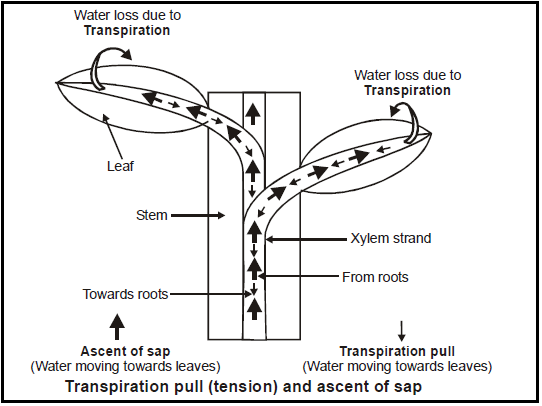
Define transpiration pull diagrammatically explain the route of transpiration pull and ascent of sap in plants.
Answer

Transpiration pull is the phenomenon which takes place when thousands of transpiring mesophyll cells withdraw water from the xylem by generating a negative pressure in the water column and exerting an upward pull over the water column. This pull is further transmitted to the roots in search of more water.

Need a full question paper?

Generate a complete, print-ready paper with questions like this in minutes — across 16+ boards, with answer keys.
Start Generating Free

Similar questions

Who was the first to attempt a more scientific basis for classification of living organisms? How did he classify plants and animals?
Explain the main characteristics of pteridophytes.
Eukaryotic cell have organelles which may bound by a double membrane. Group the various sub-cellular organelles into these categories.
While travelling at a higher altitude, a person complains of dizziness and vomiting sensation. Which part of the inner ear is disturbed during the journey?
Give the scientific terms for the following:
  1. Loss of water from leaves through stomata in the form of water vapour.
  2. Movement of water in roots exclusively through the cell wall.
  3. Water adsorbed by solids, causing them to enormously increase in volume.
Write floral formula for a flower which, is bisexual; actinomorphic; pentamerous sepal, petal, stamens free with ovary, syncarpous, superior, trilocular with axile placentation.
What is meant by development in plants? Represent schematically the processes in the development of a plant cell.
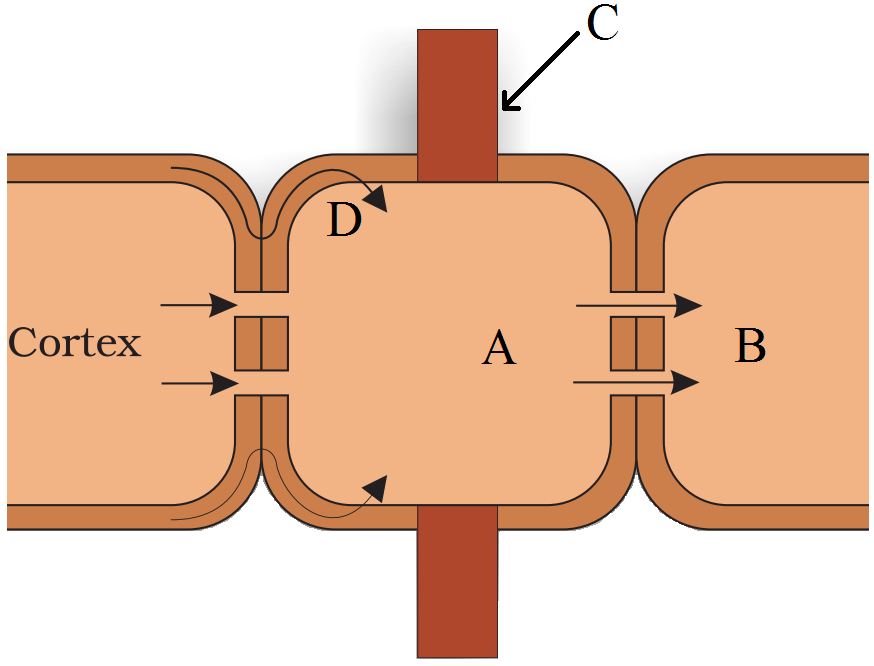
Observe the diagram given and answer the following questions:
  1. Name the cell A and B.
  2. Identify C and name the substance it is made of.
  3. Name the pathway of water movement represented as D.
Bile juice contains no digestive enzymes, yet it is important for digestion. Why?
(i) In aerobic respiration the respiratory coefficient is infinite. Please explain.
(ii) Define the following: (a) Floating respiration (b) Protoplasmic respiration (c) External respiration (d) Internal respiration.