Questions

3 Marks Question

Take a timed test

43 questions · self-marked practice — reveal the answer and mark yourself.

Question 13 Marks
What essential role does the root endodermis play during mineral absorption in plants?
Answer
In plants, nutrients are absorbed through the active and passive transports. The endodermis of roots has many transport proteins embedded in their plasma membrane. Transport proteins in endodermis cells enable plant cells to adjust the quantity and types of solutes to be absorbed from the soil. It regulates the quantity and type of minerals and ions that reach the xylem tissue of plants.
View full question & answer
Question 23 Marks
Differentiate between the following: Guttation and transpiration
Answer
Guttation and transpiration:
 
Guttation
 
Transpiration
1.
It occurs usually at night.
1.
It occurs usually during the day.
2.
Water is lost from the leaves in the form of liquid droplets.
2.
Water is lost from the leaves in the form of water vapour.
3. It occurs through the vein endings of leaves. 3. It occurs through the stomata.
4. It is an uncontrolled process. 4. It is a controlled process.
View full question & answer
Question 33 Marks
Explain what will happen to a plant cell if it is kept in a solution having higher water potential.
Answer
A hypotonic solution has higher water potential. When a plant cell is placed in a hypotonic solution or a solution having higher water potential, water diffuses into the cell causing the cytoplasm to build up a pressure against the wall, called turgor pressure. This leads to the cell getting swollen. But the rigidity of the cell wall, prevents the cell from bursting.
View full question & answer
Question 43 Marks
Differentiate between the following: Osmotic pressure and osmotic potential
Answer
Osmotic pressure and osmotic potential:
 
Osmotic pressure
 
Osmotic potential
1.
It is expressed in bars with a positive sign.
1.
It is expressed in bars with a negative sign.
2.
It is a positive pressure.
2.
It is a negative pressure.
3.
Its value increases with an increase in the concentration of solute particles.
3.
Its value decreases with an increase in the concentration of solute particles.
View full question & answer
Question 53 Marks
Explain why pure water has the maximum water potential.
Answer
Water molecules possess kinetic energy. In liquid and gaseous form, they are in random motion that is both rapid and constant. The greater the concentration of water in a system, the greater is its kinetic energy or water potential. Pure water has the highest concentration of water molecules. Therefore, it has the highest water potential. When some solute is dissolved in water, the water potential of pure water decreases.
View full question & answer
Question 63 Marks
How is the mycorrhizal association helpful in absorption of water and minerals in plants?
Answer
Mycorrhiza is a symbiotic association of fungi with the root systems of some plants. The fungal hyphae either form a dense network around the young roots or they penetrate the cells of the roots. The large surface area of the fungal hyphae is helpful in increasing the absorption of water and minerals from the soil. In return, they get sugar and nitrogenous compounds from the host plants. The mycorrhizal association is obligate in some plants. For example, Pinus seeds do not germinate and establish in the absence of mycorrhizal.
View full question & answer
Question 73 Marks
Explain why xylem transport is unidirectional and phloem transport bi-directional.
Answer
Water is absorbed by the roots from the soil, so it moves only in the upward direction through the xylem. Hence, the water transport is unidirectional. Food is formed in leaves and is required by both the root system and the shoot system of the plant. Food is transported by the phloem. Phloem sap moves upwards and downwards making the food transport bidirectional so that it may reach to every part of the plant.
View full question & answer
Question 83 Marks
Differentiate between the following: Diffusion and Osmosis
Answer
Diffusion and Osmosis:
  Diffusion   Osmosis
1. Diffusion is the passive movement of particles, ions, and molecules along the concentration gradient. 1. Osmosis is the process in which the diffusion of a solvent (water) occurs across a semi-permeable membrane.
2. It can occur in solids, liquids, and gases. 2. It occurs in the liquid medium.
3. It does not require a semi-permeable membrane. 3. It requires a semi-permeable membrane.
View full question & answer
Question 93 Marks
With the help of well-labelled diagrams, describe the process of plasmolysis in plants, giving appropriate examples.
Answer
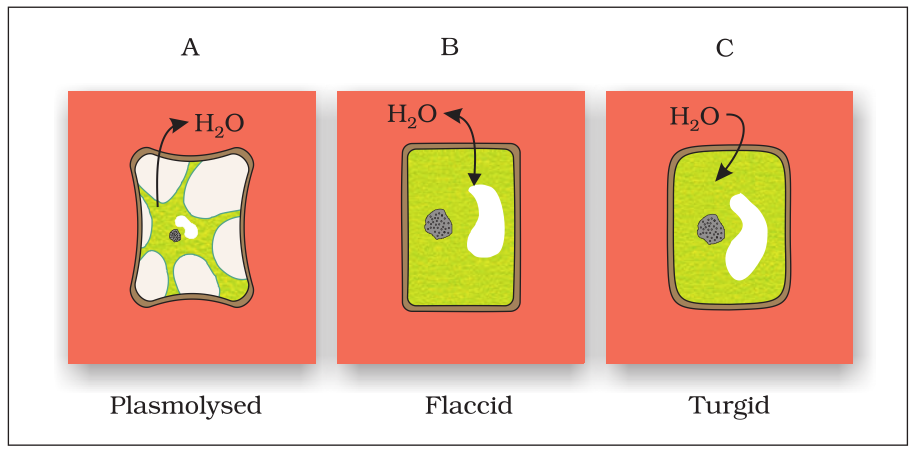
Plasmolysis occurs when water moves out of the cell and the cell membrane of a plant cell shrinks away from its cell wall. This happens when the plant cell is placed in a hypertonic solution (a solution having more solute concentration than the cell cytoplasm). This causes the water to move out of the cell and toward the solution. The cytoplasm of the cell shrinks and the cell is said to be plasmolysed. This process can be observed in an onion peel kept in a highly concentrated salt solution.
View full question & answer
Question 103 Marks
Differentiate between the following: Imbibition and diffusion
Answer
Imbibition and diffusion:
 
Imbibition
 
Diffusion
1.
Imbibition is a special type of diffusion. In this process, water is absorbed by solids and colloids, causing an enormous increase in volume.
1.
Diffusion is the passive movement of particles, ions, and molecules along the concentration gradient.
2.
It usually involves water.
2.
It involves solids, liquids, and gases.
View full question & answer
Question 113 Marks
What happens when a pressure greater than the atmospheric pressure is applied to pure water or a solution?
Answer
If a pressure greater than atmospheric pressure is applied to pure water or a solution, its water potential increases. It is equivalent to pumping water from one place to another. Pressure can build up in a plant system when water enters a plant cell due to diffusion causing a pressure built up against the cell wall, it makes the cell turgid.
View full question & answer
Question 123 Marks
Differentiate between the following: Apoplast and symplast pathways of movement of water in plants
Answer
Apoplast and symplast pathways of movement of water in plants:
 
Apoplast pathway
 
Symplast pathway
1.
The apoplast pathway involves the movement of water through the adjacent cell walls of the epidermis and cortex. The movement of water is restricted at the casparian strips of the root endodermis.
1.
The symplast pathway involves the movement of water through the interconnected protoplasts of the epidermis, cortex, endodermis, and root pericycle.
2.
It is a faster process of water movement and water moves through mass flow.
2.
It is a slower process of water movement.
View full question & answer
Question 133 Marks
In a girdled plant, when water is supplied to the leaves above the girdle, leaves may remain green for sometime then wilt and ultimately die. What does it indicate?
Answer
In a girdled plant, when water is supplied to the leaves above the girdle, leaves may remain green for sometime because leaves can synthesise their own carbohydrate food through photosynthesis, .then wilt due to non-availability of water. The system of xylem vessels from root to the leaf vein can supply the needed water, during girdling there is a possible loss of xylem vessels and the water supply cuts off, resulting in death of plant.
View full question & answer
Question 143 Marks
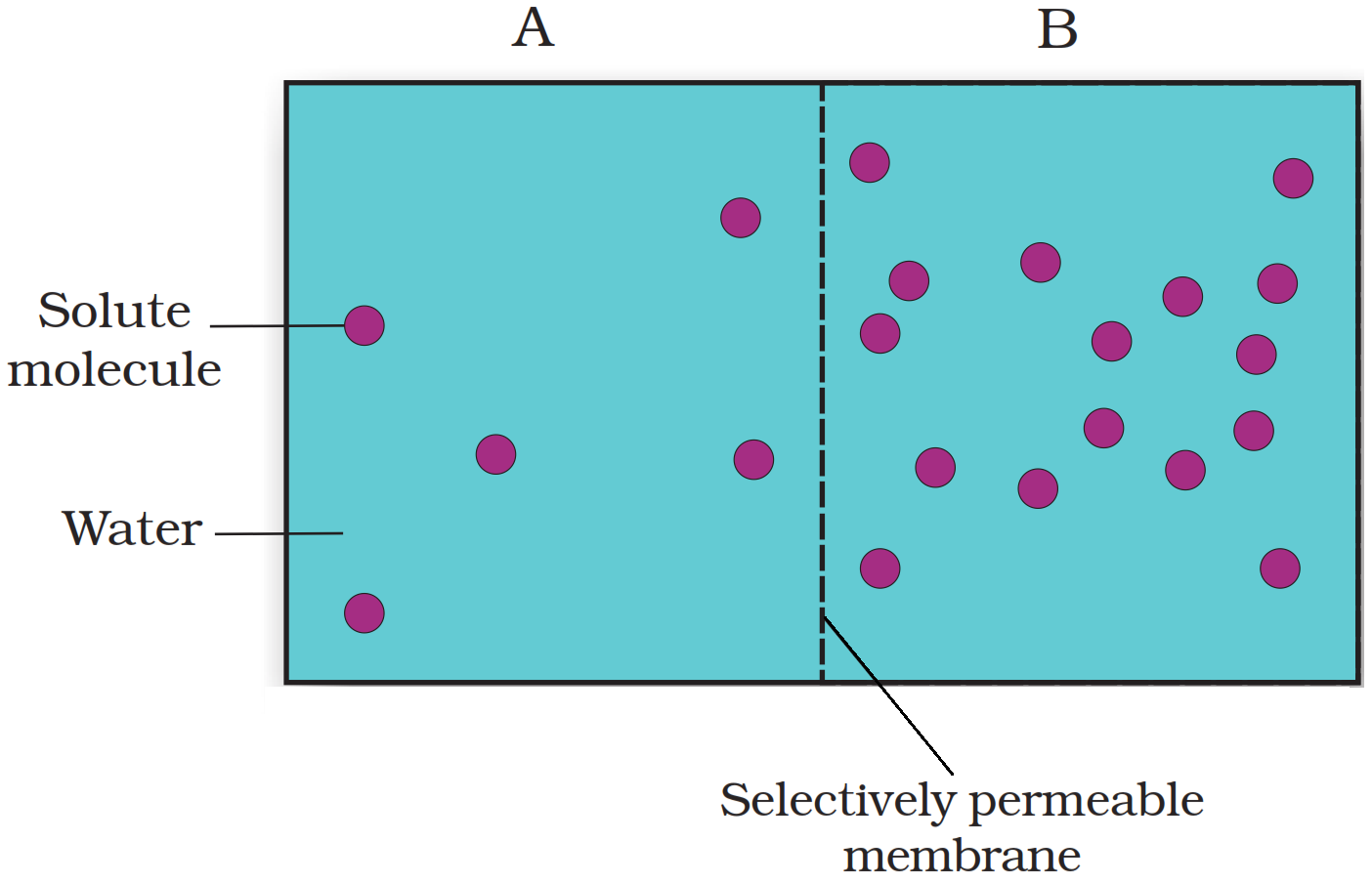
Study the figure given above, in which the two chambers A and B containing solutions are separated by a semipermeable membrane.
  1. Solution of which chamber has a lower water potential?
  2. Solution of which chamber has a lower solute potential?
  3. In which direction will osmosis occur?
  4. Which solution has a higher solute potential?
  5. At equilibrium which chamber will have lower water potential?
  6. If one chamber has a $\Psi$ of -2000 kPa and the other -1000 kPa, which is the chamber that has the higher $\Psi?$
Answer
  1. Chamber B,
  2. Chamber B,
  3. Chamber A to B,
  4. Chamber A,
  5. No chamber; both will be equal.
  6. Chamber with -1000 kPa.
View full question & answer
Question 153 Marks
Differentiate between diffusion and translocation in plants.
Answer
Diffusion: Diffusion is a passive process; the movement of molecules takes place from an area of higher concentration to an area of lower concentration. Here the molecule moves along a diffusion gradient. Translocation: Translocation is the bulk movement of the organic food from one place to another in plants. This translocation of organic food material or solutes takes place from the region of is higher concentration to the region of lower concentration.
View full question & answer
Question 163 Marks
The transpiration driven ascent of xylem sap depends on certain physical properties of water. Describe three such properties of water.
Answer
The following are the physical properties of water:
  1. Cohesion: It refers to the mutual attractive force among the water molecules.
  2. Adhesion: It refers to the attractive force between the water molecules and the surface of tracheary element.
  3. Surface tension: It refers to the attraction of water molecules in the liquid phase.
View full question & answer
Question 173 Marks
How does water moves within the root?
Answer
Most of the water moves within the root through apoplast pathway since the cortical cells are loosely packed. Only a minor portion of water moves through symplast pathway. Presence of casparian strip prevents water movement through apoplast pathway. In that case, symplast pathway is the preferred pathway for movement of water.
View full question & answer
Question 183 Marks
How does the phenomenon of mass/ bulk flow differ from that of diffusion?
Answer
Differences between mass flow and diffusion are:
S. No
Mass Flow
Diffusion
1.
It is the movement of substances in bulk or in masses from one point to another due to pressure differences between the two points.
It is the movement of substances from a region of higher concentration/ pressure to a region of lower concentration or pressure.
2.
All substances dissolved or suspended in water, move with the same pace.
Different substances move independently depending on their concentration gradients.
View full question & answer
Question 193 Marks
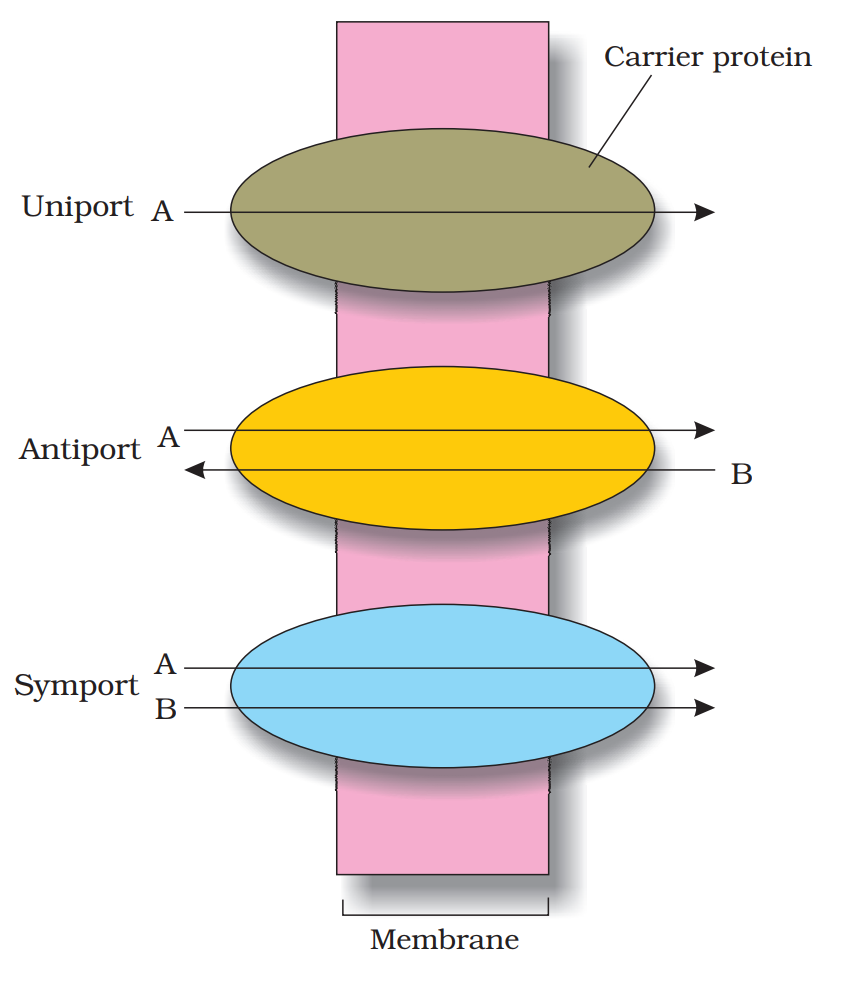
Define Uniport, Symport and Antiport. Do they require energy?
Answer
Uniport is one sided movement of a substance through the cell membrane independent of other solutes. Symport and antiport are two types of cotransport. Symport is simultaneous movement of two or more solutes across cell membrane in the same direction. Antiport is simultaneous movement of two solutes in opposite directions across the cell membrane. Uniport, symport and antiport are types of facilitated diffusion which do not require energy. Similar types of passage also occur in case of active transport where energy is required.
View full question & answer
Question 203 Marks
Describe briefly the three physical properties of water which helps in ascent of water in xylem.
Answer
Three properties of water essential for its ascent in xylem are cohesive or cohesion force, adhesive or adhesion force and surface tension.
  1. Cohesion force: It is the force by which water molecules remain attached to one another. The force develops due to hydrogen bonds amongst the water molecules. Cohesion provides tensile strength against negative pressure exerted by transpiration pull.
  2. Adhesion force: It is the force of attraction between water molecules and inner surface of xylem channels. Adhesion force adds tc tensile strength of water.
  3. Surface tension: It refers to the higher attraction present amongst water molecules at the interphase between liquid and gaseous phase.
View full question & answer
Question 213 Marks
Describe at least three major functions of turgor pressure.
Answer
Turgor pressure maintains rigidity of a plant cell, i.e., it keeps plants upright and stiff. It also plays an important role in plant cell growth whereby the cell wall undergroes irreversible changes in volume and structure. It also influences the opening and closure of stomata by influencing the turgidity of guard cells.
View full question & answer
Question 223 Marks
From your knowledge of physiology can you think of some method of increasing the life of cut plants in a vase?
Answer
Method of increasing the life of cut plants in a vase are as follows:
  1. Immerse the bases of cut plants immediately in water to prevent entry of air in the xylem channels i.e. cavitation.
  2. Adding a small quantity of cytokinin in water of the vase. Cytokinin delays the senescence of plant.
View full question & answer
Question 233 Marks
When a freshly collected Spirogyra filament is kept in a 10% potassium nitrate solution, it is observed that the protoplasm shrinks in size:
  1. What is this phenomenon called?
  2. What will happen if the filament is replaced in distilled water?
Answer
  1. Plasmolysis is the phenomenon that takes place when Spirogyra is placed in 10% potassium nitrate solution (hypertonic solution).
  2. When Spirogyra is placed in distilled water, it will again reabsorb water, protoplast will again come back in it original shape. This phenomenon is known as deplasmolysis.
View full question & answer
Question 243 Marks
"The movement of water is through transpiration pull." Discuss if this statement is 100% true. Give explanation for your answer.
Answer
This statement is partially true. Transpiration pull is the major factor which facilitates movement of water in xylem. But there are other factors at play. The cohesion-adhesion and surface tension gives high capillarity to water molecules which enables it to reach a certain height in plant's xylem. Transpiration pull has an augmentative effect on the surface tension push. So in totality it is cohesion-adhesion-surface tension and transpiration pull which does the wholefunction of transporting water to greater heights in plants.
View full question & answer
Question 253 Marks
Akanksha, while walking in the garden in the morning with her mother observed two water drops falling on the ground. She thought that it is raining. Being curious, she started finding the source of the watery fluid. Then she observed drops falling from the leaves tip. She asked her mother, who was a botanist about this. The mother explained her that it is not due to the rain instead the water drops are dripping due to the phenomenon called guttation.
  1. What are hydathodes? Why are these called water glands?
  2. Where are hydathodes present?
  3. Name the process of water loss occurring via hydathodes.
  4. What value is displayed by Akanksha's nature?
Answer
  1. Hydathodes are the pores like stomata present in leaves, which secrete water. These are called water glands because these are modified portions of leaf, which are meant to send out excess amount of water in the liquid form.
  2. Hydathodes are present on margins of leaves or where main vein ends and near the tips of blades of some vascular plants like grasses and small herbaceous plants (rose, strawberry, tomato, etc).
  3. Guttation.
  4. Akanksha has curiosity to know about scientific phenomenon and has interest in plants related processes.
View full question & answer
Question 263 Marks
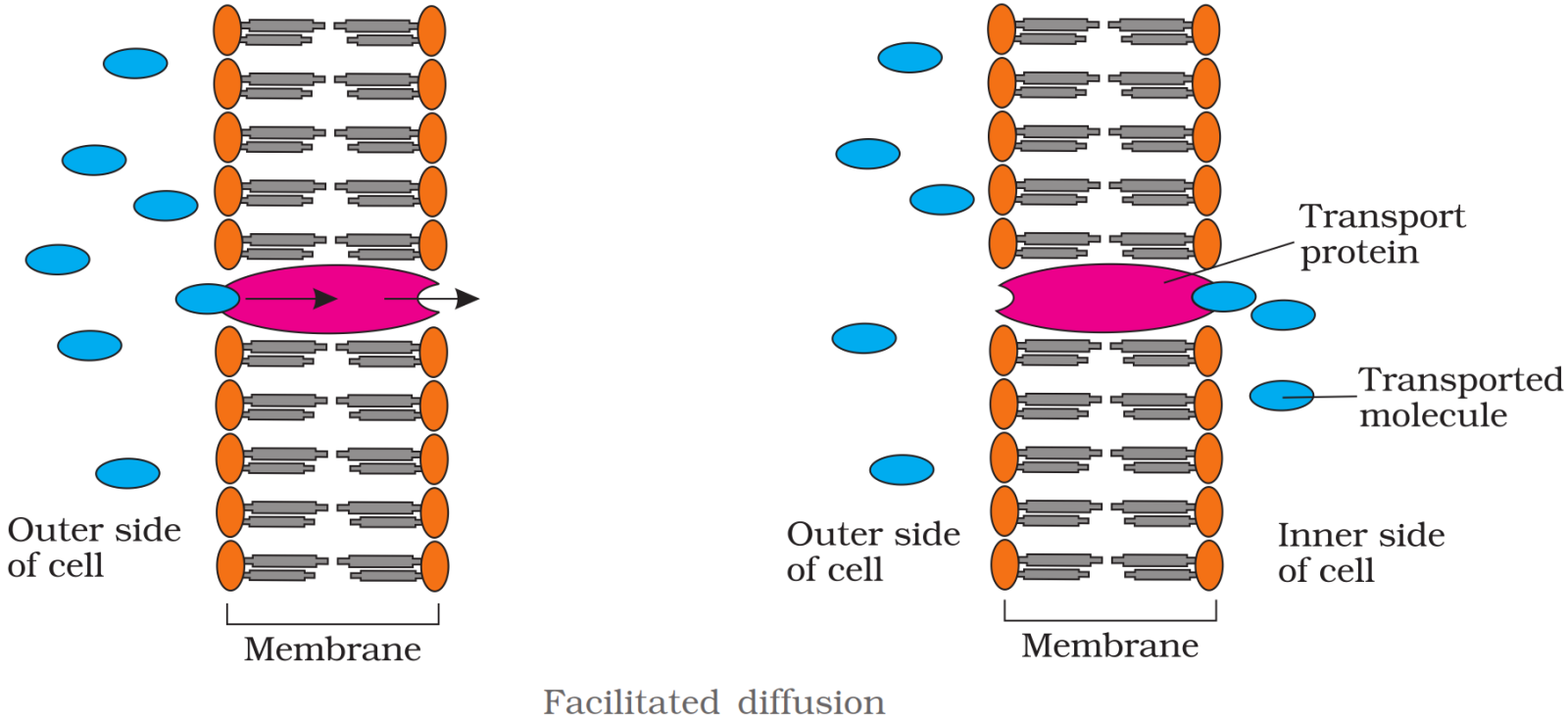
Facilitated diffusion involving membrane proteins is categorised under passive transport. Why? Also draw a neat and labelled diagram showing facilitated diffusion.
Answer
Facilitated diffusion involves special protein-lined channels or carrier proteins situated in cell membranes, which provide sites for the movement of molecules. They do not setup a concentration gradient it is already present and do not utilize energy. Since, energy is not used up in facilitated diffusion, it is called passive transport.
View full question & answer
Question 273 Marks
Define water potential and solute potential.
Answer
The measure of the relative tendency of water to move from one area to another, and is commonly represented by the Greek letter $\Psi_{\mathrm{w}}$ (Psi). Supplement. Water potential is caused by osmosis, gravity, mechanical pressure, or matrix effects including surface tension. Solute potential Symbol $\Psi_s$, the component of water potential that is due to the presence of solute molecules. It always has a negative value as solutes lower the water potential of the system "Solute potential"
View full question & answer
Question 283 Marks
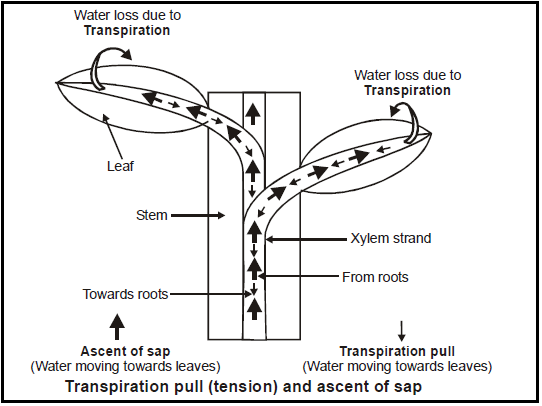
Define transpiration pull diagrammatically explain the route of transpiration pull and ascent of sap in plants.
Answer
Transpiration pull is the phenomenon which takes place when thousands of transpiring mesophyll cells withdraw water from the xylem by generating a negative pressure in the water column and exerting an upward pull over the water column. This pull is further transmitted to the roots in search of more water.
View full question & answer
Question 293 Marks
Give the scientific terms for the following:
  1. Loss of water from leaves through stomata in the form of water vapour.
  2. Movement of water in roots exclusively through the cell wall.
  3. Water adsorbed by solids, causing them to enormously increase in volume.
Answer
  1. Transpiration.
  2. Apoplast pathway.
  3. Imbibition.
View full question & answer
Question 303 Marks
We know that plants are harmed by excess water. But plants survive under flooded condition. How are they able to manage excess water?
Answer
Some varieties of rice survive under flooded conditions. These varieties of rice have certain adaptations which help them survive the flood. The stems of these plants grow quickly in case of flood. This ensures that some part of the foliage is always above water. Stems are hollow which allows exchange of gases. Thus, certain varieties of rice can survive up to one month in flooded condition.
View full question & answer
Question 313 Marks
Xylem transports water from roots to stems and leaves. This is similar to which of the following? Give reasons for your answer. Explain the problems which have cropped up because of overexploitation of water?
  1. Water being pumped from under the ground to overhead water tank.
  2. Water being supplied to different faucets in the house.
Answer
  1. Water being pumped from under the ground to overhead water tank is similar to water transport in plants in certain senses. In both the cases groundwater is transported against gravity and up to certain heights.
  2. Because of availability of powerful water pumps, we are able to access groundwater with ease. This is proving dangerous for us; because we are indulging in overexploitation of groundwater. At most of the places, the water table is going down and problems of water shortage can be seen almost everywhere. The rate at which the groundwater is recharged through natural water cycle is unable to keep pace with the rate at which we are taking out groundwater. Scientists predict that the scenario of availability of drinking water is going to be very grim in the future. A large section of the population would be devoid of access to safe drinking water.
View full question & answer
Question 323 Marks

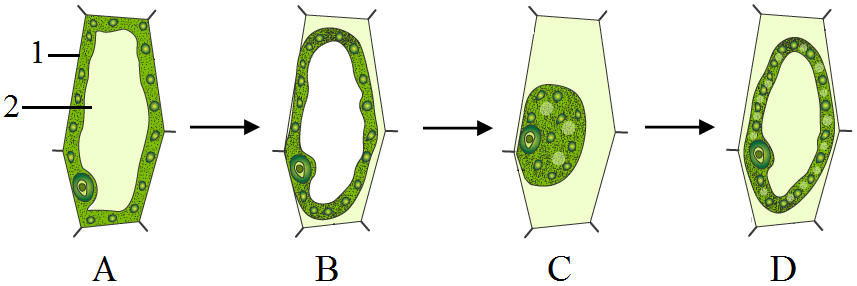
Observe the given figure and answer the 983 following questions.
  1. State the nature of solution mark (1).
  2. What process has been depicted in figures C to D?
  3. What will be present in the space marked as (2)?
  4. In which figures turgor pressure will be zero?
  5. In which figures wall pressure will be positive?
Answer
  1. The solution marked as (1) will be hypertonic (more concentrated) due to which cell shrinks.
  2. From C to D, figure is showing the process of deplasmolysis as shrinked cell has again regained its original shape.
  3. In space marked as (2) hypotonic solution and water is present.
  4. Turgor pressure will be zero in figure B and C because cell is in a flaccid condition.
  5. Wall pressure will be positive in figure A and D because in these figure cell wall is exerting equal and opposite pressure against the expanding protoplasm.
View full question & answer
Question 333 Marks
Under what condition the rate of transpiration will be maximum, when soil is dry and atmosphere is humid or when soil is humid and atmosphere is dry? Give reason.
Answer
The rate of transpiration will be maximum when the soil is humid and atmosphere is dry because of following reasons.
  1. Availability of more water in the soil is necessary for the absorption of water by the roots in order to carry it up to the xylem. Thus, lack of water decreases transpiration and overall health of the plants. Whereas, more water in soil increases transpiration rate.
  2. In dry climates, transpiration is increased. Water is forced to diffuse more rapidly into the air due to the concentration difference between the environment outside and inside the plant. Low humidity creates a vapor gradient between the plant and the air. In dry air, there is a lack of water, forcing water to be pulled from the plant to the atmosphere increasing to transpiration. Therefore, in humid climates, to transpiration is less affected by diffusion.
View full question & answer
Question 353 Marks
Various types of transport mechanisms are needed to fulfil the mineral requirements of a plant. Why are they not fulfilled by diffusion alone?
Answer
Diffusion is very slow process for movement of non gaseous substances and allows movement of molecules for short distance only that too along the concentration gradient. In higher plants, requirements of minerals is quite high in plants due to continued photosynthesis and growth which is not fulfilled by diffusion alone besides, some minerals have to be transported against the concentration gradient. Therefore plants use various channels for mineral transport like facilitated diffusion and active transport.
View full question & answer
Question 363 Marks
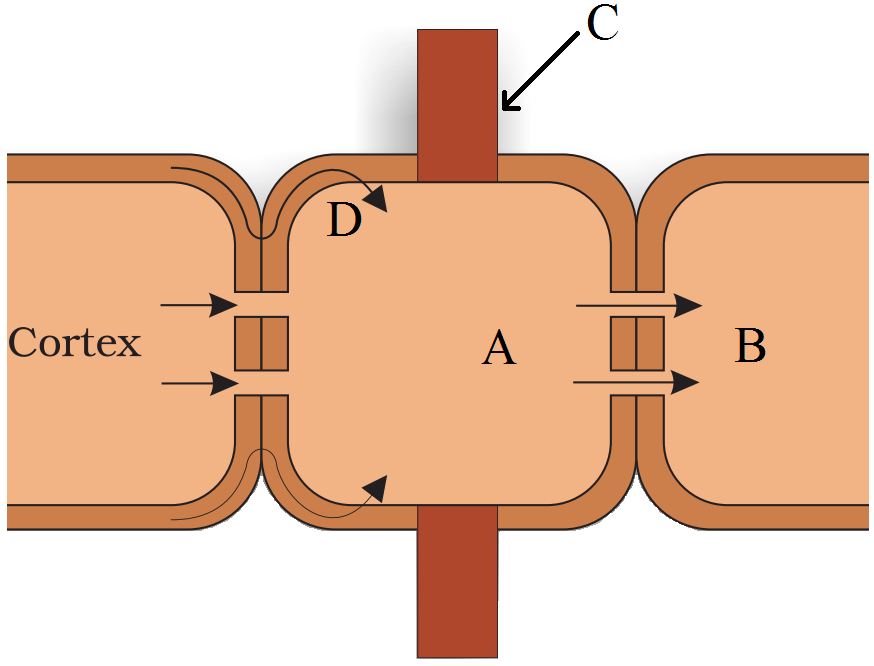
Observe the diagram given and answer the following questions:
  1. Name the cell A and B.
  2. Identify C and name the substance it is made of.
  3. Name the pathway of water movement represented as D.
Answer
  1. A. Endodermis, B. Pericycle.
  2. Casparian strip; it is made of suberin.
  3. Apoplast pathway.
View full question & answer
Question 373 Marks
Will the ascent of sap be possible without the cohesion and adhesion of the water molecules? Explain.
Answer
No, the ascent of sap is not possible without the cohesive and adhesive properties of water as they play an important role in transport of water because of the following reasons:
  1. Cohesion forces hold together the water molecule in the conducting channels, so vacuum is not created.
  2. Adhesive forces between the water molecule and cellulose of cell wall make a thin film of water along the channels so; this film can be pulled up by transpiration pull drawing more and more water upwards in the conducting channels from the root.
View full question & answer
Question 383 Marks
Explain why.
  1. Water can reach up to endodermis through apoplast but it moves through the endodermis by symplast.
  2. Primary xylem in root is exarch and in stem it is endarch.
Answer
  1. The endodermal cells are somewhat different from other living cells of root in having a conspicuous waxy thickening, the casparian strip, in their cell walls. The wax-like substance, called suberin, present in the casparian strips blocks the movement of water and minerals from one side to the other via cell wall route. Thus, water moves through the endodermis via cell sap by symplast.
  2. Primary xylem is exarch in roots to facilitate maximum inward movement of water from the cortex. Whereas it is endarch in stem to minimize the loss through cortex and epidermis.
View full question & answer
Question 393 Marks
Do different species of plants growing in the same area show the same rate of transpiration at a particular time? Justify your answer.
Answer
Plant factors which affect the rate of transpiration are: number and distribution of stomata, percent of open stomata, water status, canopy structure, etc. These factors may be different in different plant species Thus, different species in the same area may show different rates of transpiration at a particular time.
View full question & answer
Question 403 Marks
Transpiration is a necessary evil in plants. Explain.
Answer
Transpiration occurs through the stomata. The stomata are primarily meant for absorption of $\mathrm{CO}_2$, but the water vapors also escape through stomata and cause transpiration. Thus transpiration is called as a necessary evil because it is an inevitable process. The loss of water can lead to wilting, serious desiccation, and shortage of water. Transpiration helps in the ascent of the sap and the pulling of the water from the roots to the tips. Thus is it considered to be a necessary evil.
View full question & answer
Question 413 Marks
Explain how and in what form are the carbohydrates synthesized in leaves in order to reach long distance parts in a plant.
Answer
Long distance transport of organic and inorganic substances occurs from leaves to other parts of plant through phloem (vascular tissue found in plants). As the site of production is far away from the site of absorption, the bulk flow is operated due to positive hydrostatic pressure gradient.
View full question & answer
Question 423 Marks
Differentiate between Apoplast and Symplast pathways of water movement. Which of these would need active transport?
Answer
Symplast vs Apoplast Transport:
Apoplast
Symplast
It consists of non living parts of plant body, i.e., cell walls and intercellular spaces.
It consists of living parts of plant body, i.e., protoplasts connected by plasmodesmata.
There is little resistance in the movement of water.
Some resistance occurs in the movement of water through symplast.
It is faster.
It is slightly slower.
Metabolic state of root does not affect apoplast pathway.
Metabolic state of root directly affects symplast pathway.
Symplast pathways of water movement need active transport.
View full question & answer
Question 433 Marks
During summer vacation, Nitin was studying inside the home. He said to his mother that he is feeling hot inside. His mother advised him to sit under a tree in the garden to beat the heat. He was surprised after listening to his mother's opinion as temperature was much high outside than inside. He still went out and started studying under the tree. After few hours, he came to his mother and asked about it. His sister who was a biology student of class XI heard their conversation and told his brother that it is all due to the phenomenon of transpiration.
  1. What is transpiration? Also indicate the transpiring organ of the plant.
  2. What are the general factors that affect transpiration?
  3. Name different types of transpiration.
  4. What values are displayed by Nitin's sister's character?
Answer
  1. Transpiration is the phenomenon of loss of water in the form of vapour from the living tissues of aerial parts of the plant. Epidermis is the transpiring organ in plants.
  2. Factors that affect the rate of transpiration are:
  1. External factors: Relative humidity, temperature, wind, light, available soil water and atmospheric pressure.
  2. Internal factors: Leaf area, structure of leaf, root/ shoot ratio and age of the plant.
  1. Four types of transpiration exhibited by plants are cuticular, bark, lenticular and stomatal.
  2. Values that are displayed by Nitin's, sister are attentiveness towards scientific issues, aesthetic values, knows benefits of eco-friendly solutions in daily life.
View full question & answer