Question
Definitions needed to understand reflection from a Spherical mirror :

Answer

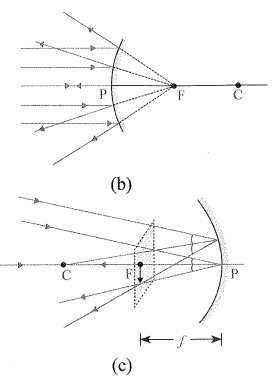
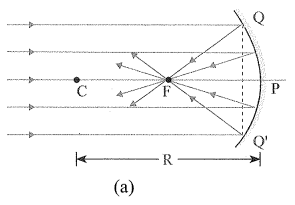
→(1) Centre of Curvature (C): The centre of the spherical shell from which the mirror is made, is called the centre of curvature (C) of the mirror.
(2) Radius of Curvature (R): The radius of the spherical shell from which the mirror is made is called the radius of curvature (R).
(3) Pole (P): The centre of the reflecting surface of a mirror is called pole (P).
(4) Principal Axis: The imaginary line passing through the pole and the centre of curvature is called the principal axis of the mirror.
(5) Aperture: The diameter of the reflecting surface is called aperture of the mirror (QQ').
(6) Principal Focus (F): The point where the rays parallel to the principal axis meet (concave mirror), or appear to meet (convex mirror), after reflection is called the principal focus of the mirror.
Image
Image
(7) Focal Plane: A plane passing through the principal focus and normal to the principal axis is called the focal plane of the mirror.
(8) Focal Length (f): This distance between the pole and the principal focus of a mirror is called focal length.
(9) Paraxial Rays: Rays close to the principal axis are called paraxial rays.
Need a full question paper?

Generate a complete, print-ready paper with questions like this in minutes — across 16+ boards, with answer keys.

Start Generating Free

Similar questions

The angular magnification of a system is less than one. Does it mean that the image formed is inverted?
Write the difference between polar and non-polar dieelctric.
Several capacitors of capacitance $C$ are connected in infinite number as shown in the figure. Find the value of total capacitance between points $A$ and $B$.
Two identical loops, one of copper and the other of aluminium, are rotated with the same angular speed in the same magnetic field. Compare (i) the induced emf and (ii) the current produced in the two coils. Justify your answer.
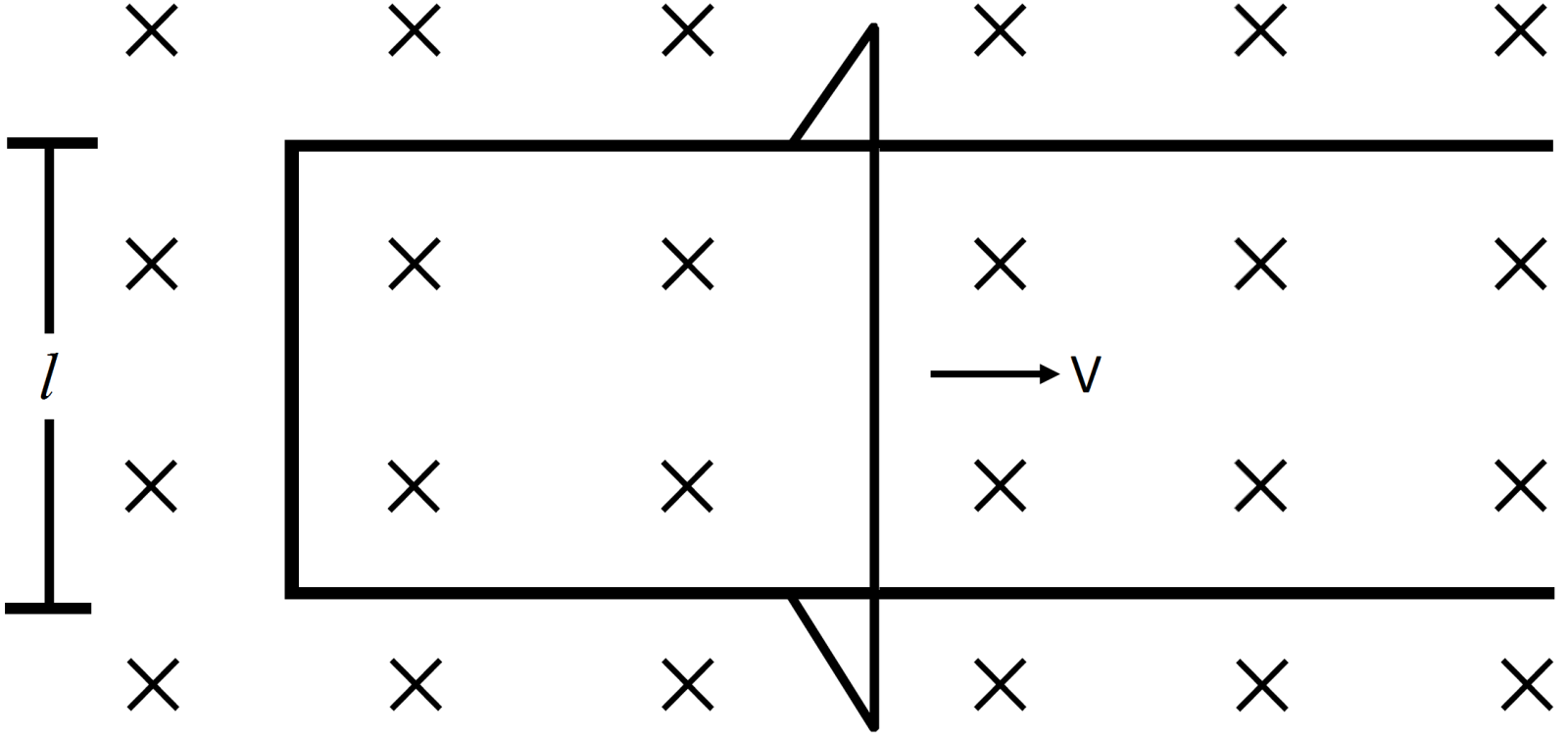
Figure shows a long U-shaped wire of width l placed in a perpendicular magnetic field B. A wire of length l is slid on the U-shaped wire with a constant velocity v towards right. The resistance of all the wires is r per unit length. At t = 0, the sliding wire is close to the left edge of the U-shaped wire. Draw an equivalent circuit diagram, showing the induced emf as a battery. Calculate the current in the circuit.
The maximum torque acting on a coil of effective area $0.04 m^2$ is $4 \times 10^{-8} Nm$ when the current in it is $100 \ pA$ . Find the magnetic induction in which it is kept.
When a boron nucleus $\big(\text{ }^{10}_5\text{B}\big)$ is bombarded by a neutron, an $\alpha$-particle is emitted. Which nucleus will be formed as a result?
A proton and a deuteron are accelerated through the same accelerating potential. Which one of the two has,
  1. greater value of de-Broglie wavelength associated with it, and
  2. less momentum?
Give reasons to justify your answer.
A spherical conducting shell of inner radius $r_1$ and outer radius $r_2$ has a charge ‘Q’. A charge ‘q’ is placed at the centre of the shell.
  1. What is the surface charge density on the (i) inner surface, (ii) outer surface of the shell?
  2. Write the expression for the electric field at a point $x > r_2$ from the centre of the shell.
The image of a small electric bulb fixed on the wall of a room is to be obtained on the opposite wall 3 m away by means of a large convex lens. What is the maximum possible focal length of the lens required for the purpose?