Question 12 Marks
Obtain the equivalent focal length of combination of thin lenses placed in cantact.
$\left(\frac{1}{f}=\frac{1}{f_1}+\frac{1}{f_2}\right)$
$\left(\frac{1}{f}=\frac{1}{f_1}+\frac{1}{f_2}\right)$
Answer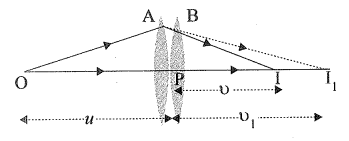
→As shown in figure two lenses A and B are arranges so that their principal axis is the same. The focal lengths of these are $f_1$ and $f_2$ respectively. Here we will assume that since both the lenses are thin, their optical centre converge on each other. Let the centre be the point P .
→Let the object be placed at point $O$ beyond the focus of the first lens A . The first lens produces an image at $I_1$. This image $I_1$ serves as a virtual object for the second lens. B producing the final image at I .
→For the image formed by the first lens A,
$\frac{1}{v_1}-\frac{1}{u}=\frac{1}{f_1}......(1)$
→For the image formed by the second lens B,
$\frac{1}{v}-\frac{1}{v_1}=\frac{1}{f_2}......(2)$
→Adding equations (1) and (2),
$\frac{1}{v}-\frac{1}{u}=\frac{1}{f_1}+\frac{1}{f_2}......(3)$
→If the two lens-system is regarded as equivalent to a single lens of focal length $f$.
$\therefore \quad \frac{1}{v}-\frac{1}{u}=\frac{1}{f}......(4)$
→Comparing equations (3) and (4),
$\therefore \quad \frac{1}{f}=\frac{1}{f_1}+\frac{1}{f_2}$
→The derivation is valid for any number of thin lenses, in contact. If several thin lenses of focal length $f_1, f_2, f_3, \ldots$ are in contact, the effective focal length of their combination is given by $\frac{1}{f}=\frac{1}{f_1}+\frac{1}{f_2}+\frac{1}{f_3}+\ldots$
View full question & answer→→As shown in figure two lenses A and B are arranges so that their principal axis is the same. The focal lengths of these are $f_1$ and $f_2$ respectively. Here we will assume that since both the lenses are thin, their optical centre converge on each other. Let the centre be the point P .
→Let the object be placed at point $O$ beyond the focus of the first lens A . The first lens produces an image at $I_1$. This image $I_1$ serves as a virtual object for the second lens. B producing the final image at I .
→For the image formed by the first lens A,
$\frac{1}{v_1}-\frac{1}{u}=\frac{1}{f_1}......(1)$
→For the image formed by the second lens B,
$\frac{1}{v}-\frac{1}{v_1}=\frac{1}{f_2}......(2)$
→Adding equations (1) and (2),
$\frac{1}{v}-\frac{1}{u}=\frac{1}{f_1}+\frac{1}{f_2}......(3)$
→If the two lens-system is regarded as equivalent to a single lens of focal length $f$.
$\therefore \quad \frac{1}{v}-\frac{1}{u}=\frac{1}{f}......(4)$
→Comparing equations (3) and (4),
$\therefore \quad \frac{1}{f}=\frac{1}{f_1}+\frac{1}{f_2}$
→The derivation is valid for any number of thin lenses, in contact. If several thin lenses of focal length $f_1, f_2, f_3, \ldots$ are in contact, the effective focal length of their combination is given by $\frac{1}{f}=\frac{1}{f_1}+\frac{1}{f_2}+\frac{1}{f_3}+\ldots$