Question
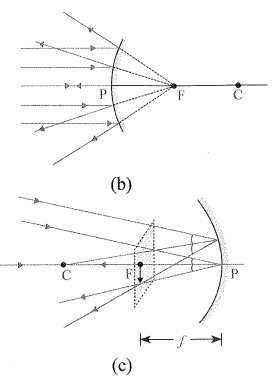
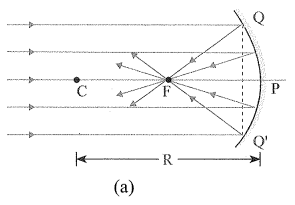
Definitions needed to understand reflection from a Spherical mirror :

Answer

→(1) Centre of Curvature (C): The centre of the spherical shell from which the mirror is made, is called the centre of curvature (C) of the mirror.
(2) Radius of Curvature (R): The radius of the spherical shell from which the mirror is made is called the radius of curvature (R).
(3) Pole (P): The centre of the reflecting surface of a mirror is called pole (P).
(4) Principal Axis: The imaginary line passing through the pole and the centre of curvature is called the principal axis of the mirror.
(5) Aperture: The diameter of the reflecting surface is called aperture of the mirror (QQ').
(6) Principal Focus (F): The point where the rays parallel to the principal axis meet (concave mirror), or appear to meet (convex mirror), after reflection is called the principal focus of the mirror.
Image
Image
(7) Focal Plane: A plane passing through the principal focus and normal to the principal axis is called the focal plane of the mirror.
(8) Focal Length (f): This distance between the pole and the principal focus of a mirror is called focal length.
(9) Paraxial Rays: Rays close to the principal axis are called paraxial rays.
Need a full question paper?

Generate a complete, print-ready paper with questions like this in minutes — across 16+ boards, with answer keys.

Start Generating Free

Similar questions

A converging lens and a diverging lens of the same focal length are placed coaxially in contact with each other. Find the focal length and power of the combination.
A bulb is hanging over a table. At which portion of the table is the illuminance maximum? If a plane mirror is placed above the bulb facing the table, will the illuminance on the table increase?
Explain characteristics of electric charge.
Suppose, in certain conditions only those transitions are allowed to hydrogen atoms in which the principal quantum number n changes by 2. (a) Find the smallest wavelength emitted by hydrogen. (b) List the wavelength emitted by hydrogen in the visible range (380nm to 780nm).
A $15.0 \mu F$ capacitor is connected to a $220 V , 50 Hz$ source. Find the capacitive reactance and the current (rms and peak) in the circuit. If the frequency is doubled, what happens to the capacitive reactance and the current?
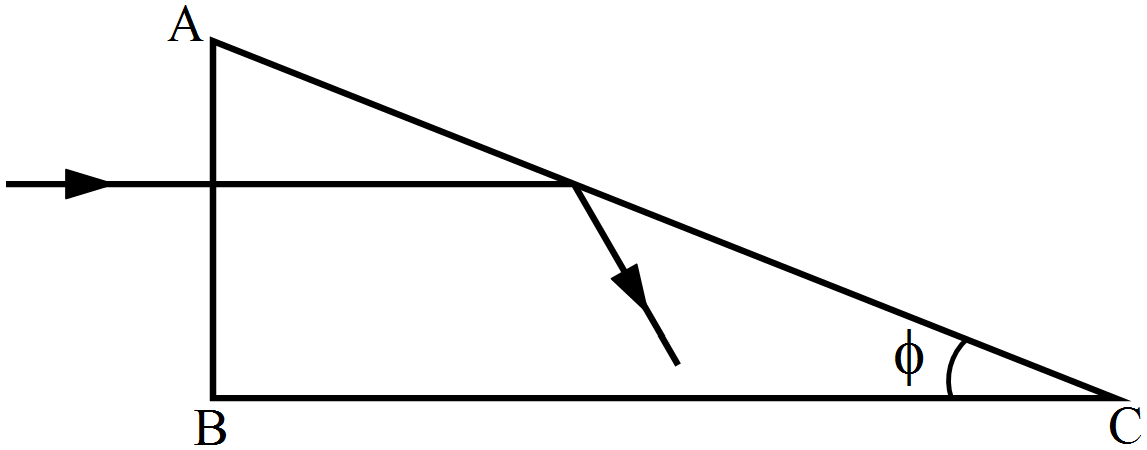
 A light ray is incident normally on the face AB of a right-angled prism ABC $(\mu=1.50)$ as shown in figure. What is the largest angle $\phi$ for which the light ray is totally reflected at the surface AC? 
The ratio of radii of two nuclei is $1: 2$. Write the ratio of their mass numbers.
Distinguish between intrinsic and extrinsic semiconductors. Although in an extrinsic semiconductor $n_e \neq n_h$, yet it is electrically neutral. Why?
Verify that the units weber and volt-second are the same.
In an electrolyte, the positive ions move from left to right and the negative ions from right to left. Is there a net current? If yes, in what direction?