MCQ
Density of Nucleus is:
  • $10^{17} kg / m ^3$
  • B
    $10^{19} kg / m ^3$
  • C
    $10^6 kg / m ^3$
  • D
    $10^2 kg / m ^3$

Answer

Correct option: A.
$10^{17} kg / m ^3$
(A) $10^{17} kg / m ^3$,
Density of Nucleus is $=2.29 \times 10^{17} kg / m ^3$

Need a full question paper?

Generate a complete, print-ready paper with questions like this in minutes — across 16+ boards, with answer keys.
Start Generating Free

Similar questions

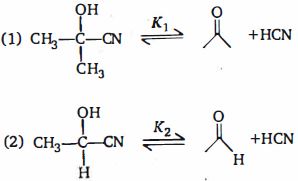
Relation between $K_1$ and $K_2$ is
In the Davisson and Germer experiment, the velocity of electrons emitted from the electron gun can be increased by
While measuring the acceleration due to gravity by a simple pendulum, a student makes a positive error of $1\%$ in the length of the pendulum and a negative error of $3\%$ in the value of time period. His percentage error in the measurement of $g$ by the relation $g = 4{\pi ^2}\left( {l/{T^2}} \right)$ will be  ........ $\%$
Assertion $(A):$ If the frequency of the applied $AC$ is doubled, then the power factor of a series $R-L$ circuit decreases.

Reason $(R):$ Power factor of series $R-L$ circuit is given by $\cos \theta=\frac{2 R }{\sqrt{ R ^2+\omega^2 L ^2}}$

According to Bohr's theory the radius of electron in an orbit described by principal quantum number $n$ and atomic number $Z$ is proportional to
Two drops of the same radius are falling through air with a steady velocity of $5 cm per sec.$  If the two drops coalesce, the terminal velocity would be
A force $\overrightarrow F = (5\hat i + 4\hat j)$ $N $ acts on a body and produces a displacement $\overrightarrow S = (6\hat i - 5\hat j + 3\hat k)$ $m$ . The work done will be......$J$
A force of $5\, N$, making an angle $\theta $ with the horizontal, acting on an object displaces it by $0.4\,m$ along the horizontal direction. If the object gains kinetic energy of $1\,J$, the horizontal component of the force is......$N$
The magnetic field of a plane electromagnetic wave is given by

$\overrightarrow{ B }=2 \times 10^{-8} \sin \left(0.5 \times 10^{3} x +1.5 \times 10^{11} t \right) \hat{ j } T$ The amplitude of the electric field would be.

A solid cylinder of mass $2\ kg$ and radius $0.2\,m$ is rotating about its own axis without friction with angular velocity $3\,rad/s$. A particle of mass $0.5\ kg$ and moving with a velocity $5\ m/s$ strikes the cylinder and sticks to it as shown in figure. The angular momentum of the cylinder before collision will be ........ $J-s$