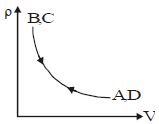
Density $vs$  volume graph is shown in the figure. Find corresponding pressure $vs$  temperature graph
Advanced
Download our app for free and get startedPlay store
process $BC$ and $AD$ is shown by a dot in $(\rho -V)$ curve.

It means $BC$ and $AD$ is a isochoric process. So, option $(3)$ is correct

art

Download our app
and get started for free

Experience the future of education. Simply download our apps or reach out to us for more information. Let's shape the future of learning together!No signup needed.*

Similar Questions

  • 1
    $Assertion :$ In adiabatic compression, the internal energy and temperature of the system get decreased.
    $Reason :$ The adiabatic compression is a slow process.
    View Solution
  • 2
    Considere the thermodynamics cycle shown on $PV$ diagram. The process $A \rightarrow B$ is isobaric, $B \rightarrow C$ is isochoric and $C \rightarrow A$ is a straight line process. The following internal energy and heat are given $: \Delta U_{A \rightarrow B} = + 400\,\, kJ$ and $Q_{B \rightarrow C} = - 500\,\, kJ$ The heat flow in the process $Q_{C \rightarrow A}$ is  ...... $kJ$
    View Solution
  • 3
    The temperature inside and outside a refrigerator are $273 \,K$ and $300 \,K$ respectively. Assuming that the refrigerator cycle is reversible, for every joule of work done, the heat delivered to the surrounding will be nearly ........ $J$
    View Solution
  • 4
    When an ideal monoatomic gas is heated at constant pressure, fraction of heat energy supplied which increases the internal energy of gas, is
    View Solution
  • 5
    $Assertion :$ In an isolated system the entropy increases.
    $Reason :$ The processes in an isolated system are adiabatic.
    View Solution
  • 6
    What is the nature of change in internal energy in the following three thermodynamical processes shown in figure
    View Solution
  • 7
    A gas undergoes a change at constant temperature. Which of the following quantities remain fixed?
    View Solution
  • 8
    Two identical balls, $A$ and $B$ , of uniform composition and initially at the same temperature, each absorb exactly the same amount of heat. $A$ is hanging down from the ceiling while $B$ rests on the horizontal floor in the same room. Assuming no subsequent heat loss by the balls, which of the following statements is correct about their final temperatures, $T_A$ and $T_B$ , once the balls have reached their final state?
    View Solution
  • 9
    One mole of a monatomic ideal gas is taken along two cyclic processes $E \rightarrow F \rightarrow G \rightarrow E$ and $E \rightarrow F \rightarrow H \rightarrow$ E as shown in the $PV$ diagram. The processes involved are purely isochoric, isobaric, isothermal or adiabatic. $Image$

    Match the paths in List $I$ with the magnitudes of the work done in List $II$ and select the correct answer using the codes given below the lists.

    List $I$ List $I$
    $P.$ $\quad G \rightarrow E$ $1.$ $\quad 160 P_0 V_0 \ln 2$
    $Q.$ $\quad G \rightarrow H$ $2.$ $\quad 36 P _0 V _0$
    $R.$ $\quad F \rightarrow H$ $3.$ $\quad 24 P _0 V _0$
    $S.$ $\quad F \rightarrow G$ $4.$ $\quad 31 P_0 V_0$

    Codes: $ \quad  \quad P \quad Q \quad R \quad S $ 

    View Solution
  • 10
    The specific heat of hydrogen gas at constant pressure is ${C_P} = 3.4 \times {10^3}cal/kg{\,^o}C$ and at constant volume is ${C_V} = 2.4 \times {10^3}cal/kg{\,^o}C.$If one kilogram hydrogen gas is heated from ${10^o}C$ to ${20^o}C$ at constant pressure, the external work done on the gas to maintain it at constant pressure is
    View Solution