MCQ
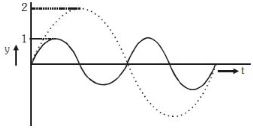
Dependence of disturbances due to two waves on time is shown in the figure. The ratio of their intensities $I_1 / I_2$ will be
  • $1 : 1$
  • B
    $1 : 2$
  • C
    $4 : 1$
  • D
    $16 : 1$

Answer

Correct option: A.
$1 : 1$
a
$I \propto {n^2}{a^2}$

$\frac{I_{1}}{I_{2}}=\left(\frac{2}{1} \times \frac{1}{2}\right)^{2}=\frac{1}{1}$

Need a full question paper?

Generate a complete, print-ready paper with questions like this in minutes — across 16+ boards, with answer keys.
Start Generating Free

Similar questions

A wheel completes $2000$ revolutions to cover the $9.5\, km$. distance. then the diameter of the wheel is
Three particles each of mass $M$ are placed at the three corners of an equilateral triangle of side $l$ . What is the force due to this system of particles on another particle of mass $m$ placed at the mid -point of any side?
An ideal gas at a pressures of $1$ atmosphere and temperature of ${27^o}C$ is compressed adiabatically until its pressure becomes $8$ times the initial pressure, then the final temperature is ..... $^oC$ ($\gamma  = 3/2$)
Two stones are thrown up vertically and simultaneously but with different speeds. Which graph correctly represents the time variation of their relative positions $\Delta x$.Assume that stones do not bounce after hitting ground.
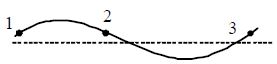
The diagram below shows as instantaneous position of a string as a transverse progressive wave travels along it from left to right Which one of the following correctly shows the direction of the velocity of the points $1,2$ and $3$ on the string
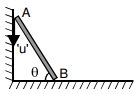
The velocity of end ' $A$ ' of rigid rod placed between two smooth vertical walls moves with velocity ' $u$ ' along vertical direction. Find out the velocity of end ' $B$ ' of that rod, rod always remains in constant with the vertical walls.
What is the value of linear velocity, if $\vec \omega = 3\hat i - 4\hat j + \hat k$ and $\vec r = 5\hat i - 6\hat j + 6\hat k$
While measuring the thermal conductivity of a liquid, we keep the upper part hot and lower part cool, so that
A system consists of $3$  particles each of mass $m$ and located at $(1, 1), (2, 2), (3, 3)$. The co-ordinate of the centre of mass are
A car, moving with a speed of $50 \,km/hr$, can be stopped by brakes after at least $6\,m$. If the same car is moving at a speed of $100 \,km/hr$, the minimum stopping distance is..........$m$